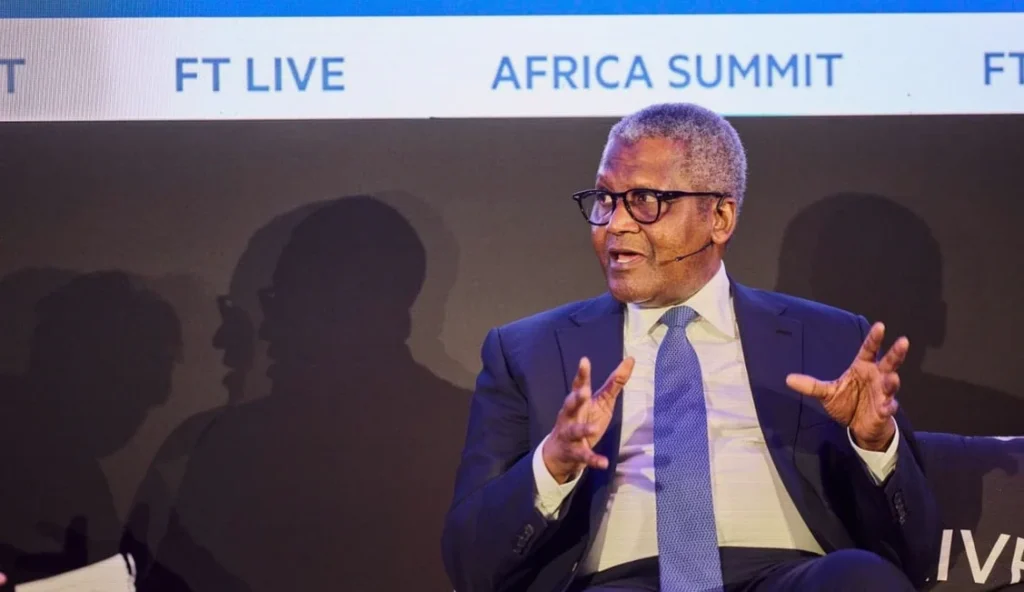
Aliko Dangote, president and chief executive of Dangote Industries Limited, has set out plans for a far-reaching fuel distribution system spanning Africa, backed by spending on pipelines, storage terminals and key supply routes. He also urged African governments to shield local producers from what he described as unfair overseas competition. Dangote said the group was rapidly building petroleum distribution capacity in East, Central and Southern Africa to tackle chronic supply gaps, ease transport constraints and improve energy security across the continent. In an extensive discussion with Financial Times journalist David Pilling, he said the company had purchased a 25% holding in a Kenyan petroleum-products pipeline network and was advancing further projects between Djibouti and Ethiopia, as well as investments in Cameroon and Namibia. Africa, he argued, cannot achieve meaningful economic change without pairing essential infrastructure spending with industrial policies that support domestic production, preserve manufacturing capability and keep jobs within African economies. Permitting imports to crowd out local manufacturers, he said, meant “exporting our jobs out of the continent, importing poverty into the continent.” The expansion of Dangote Group’s fuel-distribution business is intended to create an integrated continental energy system, connecting major refining hubs to markets long reliant on imported fuels and disjointed supply networks. “We are very aggressive with that,” Dangote said when asked about plans for depots, pipelines and other fuel-distribution assets. He said that, the previous day, the group had secured a 25% stake in Kenya’s pipeline infrastructure for distributing petroleum products, with backing from Kenya’s President. “Just let me tell you, yesterday, with the support from the President of Kenya, we bought 25 per cent of the pipeline network for the distribution of petroleum products,” he said. The company is also developing a supply route from Djibouti to Addis Ababa, Ethiopia’s capital, including tank farms to store and move fuel. A separate Cameroonian project is close to completion, while Namibia has been selected as a key base for the group’s move into Southern Africa. Namibia is especially important, Dangote said, because it lies relatively close by sea to the Dangote Petroleum Refinery in Lagos, enabling an efficient southern-African supply line. “From our refinery to Namibia is just about four days of steaming,” he said. The group intends to ship refined products from Lagos to Namibia before distributing them into connected markets including Botswana and South Africa. Dangote also described a proposed corridor through Zimbabwe and Zambia, designed to create a broad network that can supply numerous countries through strategically placed transport and storage facilities. The distribution expansion accompanies plans for an additional refinery in Lamu, Kenya, expected to process about 700,000 barrels a day. The East African investment reflects the region’s extensive industrial and mining operations, rising fuel demand, and ongoing problems obtaining diesel and other petroleum products, he said. The planned Kenyan refinery would procure crude from multiple sources rather than rely solely on output from Uganda or Kenya, giving its operations a more diversified supply base. Lamu was chosen after technical reviews of several sites, with deep-water access, marine infrastructure and adequate water supplies identified as decisive factors. Dangote said the investment was approved within four months, though he alleged that commercial interests seeking to block it had launched legal action shortly before the project was publicly announced. He said the episode illustrated the fierce rivalry and influential players within the global oil sector. Turning to industrial policy, Dangote said African economies need conditions that allow local manufacturers to grow if they are to reduce their dependence on imported products. He questioned why African nations should leave nascent industries open to unrestricted foreign competition when larger economies are increasingly using policies to protect their own manufacturing bases. Referring to developments in the United States and the worldwide auto industry, he said safeguarding strategic sectors was not unique to developing countries but was an established tool of industrial policy. “If America is now saying, no, we are going to protect our industries, who are we in Africa not to protect our own industries?” he asked. Dangote further said the group has allocated roughly $50 billion for investment from 2026 to 2030, framing the programme as part of a wider drive to prove that Africa can deliver industrial projects at scale. The spending is meant both to enlarge the group’s businesses and to spur other African entrepreneurs and investors to take part in the continent’s industrial development. “The legacy we are trying to set up is how do we industrialise our continent?” he said. He argued that development will require robust financial institutions, sound agricultural and industrial strategies, and action on infrastructure shortfalls that still hold back growth. Unreliable electricity was among the biggest barriers to industrialisation, especially for mining and mineral processing, where insufficient dependable power frequently prevents countries from processing natural resources before exporting them. About 650 million people in Africa have no electricity access, he said, adding that addressing the power deficit could unlock manufacturing, employment and economic diversification. Asking why a continent with large areas of farmland, substantial mineral wealth and a young population should remain marked by widespread poverty, Dangote said Africa has the ingredients to emerge as a major industrial power. He said he believed the economic transition was already underway and that governments and business leaders across the continent were increasingly aware of their responsibility for Africa’s industrial future. “The journey has started,” he declared. “But now we’re awake, and we will make it happen.”