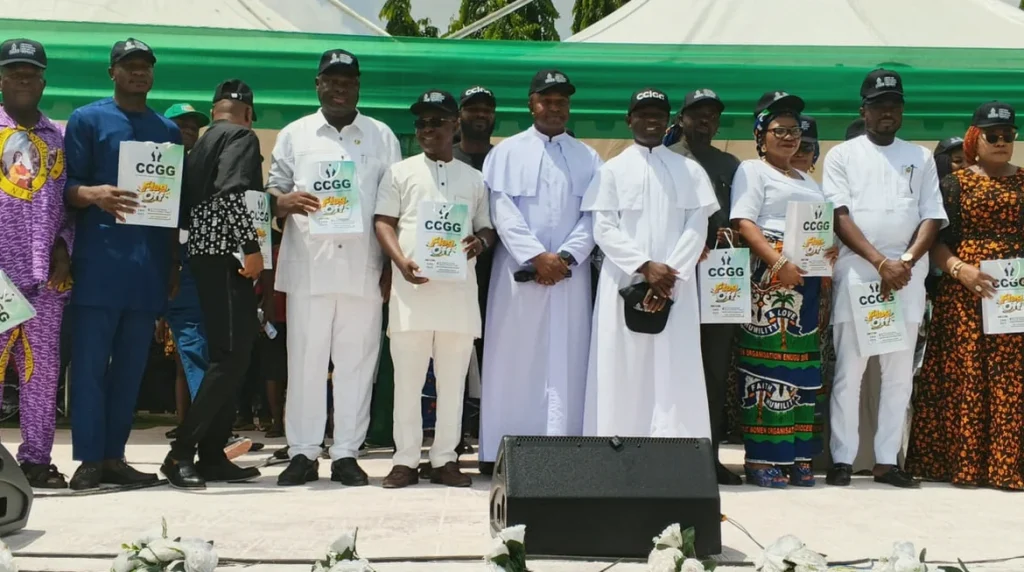
With Nigeria’s 2027 general elections approaching, the Catholic Diocese of Enugu has introduced a programme aimed at strengthening governance standards, civic awareness and public involvement across Enugu State.
The project, called Church for Community Care and Good Governance, or CCGG, was launched by the Catholic Institute for Development, Justice and Peace at St. Theresa Catholic Church in Abakpa, Enugu.
Enugu State House of Assembly Speaker Uche Ugwu and Vita Ndu, chairman of Ezeagu Local Government Area, both promised to back the programme. They said cooperation between religious institutions and public authorities was important for local development and for leadership that can be held accountable.
Ugwu said the Church and the state administration had a shared duty to improve living conditions for residents, and should therefore coordinate their efforts in support of effective government. “The Church and the state are not different. We work together as a team to care for our people. We will continue to support this initiative as we continue to deliver good governance to the good people of Enugu State,” he said.
Addressing the theme, “The Role of Faith and Priestly Leadership in Transforming Communities and Governance,” Ndu said leadership must be grounded in service, empowerment and environmental improvement.
He said the idea of faith that cares and leadership that serves reflected the core of responsible public administration. Political officeholders and clergy, he argued, should cooperate to improve citizens’ welfare.
Ndu said priests have an important role in community transformation, especially at the grassroots level, where their close ties to residents give them scope to contribute to social progress.
He called on priests to continue supporting leaders whose focus is public service, saying elected and appointed positions should be seen as a duty to serve rather than a route to private enrichment.
The Ezeagu council chairman praised the Catholic Church for creating the programme and said his administration would support its goals while working with other stakeholders on community-development efforts.
Earlier, CCGG Project Lead Very Rev. Fr. Dr. Longinus Ikenna Ugonwa said the programme was created to narrow the divide between political decision-makers and the daily realities faced by ordinary people.
Ugonwa said CCGG was not a political party and would not be used to campaign for, or target, particular political figures. Instead, he described it as a non-partisan platform focused on truth, responsible citizenship and the broader public interest.
“We do not tell people what to think. We help them understand issues, ask informed questions, examine evidence and make responsible decisions,” he said.
He said the initiative would use podcasts, radio broadcasts, interviews, documentaries, social-media channels and direct community outreach to bring public concerns into view, recognise real improvements and promote workable responses to social problems.
The purpose was not to shame government agencies or public institutions, Ugonwa said, but to encourage constructive contact between citizens and those in authority.
“Governance works better when people are informed and institutions remain open to dialogue,” he said.
CCGG plans to work through Catholic Church bodies including the Justice, Development and Peace Commission, Diocesan Communication, the Catholic Men Organisation, Catholic Women Organisation and Catholic Youth Organisation of Nigeria. The partnerships will support civic learning, cultural activities, talent development and wider participation in community affairs.
In his opening remarks, CCGG Coordinator Dr. Chinonso Opah described the launch as the start of continuing dialogue, substantive partnerships and practical measures intended to improve communities. He thanked the bishops for their pastoral guidance and recognised the initiative’s convener, Msgr. Prof. Francis Obiora Ike, for developing the vision behind the project.