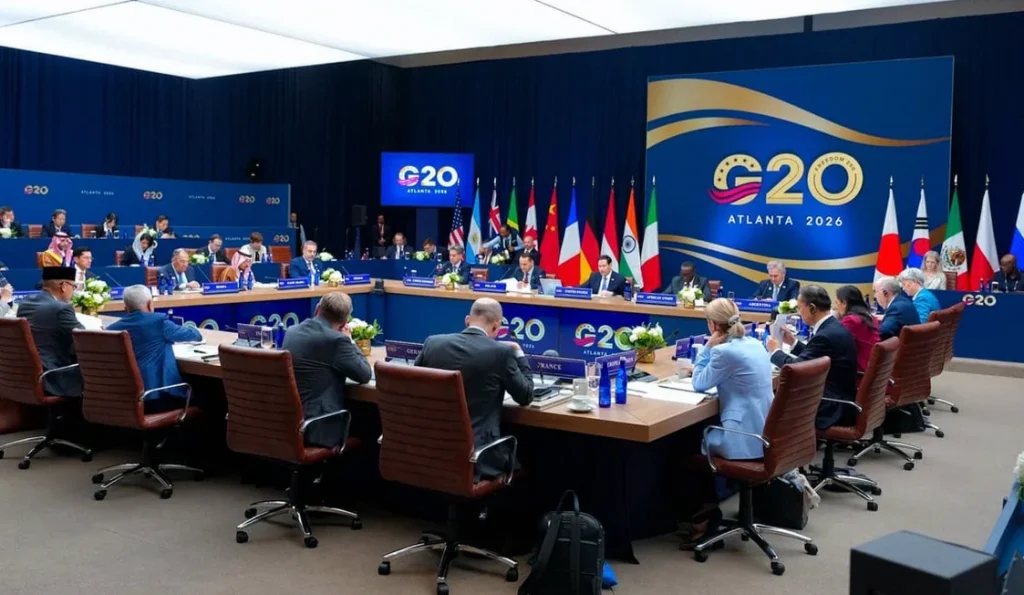
G20 foreign ministers meeting in Atlanta, Georgia, warned that the use of food trade as geopolitical leverage has become a repeated threat to the global trading system, calling for agricultural commerce to be kept separate from political and economic coercion.
Key takeaways
- Ministers said governments should not restrict food and agricultural trade to pressure other countries over unrelated disputes.
- The group called for dependable energy supply routes, protected infrastructure and secure passage through international waterways.
- Supply-chain resilience was linked to greater transparency, information exchange, investment and streamlined permitting rules.
- South Africa was not invited by the United States amid continuing bilateral strains.
- The Atlanta meeting preceded the G20 leaders’ summit in Miami, Florida, to be hosted by President Donald Trump.
Food, energy and critical-material supply risks
In a statement issued after Saturday’s discussions, the diplomats expressed concern that targeted measures affecting food shipments are being used to exert pressure over geopolitical matters unrelated to agriculture or trade. They urged the international community to establish the principle that food and farm-product commerce must not become an instrument of political or economic pressure.
The ministers also addressed disruptions in global energy markets, backing energy flows that are secure, resilient and uninterrupted. Their priorities included safe maritime transit through international sea lanes and stronger protection for essential infrastructure.
Discussions covered the availability of fertiliser needed for agricultural output and food security, as well as access to raw materials used in basic manufacturing. Ministers additionally considered critical minerals required for energy security, advanced manufacturing, emerging technologies and artificial intelligence-related development.
G20 members said more durable supply chains will require wider sharing of information, improved transparency, investment mobilisation and reforms to permitting procedures and regulatory frameworks.
Attendance and US presidency agenda
Foreign ministers from Australia, the United Kingdom, Japan, India, Saudi Arabia, Turkey, South Korea and Mexico attended the Atlanta gathering. South Africa did not receive an invitation from the United States because of unresolved tensions between the two countries.
Other G20 countries, along with the European Union and the African Union, were represented at the meeting. Poland’s Foreign Minister, Radosław Sikorski, participated as a guest invitee.
US Secretary of State Marco Rubio hosted the G20 Foreign Ministers Meeting ahead of the G20 Leaders’ Summit in Miami, Florida, which President Donald Trump will host.
The United States’ G20 presidency has placed economic prosperity at the centre of its programme, focusing on reducing regulatory burdens, strengthening affordable and reliable energy supply chains, and advancing artificial intelligence and other emerging technologies.