Lagos State Governor Babajide Sanwo-Olu has held up the Dangote Refinery as proof that Africa can deliver projects on an industrial scale, arguing that its development illustrates the ambition needed to accelerate the continent’s economic progress.
A model for large-scale development
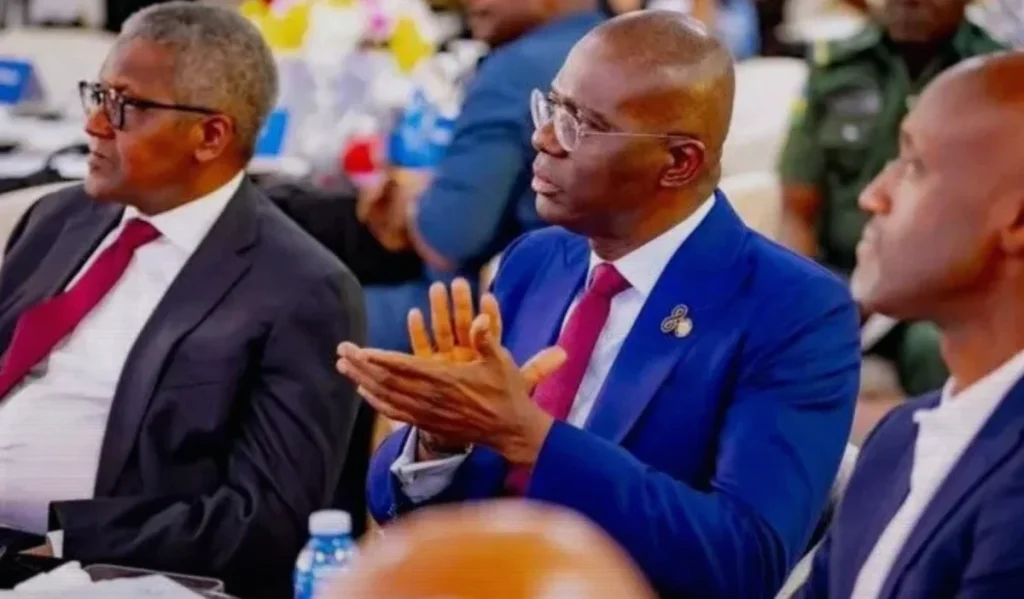
Sanwo-Olu made the comments during the Lagos-New York 2026 Learning Journey, organised by the Aliko Dangote Foundation and the Forum of Young Global Leaders at the Dangote Refinery in Lekki, Lagos.
He noted that the site had been open water roughly 10 years ago before being transformed into a major industrial complex. In his view, that change demonstrates the combination of vision, capital and persistence required to develop Lagos.
The refinery’s capacity of 650,000 barrels per day, he said, shows that African businesses and institutions can implement projects of exceptional size.
Sanwo-Olu praised Aliko Dangote, the Aliko Dangote Foundation, the Forum of Young Global Leaders, The Africa Center and Afreximbank for helping support the engagement.
He said the development of the Lekki corridor reflects Lagos’s wider strategy for infrastructure and economic expansion, including efforts to establish the conditions that can attract more private investment.
Lagos, he added, is already confronting several challenges likely to define Africa’s future, including transport infrastructure, energy supply and the demands of a fast-growing young population. Those pressures, he said, could either become a source of economic momentum or increase the risks facing the region.
Making the next project easier
The governor cautioned that development should not depend on the extraordinary determination of a single investor. He called for systems that allow entrepreneurs and companies to undertake major projects more efficiently and with less reliance on individual heroics.
In that context, he said the refinery should be judged not only by the volume of fuel it produces, but also by whether the next investor can establish a large-scale operation in Lagos more easily than Dangote did.
Sanwo-Olu said his administration’s projects along the Lekki corridor are intended to build that platform. They include the Lekki Deep Sea Port, the Lekki Free Zone and the Blue Line rail service, while an airport is also planned.
Together, he said, those assets are designed to form an integrated infrastructure network that supports additional investment. Future developers should not have to begin by constructing the basic transport and logistics systems needed to make their businesses viable.
From discussion to partnerships
Sanwo-Olu called on the Young Global Leaders participating in the learning journey to convert debates about Africa’s development into practical partnerships. Africa, he said, has already begun building its future and should now focus on turning dialogue into collaborative action.