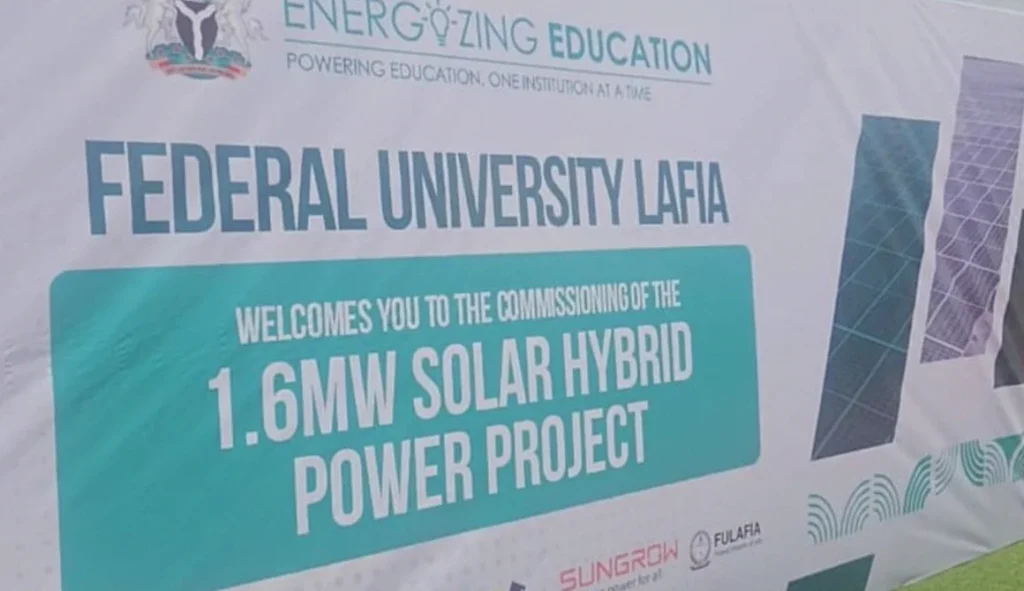
Nigeria’s Federal Government has inaugurated a 1.6-megawatt solar-hybrid mini-grid at the Federal University of Lafia in Nasarawa State, a project expected to cut the institution’s monthly electricity costs by N30 million.
The installation includes a photovoltaic solar facility of about 1.6MWp, supported by a Power Conditioning System and an Energy Storage System. The configuration is designed to improve supply stability, manage peak demand and keep essential services powered after solar-generation hours.
At Thursday’s inauguration in Lafia, held under the Rural Electrification Agency’s Energising Education Programme, Nasarawa State Governor Abdullahi Sule thanked President Bola Ahmed Tinubu for selecting the university. He said the project had eased pressure on the state government.
“I believe Nigeria should develop as many mini-grids as it can. That is where the future of electrification lies. Mini-grids can help us reach communities that still lack access,” Sule said.
He described the scheme as a practical response to Nigeria’s energy challenges, adding that he valued the approach being taken by the president and the minister in confronting those issues directly.
Power Minister Joseph Tegbe said the Federal Government remained committed to expanding electricity access to all Nigerians.
Referring to the university’s assessment after a three-month trial operation, Tegbe said the government wanted households and businesses across the country to eventually receive the kind of dependable supply now available at the Federal University of Lafia and other schools participating in the Energising Education Programme.
He said infrastructure investment that allows people to study, work and realise their potential forms a core element of President Tinubu’s Renewed Hope Agenda.
“During his administration, power-sector investment is being channelled into services and productive uses that make a tangible difference in people’s lives. At this university, that is reflected in improved conditions for learning and a firmer base for the ambitions of young Nigerians,” Tegbe said.
Rural Electrification Agency Managing Director Abba Aliyu said the Federal Government was shifting away from isolated interventions and toward electrification programmes that are coordinated and capable of being expanded.
Aliyu praised Governor Sule as an early leader in adopting renewable-energy solutions. He also acknowledged the financial and development partners behind the pilot Energising Education Programme, with particular recognition for the African Development Bank.
The REA has funded the completion of 22 mini-grid schemes in Nasarawa State, Aliyu said, with 37 additional projects expected to be rolled out soon.
Raimat Abdullahi, a 300-level student, said the consistent power supply had allowed her to spend more time studying.
Aliyu said her experience illustrated how reliable electricity can reduce interruptions to academic work.
He said electricity should be seen as a means of removing constraints and enabling opportunities that previously appeared out of reach. “This goes beyond supplying a university with electricity; it means linking an entire generation of Nigerians to a world of opportunity,” he said.
“The project being inaugurated is an investment in technology and in a competitive ecosystem. Universities are institutions that drive the country’s future,” Aliyu added.
He said the agency was developing an integrated electricity ecosystem based on the principle that power should be deployed where it can generate the strongest socio-economic gains across different clusters nationwide.
“Our goal is to create a renewable-energy economy through the electrification of Nigeria,” Aliyu said.
Federal University of Lafia Vice-Chancellor Professor Mohammed Isa Kida said the institution had received uninterrupted electricity since the trial phase began.
He described the intervention as a strategic project that would materially strengthen the university’s ability to carry out its mandate, benefiting more than 30,000 students and employees.
Kida said the project should improve digital and technology-based services while expanding hands-on renewable-energy training opportunities.
He also welcomed the project’s STEM training programme for women and said the university would protect and maintain the facilities to ensure their benefits endure over the long term.