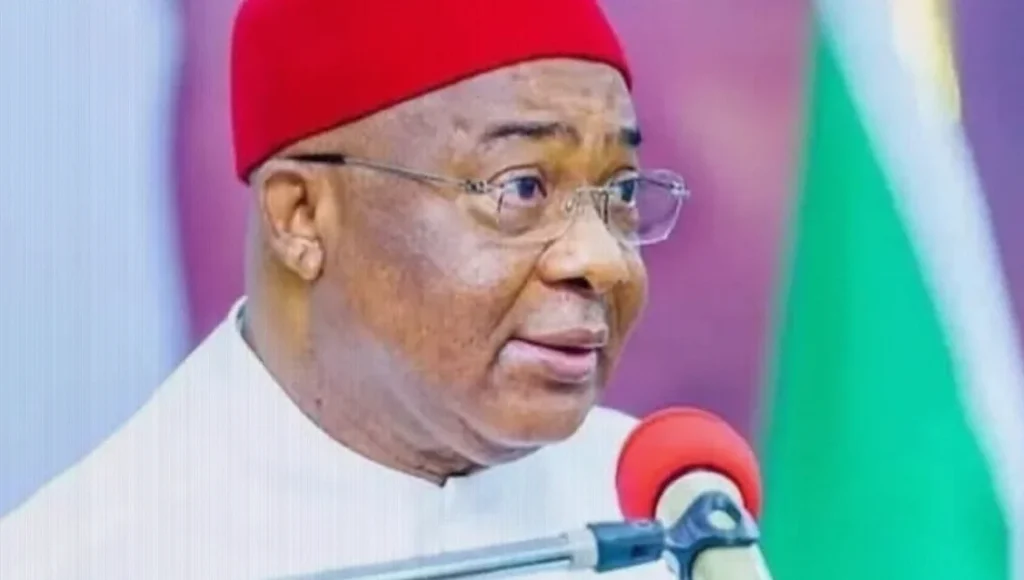
Imo State Governor Hope Uzodimma has urged political and civic leaders in Nigeria’s South-East to move away from a long-standing opposition posture and pursue closer engagement with the federal government to secure political and economic gains for the region.
Call for a new regional political strategy
Speaking at a high-level meeting of South-East stakeholders held on Friday at the Imo State Government House in Owerri, Uzodimma said the region should stop concentrating on complaints about political exclusion and instead develop a practical strategy for negotiating its interests with other parts of the federation.
He argued that other regions have systematically built relationships with the country’s political centre and obtained benefits through that engagement, while the South-East has continued to rely too heavily on opposition politics.
Uzodimma said the broader Nigerian project must take priority over narrower political ambitions, describing national participation as essential for the South-East’s political advancement.
- The South-East should abandon a pattern of permanent opposition politics.
- Regional leaders should focus on negotiating with other parts of Nigeria for political progress.
- The region should engage directly with the federal centre to pursue tangible outcomes.
- Internal rivalry and local political competition should not obstruct a united regional agenda.
“We need results,” Uzodimma said, calling for a change in approach. “We must decide how to sit with the person in power and negotiate our interests. We must put aside local competitions. As Igbo people, we must make courageous decisions.”
Stakeholders asked to work with state governments
The governor said South-East governors could not act effectively without the support and participation of wider regional stakeholders, stressing that elected officials serve the public and do not own political authority.
“The South-East governors are only servants; power and sovereignty belong to the people,” he said. “We cannot work by ourselves. We have to work with stakeholders. The politics of opposition must not remain in place.”
Uzodimma contrasted the South-East’s position with that of other geopolitical zones, saying leaders from the South-South, Middle Belt and North-East had held meetings with the President while the South-East continued to raise concerns about marginalisation.
Evidence-based demands for negotiations with the President
He asked the stakeholders to prepare a specific and well-documented inventory of the region’s needs, which could then be presented to the President as the foundation for substantive negotiations.
According to the governor, the South-East needs to quantify its priorities and support them with data rather than relying on general appeals for greater inclusion.
- Identify the region’s political, economic and development needs.
- Compile statistics and evidence supporting those demands.
- Agree on a common South-East position among governors and stakeholders.
- Meet with the President to negotiate possible outcomes for the region.
Uzodimma said a data-driven presentation of the South-East’s demands would improve the region’s ability to negotiate directly with the federal government and pursue concrete benefits.