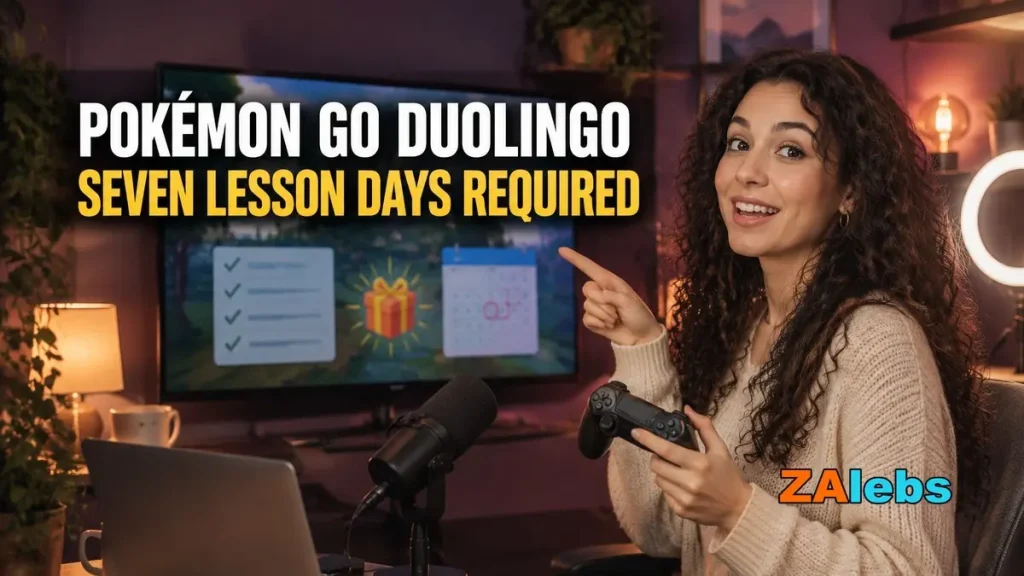
Pokémon GO’s Duolingo collaboration began on November 17, 2026, offering a research code after lessons on seven different days, according to coverage of the official announcement. The Pokémon GO Duolingo code unlocks language-themed Timed Research, a set of objectives with an expiry date, after redemption in the Pokémon GO Web Store. Participants must join the Duolingo quest by December 21, claim its rewards by December 29, and finish the Pokémon GO research by December 31.
The Pokémon GO Duolingo code takes seven lesson days to earn
The quest starts inside Duolingo
The Pokémon Company International and Duolingo have connected language practice with a separate activity in Pokémon GO. The starting point is Duo’s Pokémon Party, a limited-time quest in the latest version of the Duolingo app. As jeu.video explains, participants join that quest, complete the required lessons and collect an offer code for the game. The code then goes into the Pokémon GO Web Store, where redemption opens the research.
Seven different lesson days are the requirement described in the coverage, so completing seven lessons in one sitting does not satisfy it. Installing the apps also leaves the actual quest and learning requirements to complete. The important distinction is between doing a lesson and earning the Pokémon GO reward: the code follows the required days of participation. It opens another activity rather than immediately delivering the full set of Pokémon encounters.
The app’s instructions matter when planning lesson days
There is one practical complication in the wording of the lesson requirement. Coverage drawing on Serebii’s breakdown uses “7 day streak,” while other accounts describe seven different days. Before planning around a missed day, check the instructions shown in the live Duolingo quest. Completing a lesson each day is the cautious approach because it accommodates either description.
The research keeps Pokémon GO’s familiar activities
Lessons open the door to catching and exploring
Pokémon GO revolves around activities such as catching Pokémon, making throws, exploring, evolving creatures and hatching Eggs. Research groups objectives into a set of tasks that award resources or Pokémon encounters when completed. This crossover adds a language-learning route into that familiar structure. The lessons take place in Duolingo, while the resulting catching and exploration objectives belong to Pokémon GO.
That division is useful for newcomers to either service. Duolingo supplies the learning quest and its rewards, the Pokémon GO Web Store handles the offer code, and Pokémon GO contains the research itself. Each stage has a different job in the process. Collecting the code completes the route into the game activity, but the research tasks still require play.
Professor Willow helps with translated objectives
After unlocking the research, players choose a language, and the objectives appear in that language. Professor Willow serves as a guide who can provide hints. The format brings language practice into instructions for familiar game actions. A player’s chosen research language therefore becomes part of completing the tasks, rather than merely a detail attached to the promotion.
Examples in the task breakdown include catching five Pokémon and making three Nice Throws, a named throwing objective in the game. Exploration also features, with a task to cover 2 km. Other objectives include evolving two Pokémon and hatching an Egg. Those activities explain why finishing the Duolingo lessons still leaves catching, walking and other game progress before the event is complete.
The rewards combine encounters with language features
Special Backgrounds accompany the featured Pokémon
Completing the research can award XP, meaning experience points, and Stardust, an in-game resource. The featured encounters include Pikachu, Meowth, Chatot and Lucario. Those Pokémon are eligible for the Duolingo Special Background associated with the event. A Special Background is a presentation feature for the Pokémon reward, separate from an outfit for a Duolingo avatar.
Shiny versions of those featured Pokémon are also possible encounters. Shiny refers to an alternate-color version, so that possibility concerns the Pokémon’s appearance rather than an additional research task. The Special Background and Shiny possibility are distinct parts of the reward description. Neither should be confused with the Duolingo Pokémon GO rewards collected inside Duolingo.
Language tags extend the theme beyond task instructions
Some Pokémon obtained through the research have a language tag on their summary page. Selecting it lets players discover Pokémon names in other languages. The Pokémon Company International and Duolingo’s first collaboration also includes free participation, as Nintendojo explains while quoting the announcement’s description of the naming feature. The tag gives the language theme a place alongside the collected Pokémon.
Translated objectives and language tags serve different purposes within the same event. One changes the language used to present research tasks, with Willow available to help. The other provides a way to explore names from a Pokémon’s summary page. Together, they connect the learning activity to something more specific than simply earning a code and leaving Duolingo behind.
Three deadlines govern enrollment, lessons and research
December 21 closes entry to the Duolingo quest
The first cutoff is December 21, 2026, at 11:59 p.m. local time, when enrollment in Duo’s Pokémon Party closes. Joining by that deadline is a requirement separate from completing the lessons. The later dates do not replace the enrollment window. A plan built only around the final Pokémon GO deadline would therefore overlook the first necessary step.
After joining, participants have until December 29, 2026, at 11:59 p.m. local time to complete the required lessons and claim the Duolingo rewards. This is the deadline for progress in the learning quest, including collecting the earned offer code. The daily nature of the requirement makes that window different from a task that can be finished in one long session. Lesson days have to fit within the Duolingo portion of the event.
December 31 closes the Pokémon GO research
The final cutoff is December 31, 2026, at 11:59 p.m. local time. By then, the Pokémon GO research tasks must be complete and their rewards claimed. Unlocking the research through the Web Store is an intermediate step in that process. The encounter rewards still sit behind the game’s objectives and their separate expiry date.
All three December deadlines use local time, according to the event schedule described by ContentGrip. The later Pokémon GO cutoff provides time for that stage after the Duolingo reward window closes. It does not extend the lesson deadline or reopen enrollment. Keeping the enrollment, learning and research dates separate is essential to understanding which action remains available.
The partnership connects learning with an existing game routine
The crossover began with the November announcement
The Pokémon GO announcement was published on November 17, 2026, the same date the event opened. Its design links a repeated learning activity with a set of game objectives that also take time to complete. The Duolingo quest produces the offer code, while the research supplies translated instructions, resources and encounters. Both services contribute activities rather than leaving the partnership at a shared visual theme.
Duolingo had already connected its learning identity with a game promotion earlier in the year. Its September 2026 Brawl Stars collaboration involved boss battles, quizzes and game rewards. That earlier crossover provides context for the Pokémon partnership’s use of lessons as an entry point. The Pokémon GO event gives that approach its own structure through research tasks and the language-tag feature.
The homework framing reflects the actual requirements
Digg frames the event as “homework first, Pokémon second,” emphasizing the time required in both apps. Its coverage draws on Serebii’s task breakdown for the catching, throwing, exploration, evolution and Egg-hatching objectives. That combination explains the practical demand behind the headline reward. The seven lesson days earn access, and the Pokémon GO tasks determine progress through the research afterward.
The event’s language theme continues across those stages. Lessons precede the code, selected-language objectives shape the research, and language tags let players explore Pokémon names. For a casual player, these are separate features with a common theme. Understanding their roles also helps distinguish the learning quest’s rewards from the encounters waiting inside Pokémon GO.
What it means for players
The sensible recommendation is to join early and treat the event as a schedule across two apps. If you want the research, update Duolingo, enter Duo’s Pokémon Party and follow its lesson instructions before collecting the offer code. Redeem that code in the Pokémon GO Web Store, then leave time for the game objectives and reward claims. The 2 km exploration and Egg-hatching tasks are concrete reasons to avoid leaving the Pokémon GO stage until the final evening.
Free participation makes this worth considering for players who already enjoy daily lessons or want a reason to try them, but the time commitment is the deciding factor. Put the December 21 enrollment cutoff, December 29 Duolingo cutoff and December 31 Pokémon GO cutoff in your calendar, all at 11:59 p.m. local time. The useful reward is access to another activity, so plan for both the learning days and the play that follows. Finishing the lessons is the handover between those activities.
Frequently asked questions
Which Duolingo courses count toward the Pokémon GO code?
A lesson in any Duolingo course qualifies, according to coverage of the Pokémon GO announcement. Participation is therefore not tied to studying one particular language course.
How many Pokémon outfits can a Duolingo avatar unlock?
The quest offers up to four Pokémon-themed outfits for a Duolingo avatar. These are used inside Duolingo, separately from the Pokémon GO research encounters.
Can players choose German for the Pokémon GO Duolingo research?
Yes. The Serebii language list cited in the supplied coverage includes German alongside English, Hindi, French, Japanese and Korean.
Are Chespin, Grookey and Sprigatito among the research encounters?
Yes. Serebii’s task breakdown, as described in the supplied coverage, also lists Chespin, Grookey and Sprigatito among the encounters.
What time did Duo’s Pokémon Party begin?
The quest began on November 17, 2026, at 1 a.m. UTC. That launch time is separate from the local-time cutoffs used for the December deadlines.