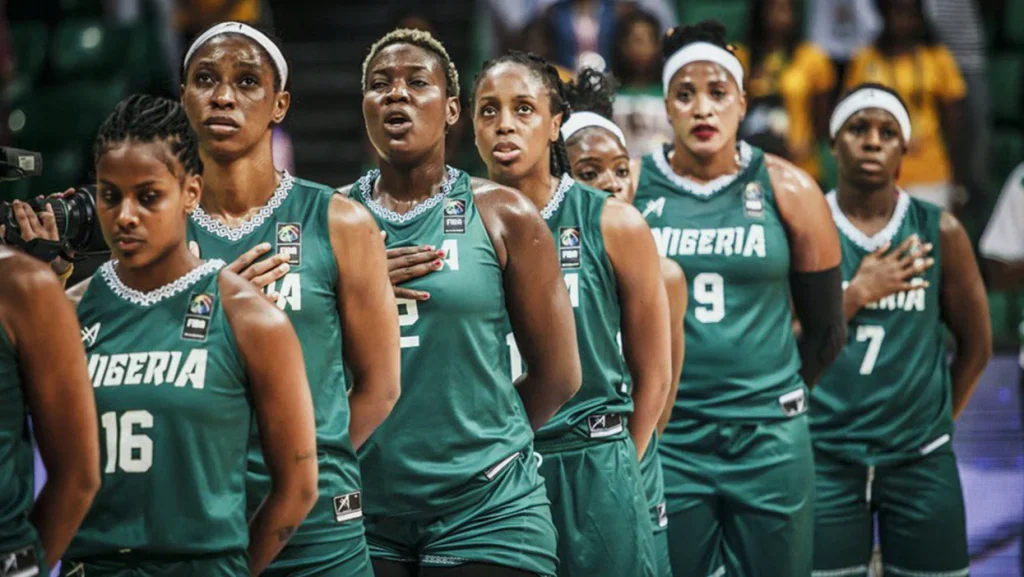
Nigeria’s D’Tigress will enter the 2026 FIBA Women’s Basketball World Cup in Berlin with far more than another African championship to their name. They bring a decade-long reputation for pushing beyond the limits traditionally placed on African women’s basketball.
A continental powerhouse seeking a wider breakthrough
The tournament begins in Germany on September 4, with Nigeria opening against South Korea. Hungary awaits on September 5, before a meeting with France follows two days later.
For head coach Rena Wakama and her squad, that demanding opening sequence will show how far the world’s eighth-ranked team can progress after a period of extraordinary achievement.
Breaking new ground has become familiar territory for D’Tigress. Their control of the African game is now almost expected, with Nigeria having collected seven Women’s AfroBasket championships. Those successes include back-to-back victories in 2003 and 2005, followed by an exceptional five-title streak from 2017 through 2025.
The latest crown came in Abidjan last year. It underlined that, even amid changes in players, coaches and circumstances, Nigeria remains the benchmark for women’s basketball across the continent.
Berlin, however, will pose a different kind of question. The issue is no longer whether Nigeria can rule Africa, but whether that dominance can be transformed into consistent results against the strongest nations in the world.
Evidence of progress on the global stage
D’Tigress advanced to the quarter-finals of the 2018 World Cup in Tenerife, Spain. Along the way, they produced notable wins over Turkey and Greece before eventual champions the United States ended their run.
Six years later, Nigeria created an even more significant piece of history at the Paris 2024 Olympic Games. Their passage into the last eight made them the first African basketball team, men’s or women’s, to reach an Olympic quarter-final.
That achievement represented another broken barrier for a generation that has repeatedly challenged long-standing assumptions about what African basketball teams can accomplish.
The Olympic performance also strengthened Wakama’s reputation. She became head coach in 2023, taking over a programme that was already successful while adding a new layer to its story by combining African supremacy with increased confidence internationally.
The World Cup in Berlin will provide the next assessment of that development.
International preparation and backing
Nigeria’s build-up was designed around varied international opposition. The team first established camp in Illinois, United States, then travelled to Haikou in China for a run of games. The preparations later continued in Spain, where opponents included Spain, Belgium and Puerto Rico.
The results were mixed, but the purpose of exhibition basketball is not simply to accumulate wins. It is also to expose problems early enough for them to be corrected before the games that matter.
Nigeria Basketball Federation president Ahmadu Musa Kida said the programme had placed the squad in a strong position to compete. He described the players as ready and driven to represent the country well, adding that the training schedule and international fixtures should help them perform effectively.
Kida also recognised the assistance provided by the federation’s partners and urged Nigerians both at home and overseas to support the African champions.
That optimism is shared by figures from previous generations who helped establish the D’Tigress identity.
- FIBA Africa Zone 3 president and FIBA Africa Executive Committee member Col. Sam Ahmedu (Rtd.) has called on the players to display the fighting qualities that have become central to the team.
- Former Nigeria internationals Mfon Udoka and Mactabene Amachree have also expressed their backing for Wakama’s group.
The link between past and present matters because Nigeria’s current status was built over many years. The early-2000s teams, the revival led by Sam Vincent in 2017, the Otis Hughley period that featured the outstanding 2018 World Cup campaign, and Wakama’s current tenure have all contributed to an identity founded on physical strength, resilience and fearlessness against higher-ranked opposition.
Experience, new faces and a demanding start
Continuity is visible within the playing group as well. Ezinne Kalu and Promise Amukamara have been part of the national setup since the 2016 Olympic qualifying tournament in Nantes, giving the squad important experience.
Amy Okonkwo has developed into one of Nigeria’s key performers, while Murjanatu Musa, Elizabeth Balogun, Victoria Macaulay and their teammates offer Wakama a range of options in different areas of the court.
The final selection also combines established internationals with players seeking to make their own mark at a World Cup, including Grace Efosa, Shay Ijiwoye, Jordan Obi, Nicole Enabosi and Rita Igbokwe.
Attention must remain on the next opponent rather than the wider tournament picture. South Korea is the immediate challenge, Hungary arrives less than 24 hours later, and France — one of the leading teams in the world and the silver medallist at the Paris Olympics — is likely to provide the group phase’s sternest examination.
Such a schedule will test Nigeria’s focus, bench strength and ability to recover rapidly between games.
Simply reaching major tournaments, however, no longer satisfies D’Tigress. Their accomplishments have raised the standard expected of them.
- Nigeria are the reigning African champions.
- They are Olympic quarter-finalists after their historic Paris run.
- They have also reached the last eight at a World Cup.
None of those milestones guarantees success in Berlin, but together they show that Nigeria can compete well beyond Africa. The next task is to demonstrate that ability once more.
As the World Cup campaign begins, D’Tigress have the support of former players, administrators and millions of Nigerians. Above all, they possess confidence earned through repeatedly entering territory once considered unreachable for African basketball. Berlin represents the latest frontier.
D’Tigress roster by position
- Guards: Ezinne Kalu, Promise Amukamara, Grace Efosa, Shay Ijiwoye and Jordan Obi.
- Centres: Pallas Kunaiyi-Akpanah and Victoria Macaulay.
- Forwards: Murjanatu Musa, Amy Okonkwo, Elizabeth Balogun, Nicole Enabosi and Rita Igbokwe.