Nigeria’s repeated inability to earn a place at the FIFA World Cup has prompted warnings that the problem goes far beyond football. Economists and policy specialists say the setback highlights deeper structural weaknesses tied to governance, insecurity, and the way skills are developed for long-term competitiveness.
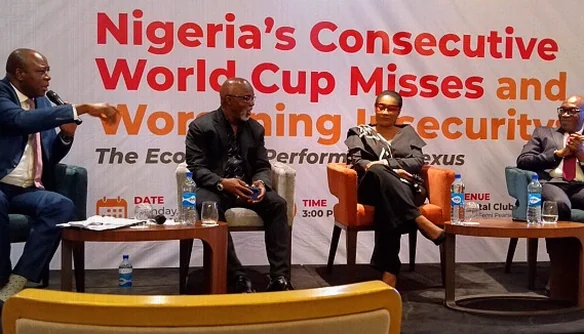
The concerns were raised on Wednesday at the Cowry Asset Management Quarterly Economic Discourse held at the Capital Club in Victoria Island, Lagos. Stakeholders argued that the country’s declining standing in the game echoes broader obstacles to sustained economic growth.
Quick facts
- The discussion linked Nigeria’s consecutive World Cup qualification misses to governance, insecurity, and human capital shortcomings.
- Johnson Chukwu said Nigeria’s football struggles point to systemic failures in talent development and administration.
- Chukwu noted that 16 players born in Nigeria appeared for nine other countries at the 2026 World Cup.
- Insecurity cited included terrorism, banditry, kidnapping, and pipeline vandalism.
- Amaju Pinnick stressed that leadership and investment in sport can translate into economic value, citing England and Morocco.
- Chinwe Egwim said inflation remains a major economic challenge despite recent exchange-rate steadiness and stock market improvement.
- Bongo Adi highlighted inadequate infrastructure, insecurity, and the high cost of doing business as barriers to competitiveness.
- Dakuku Peterside said Nigeria lacks long-term planning and effective systems, with corruption undermining delivery.
- Participants called for stronger human capital development, better security, long-range planning, and greater use of sport’s economic potential.
Sport, governance and the jobs question
Cowry Asset Management managing director Johnson Chukwu delivered the warning under the theme “Nigeria’s Consecutive Worsening World Cup Misses and Worsening Insecurity: The Economic Performance Nexus.” He argued that Nigeria’s inability to compete, despite having both human and natural resources, reflects failures that run through talent pipelines and governance systems.
Chukwu said sport should be treated as a strategic economic pillar with the ability to generate employment and help build youth capacity. He added that meaningful progress depends on intentional investment in people starting from childhood, rather than short-term initiatives.
He pointed to a talent management issue by noting that around 16 players born in Nigeria featured for nine other nations at the 2026 World Cup. For Chukwu, that pattern is evidence that domestic development and local administration have not been effective enough to keep talent focused within the country.
Chukwu also argued that serious football nations reassess their performance after every tournament, adjust their structures, and begin preparations for the next competition without delay. In his view, Nigeria has not shown that kind of urgency after missing qualification.
Insecurity and the economic knock-on effects
On the security front, Chukwu described insecurity—including terrorism, banditry, kidnapping, and vandalism of pipelines—as a direct threat to Nigeria’s ability to compete. He said these pressures weaken productivity, reduce investor confidence, and accelerate brain drain.
Turning to the macroeconomy, he explained that inflation is the sustained rise in general prices rather than a single, temporary increase. He also highlighted Nigeria’s population scale, noting that the country has more than 240 million people, with roughly 42% of them young, describing it as an advantage that remains underused.
Meanwhile, former Nigeria Football Federation president Amaju Pinnick said leadership continues to be the decisive factor behind both sporting and economic success. He cited England and Morocco as examples of countries that have converted long-term investment in sport into tangible economic benefits.
Pinnick said Nigeria’s journey to the 2018 World Cup was powered by players’ confidence, strong leadership, and partnerships with major global sports brands. He added that shortcomings in leadership since then have harmed Nigeria’s football trajectory.
Inflation, policy priorities and competitiveness
Economist Chinwe Egwim said Nigeria has seen relative stability in the exchange rate and an improvement in stock market performance in recent months. However, she maintained that inflation continues to pose a major challenge, urging the government to focus on agriculture, manufacturing, agro-processing, transportation, real estate, and the creative economy to unlock growth and job creation.
Economist Prof. Bongo Adi identified inadequate infrastructure, insecurity, and the high cost of doing business as key obstacles to competitiveness. He called for upgrades to infrastructure and the adoption of consistent economic policy to help the country improve performance across sectors.
Football as a mirror of national systems
Public policy expert Dakuku Peterside said Nigeria’s struggles in football are also a sign of wider governance breakdowns. He argued that the sport mirrors what is working and what is not, adding that the country lacks long-term plans, dependable systems, and effective structures, while corruption continues to undermine delivery.
Peterside called for institutions that can outlast political cycles, warning that without durable bodies and frameworks, progress in both football and the economy will remain fragile.
Calls to action
Across the discussion, participants urged the Federal Government to strengthen human capital development, improve security, and put long-range planning in place. They also emphasized the need to better harness the economic value of sports, treating it as a practical tool for employment, youth development, and wider national performance.