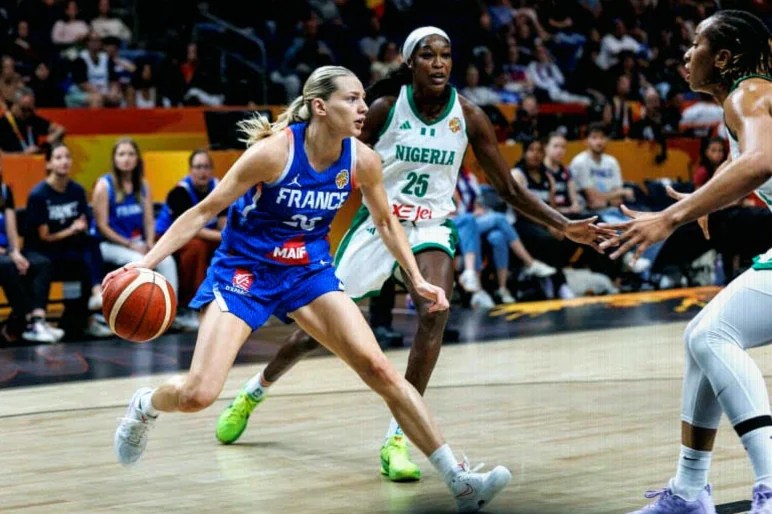
France secured first place in Group B at the 2026 FIBA Women’s Basketball World Cup in Germany with a 111-56 victory over African champions Nigeria, who completed the group stage without a win.
D’Tigress never found a foothold at Berlin Arena. France dictated the pace from the opening possession, while Nigeria struggled to build any attacking rhythm in a heavily one-sided game.
Quick facts
- Final score: France 111, Nigeria 56
- France led 65-26 at half-time after scoring 31 points in the first quarter and 34 in the second
- France added 30 points in the third period before easing off
- Gabby Williams and Marine Johannes combined for eight three-pointers from 11 attempts
- Grace Efosa scored 15 points in approximately 20 minutes as a substitute
France’s early surge produced a 31-13 advantage after one quarter, and another 34 points before the interval left Nigeria 39 points behind. The French added 30 more in the third period, then reduced their intensity once the result was beyond doubt.
The loss ended a challenging tournament for Nigeria, who had arrived with renewed belief after their impressive showing at the 2024 Paris Olympics. France, meanwhile, enhanced their status among the leading title contenders with a remarkable display from three-point range.
The French reportedly converted 22 shots from outside the arc, surpassing their previous best at a World Cup as well as an earlier tournament record set by Japan. Williams and Johannes were responsible for eight of France’s 11 first-half attempts from long distance, while the team as a whole reportedly made 14 triples before the break.
Nigeria captain Amy Okonkwo acknowledged that France’s level punished her side’s slow start.
“It was a difficult night against an excellent France team,” Okonkwo said. “We already saw their quality at the 2024 Olympics and during the qualifying campaign. We did not settle early, struggled to establish our rhythm and could neither secure the victory nor contain them properly.”
Coach Rena Wakama said the present D’Tigress group was being rebuilt and could not simply reproduce the success achieved by the Olympic squad in Paris.
“People remember what we accomplished in 2024, but the team we have now is in a rebuilding phase,” Wakama said. “We are still working out our identity, although I am confident we will find it.”
Wakama also highlighted the difference in experience. Several members of the French roster were established WNBA starters and had entered their league playoffs in top condition.
She nevertheless found encouragement in Nigeria’s response, particularly the determination of the younger players, with several competing at the tournament for the first time. Grace Efosa was praised after contributing 15 points in roughly 20 minutes from the bench.
With the 2028 Los Angeles Olympics ahead, Wakama said the rebuilding project should begin by locating and selecting the country’s strongest available players. She recognised the backing provided by the Nigeria Basketball Federation but said the team’s preparation standards must improve further.
“There has never been a better moment to be involved in women’s basketball, especially,” Wakama said.