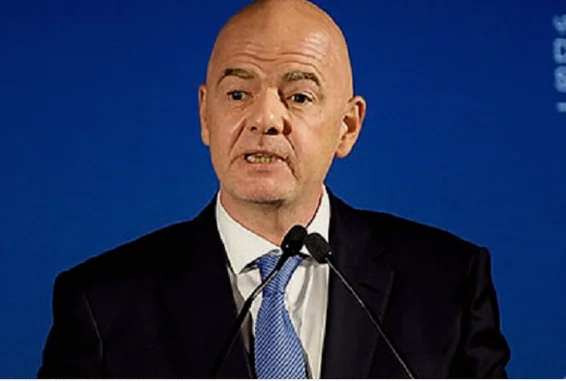
FIFA president Gianni Infantino has apologised to the FIFA Council over his failed World Cup commercial-rights proposal, but has been warned that he cannot remain an acceptable leader without releasing documents and responding to major concerns.
The Council gathered in Zurich on Thursday for its first meeting since details emerged of Infantino’s previously undisclosed FIFA Forward Enterprise, or FFE, project.
Quick facts
- The FFE plan involved transferring part of FIFA’s commercial rights to a private investment company.
- Infantino withdrew the proposal only days after it became public.
- The FIFA Council meeting in Zurich lasted three and a half hours.
- Other issues raised included Folarin Balogun’s suspended red-card sanction, the FIFA Peace Prize and money for member associations.
Under the abandoned FFE scheme, a share of the commercial rights held by world football’s governing body would have been placed with a private investor.
During the three-and-a-half-hour session, Infantino was also challenged over the case involving US forward Folarin Balogun, the Peace Prize and financial support for national football associations.
Several hours after the meeting, FIFA published a video message from Infantino. He did not speak with reporters or take media questions.
In the video, Infantino said he had apologised for errors in the way the FFE initiative had been communicated and consulted upon, adding that the process had produced significant consequences.
He stressed that the project had remained only a proposal, rather than an agreed transaction. Infantino said its aim had been to allow FIFA to put more money into its member associations, not to substitute existing funding streams.
Infantino said he would provide written answers at the appropriate time after what he described as a constructive meeting containing differing views and perspectives.
Debbie Hewitt, the Football Association chair and a FIFA vice-president, said substantial issues were still unresolved despite what she called the most direct, open and robust Council meeting she had attended.
Hewitt said the Council had not received responses to the specific requests it had made, including access to the FFE documentation.
She said she had asked why those papers had not been provided, only to be told that the questions should be submitted in writing.
“He must answer those questions,” Hewitt said. “If he does not do so now, then he is not suitable to be FIFA president. That view was expressed during the meeting.”
Hewitt said she had repeatedly requested the documents and had still not received them, including after the latest Council request.
She said the unanswered matters covered the reasoning behind the way FFE was handled, the Balogun case and the Peace Prize.
“The answers to those issues, which I still do not have, will decide for me personally whether Gianni is the right person,” Hewitt said.
She added that only full disclosure of what occurred would make it possible to judge whether those involved in FFE could be trusted and whether their conduct needed to change.
Hewitt accepted that Infantino’s apology had shown a degree of remorse.
She said Council members had nevertheless spoken without restraint about their feelings over the affair.
“His real apology was for failing to bring it to the Council,” Hewitt said. “If he regrets that so strongly, he should share the material with us.”