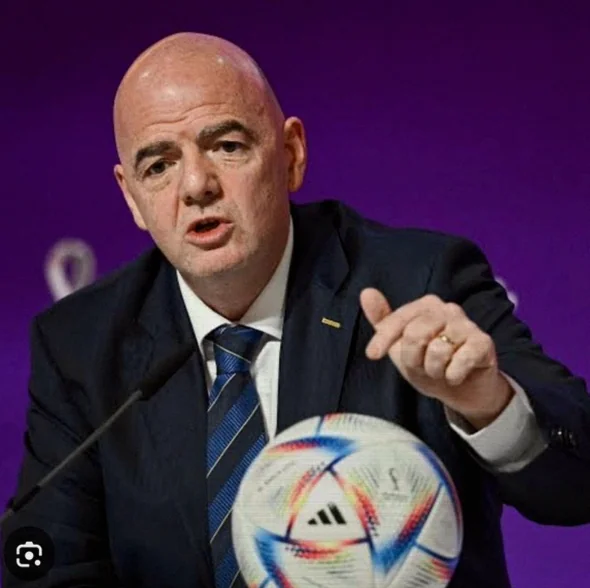
FIFA president Gianni Infantino is facing allegations of possible abuse of office and conflicts of interest after the Norwegian Football Federation submitted formal complaints to two of FIFA’s internal committees.
The NFF’s concerns centre on three episodes: Infantino’s withdrawn proposal to bring private investment into the World Cup, the removal of a 2026 World Cup suspension for United States forward Folarin Balogun after Donald Trump’s intervention, and FIFA’s decision to give its Peace Prize to the US president.
Quick facts
- The Ethics Committee has been asked to investigate Infantino and any other people identified for potential violations of FIFA’s Code of Ethics.
- FIFA’s Governance, Audit and Compliance Committee has been asked to review its governance, financial supervision, controls and decision-making procedures.
- The complaints involve the FIFA Forward Enterprise proposal, Balogun’s overturned ban and Trump’s FIFA Peace Prize.
The first complaint, lodged on Tuesday, calls for an examination of whether Infantino’s conduct, as well as that of others uncovered during the inquiry, may have breached FIFA’s ethical rules.
A separate submission to the Governance, Audit and Compliance Committee asks whether FIFA’s systems of governance, financial monitoring, internal safeguards and decision-making functioned properly.
NFF president Lise Klaveness, an outspoken Infantino critic, said Trump linked each of the three matters.
Josh Kushner, whose brother Jared is Trump’s son-in-law, had been set to become the principal investor through his venture-capital company in the proposed FIFA Forward Enterprise project.
Unveiled shortly after July’s highly successful World Cup, jointly staged by Canada, Mexico and the United States, Infantino’s proposal would have enabled private investors to buy shares in a company formed through the FFE scheme.
Strong opposition forced Infantino to abandon the project only days later in an embarrassing retreat.
“The FIFA Forward Enterprise matter concerns governance, but it is tied to the other two through a potential conflict of interest and possible misuse of position,” Klaveness said. “There is a connection across all three cases: the same political regime.”
The former international player said Infantino must answer major questions over transparency.
Balogun was automatically barred from the Belgium match after receiving a red card in the last-32 victory over Bosnia and Herzegovina at the World Cup.
FIFA then put the suspension on hold, prompting extensive criticism, particularly after it emerged that Trump had called Infantino to intervene.
Infantino’s presentation of FIFA’s Peace Prize to Trump in December has also drawn widespread mockery.
“They are three distinct cases on the facts, but there is a shared issue that we want investigated,” Klaveness said.
“Was there an abuse of power or position? Was political neutrality breached?
“And did the governance rules apply properly, given that the FIFA Council is supposed to be the strategic authority and the president should not hold unilateral power?”
In August, Klaveness, 45, urged Infantino to step down and not pursue a fourth and final presidential mandate.
The 56-year-old Swiss official has maintained that he will stand for re-election in Rabat next March. No challenger has yet formally entered the race.
Infantino, first chosen as FIFA president in 2016, needs a majority from the organisation’s 211 member votes to retain the post.
Prospective candidates must declare by November 18.
Klaveness has ruled herself out, despite some figures, including former FIFA president Sepp Blatter, suggesting she would be well suited to lead world football’s governing body.
UEFA president Aleksander Ceferin has also said he does not intend to run.
European football’s governing body has repeatedly criticised Infantino and FIFA, branding the FFE initiative a “shady and opaque backroom deal”.
Canadian Victor Montagliani, the CONCACAF president, is viewed as the most likely alternative candidate. CONCACAF, UEFA and the Asian Football Confederation have formed an alliance opposed to Infantino.
Although numerous UEFA member associations have publicly withdrawn support for the Swiss president, several AFC members remain loyal, including Saudi Arabia, hosts of the 2034 World Cup, and Qatar, which staged the 2022 tournament.
CAF, African football’s governing body, and South American confederation CONMEBOL are also backing Infantino.
UEFA has additionally filed a case in a Florida court seeking documents linked to Infantino’s collapsed private-investment plan, hoping to gather material for a possible criminal complaint in Switzerland, where both UEFA and FIFA are headquartered.
FIFA responded by accusing UEFA of running a “misinformation campaign” and attempting to “influence” the election.