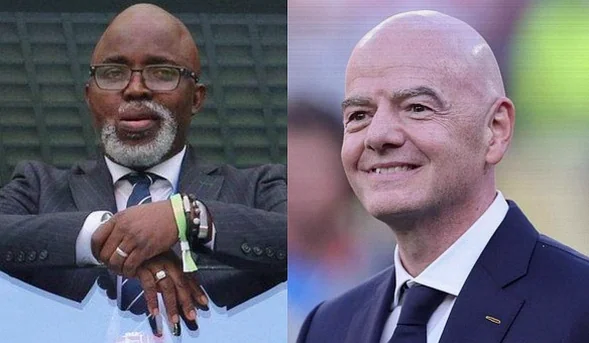
Former Nigeria Football Federation president Amaju Pinnick has backed FIFA’s plan to offer a 20 per cent interest in the commercial rights to the World Cup and other tournaments, saying the idea should be judged on its substance rather than rejected immediately.
Quick facts
- FIFA has proposed selling a 20 per cent minority interest in tournament commercial rights.
- UEFA and other football stakeholders have criticised the plan.
- Pinnick says member associations could receive $20 million from the proposal.
- He cited FIFA Forward funding as a possible additional $20 million source.
Pinnick, the deputy chairman of FIFA’s Men’s National Teams Competitions Committee, also praised FIFA president Gianni Infantino’s record, arguing that his reforms have delivered major gains for national football associations.
FIFA announced on Tuesday that it intends to make a minority share of the commercial rights to the World Cup and other competitions available to private investors. UEFA and several other stakeholders have strongly opposed the move.
During a Thursday television interview, Pinnick said the purpose of the proposal was to grow FIFA’s income and increase the resources available to its member associations, not damage the international game.
He cautioned, however, that he was not in a position to give a definitive assessment because he had not seen any formal communication about the plan. Pinnick said Infantino does not produce major proposals without extensive consultation, although he acknowledged that many within football are uncomfortable with the FIFA president’s approach.
Pinnick described Infantino as ambitious and bold, recalling their first meeting while the Swiss official was campaigning for the FIFA presidency in Rwanda.
Infantino had asked for a private meeting and requested three minutes of Pinnick’s time. He then promised to raise the annual funding available to each football association from $200,000 to $1.25 million if elected.
Pinnick said he initially doubted the pledge and asked where the additional money would come from. Infantino replied that he had transformed UEFA’s finances, had reviewed the figures and consulted widely, and believed the same could be achieved at FIFA.
After Infantino won the election, Pinnick said, the $1.25 million payments began immediately. Over one funding cycle, each association received roughly $6 million.
He said the current initiative should be viewed in the same way: as a proposal that FIFA’s members can either accept or reject through the organisation’s decision-making system. Pinnick added that the mere presentation of an idea should not automatically turn it into a controversy.
To illustrate his point, he referred to commercial changes introduced during João Havelange’s time as FIFA president. Those arrangements involved International Sports and Leisure, or ISL, and were later inherited by Sepp Blatter, first as FIFA general secretary and subsequently as president.
Pinnick said the eventual impact of those reforms is now part of football history.
He also argued that the new plan could make national associations less reliant on government support. In his view, the principal beneficiaries would be the member associations themselves, including those of Nigeria, Niger, Ghana and South Africa.
Pinnick said FIFA had indicated that associations could receive $20 million once the arrangement was completed. They could potentially obtain another $20 million through the FIFA Forward Programme, meaning an association with access to $40 million would, in his assessment, no longer need government funding to operate its football programmes.
His main concern, he said, was not the concept of private investment but the safeguards surrounding the money. He called for scrutiny of the integrity of the funds, the people involved, the consortium or company selected, and the way the proceeds would ultimately be spent.
Pinnick questioned whether the companies involved would be listed on stock exchanges around the world and said those governance issues deserved more attention. He added that FIFA has control mechanisms in place and concluded that the proposal should not be dismissed without consideration of its potential benefits.