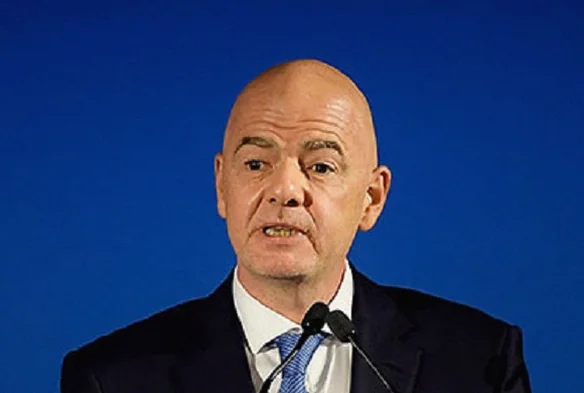
UEFA remains determined to identify a credible candidate capable of challenging FIFA president Gianni Infantino at next March’s election, vice-president Laura McAllister said, insisting the organisation’s drive for change has not faded into mere optimism.
Search for a unifying challenger
McAllister said the eventual nominee did not have to come from Europe, but would need the strength to defeat Infantino, bring football’s confederations together and secure long-term improvements to FIFA’s governance.
Speaking in Madrid after UEFA’s Executive Committee meeting in Thessaloniki, she dismissed the idea that resistance to Infantino had lost its force simply because the FIFA president appears to retain enough backing to win another term.
She said UEFA was not seeking to place a European leader at the head of an anti-Infantino campaign. Its aim was to build a broad coalition behind a candidate offering a defined programme of reform.
Asked whether Infantino’s critics had misjudged the extent of the damage to his position, McAllister said the process was never expected to produce instant results. She said UEFA had anticipated both opposition to change and a gradual political battle.
“That was never going to happen overnight, and expecting it would have been naive,” McAllister said. “We knew there would be resistance. We are moving forward in stages, both through the political process of identifying an alternative candidate and through the governance reforms we believe are necessary.”
Dispute intensified by investment plan
The Swiss-Italian Infantino, 56, encountered the most serious threat to his leadership after his proposal to sell private investors a stake of as much as 20% in FIFA competitions, including the World Cup, collapsed.
The plan drew strong criticism. UEFA, the Asian Football Confederation and CONCACAF were among the bodies demanding change at FIFA’s highest level. A number of European national associations have subsequently stopped backing Infantino’s re-election, with Greece becoming the latest to do so on Tuesday.
McAllister said UEFA’s national associations were still “united and very concerted” in seeking a different model for FIFA, while emphasising that the issue was not solely a personal dispute with the president.
“This has always involved more than one individual,” she said.
UEFA, she added, had been pursuing its objectives discreetly on several fronts and considered the reform agenda more significant than the eventual candidate’s name or nationality.
- The campaign requires political tactics as well as a credible alternative candidate.
- UEFA believes every confederation shares serious concerns about the need for change.
- The eventual challenger is expected to run on a manifesto focused on reform and modernisation.
Opposition must be capable of winning
Infantino has confirmed that he will seek another term in March. McAllister said those opposing him could not settle for a purely symbolic contest and had a responsibility to select someone with a genuine chance of victory.
She said that, with Infantino making clear he intends to stand unless circumstances change before next March, his opponents must choose the right person to face him.
“There is no point entering an election unless you believe you can win it,” McAllister said.