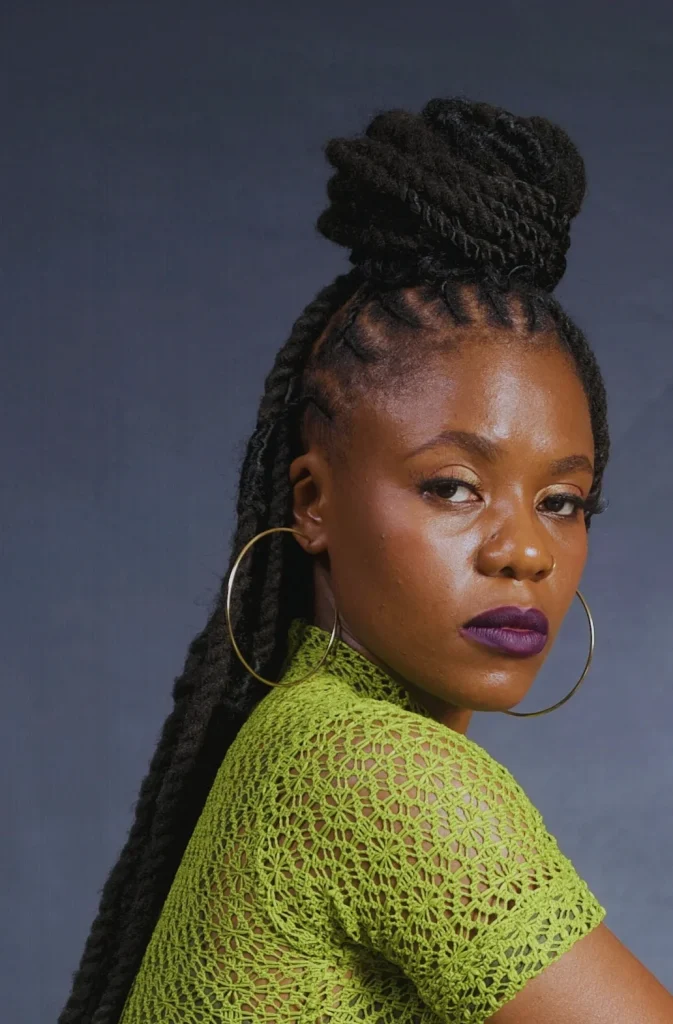
Ayanda Jiya has embraced the label of a catalogue artist, a fitting description for a career shaped less by instant success than by music, quiet seasons, heartbreak, spirituality and the determination to start over.
“I’ve had to reconstruct my career on three separate occasions,” she says.
“Every time I did that, I discovered more about myself and my identity as a musician.”
That pattern began at the start of her journey. Brought up in the Seventh-day Adventist faith, Ayanda stepped into music with a strong sense of purpose, but also anxiety about how her family would respond to the path she had chosen.
A Metro FM Award nomination for Best R&B Single eventually made it impossible for her to keep that ambition hidden.
However, public recognition did not spare her from the industry’s more painful realities. Ayanda says some of her professional partnerships left her without control, and she ultimately lost her debut body of work, Very Intimate Conversations. She went on to make To Whom It May Concern, Ayandastand and Queen.
Having music she had invested so much of herself in taken away could have ended her momentum. Instead, the experience showed her exactly where her lasting strength came from.
“I am the vocalist, the identity and the force driving everything I make.”
That belief defines Ayanda’s outlook today. Whenever the business seemed determined to measure her by what had been taken from her, she came back with a clearer understanding of what remained beyond anyone else’s control.
When Queen was lost, she began again with A Tale of a Fallen Queen, this time making ownership a central priority.
“For the first time, I was able to fully stand behind a project and say that it belonged to me. I owned my masters,” she says.
Working independently has not been easy or glamorous. Ayanda acknowledges that it has demanded sacrifices and, at times, restricted how widely her music could travel. Even so, it offered her something that exposure alone could never provide: control over her own career.
That difference is especially important to her as she watches an industry she considers increasingly “bubblegum”, one that continually expects artists to release more songs, post more often and repeatedly demonstrate that they still matter.
“Attention may come from being visible, but visibility does not automatically create a lasting career,” she says. “I am not a one-hit wonder, nor do I need to keep pushing out music simply so people do not forget me.”
Her newest single, Don’t Lie To Me, grows out of that same resistance to manufactured emotion. Inspired by the disappointment that followed her decision to be vulnerable once more, the track transforms pain into a clearer understanding of her feelings.
“The problem was not allowing myself to be open, and loving sincerely was not wrong either,” she says. “I do not want my songs merely to recount events. I want them to capture the experience of what it was like to endure them.”
Ayanda is now starting over from a transformed position. Her faith in God has become stronger, her artistry has developed and her self-belief has returned. The woman who once relied on other people to help shape her direction is no longer seeking permission from the culture to claim her place.
“I have moved beyond the fear that my time has passed,” she says. “I see myself as an iconic artist.”
Rather than sounding boastful, the statement feels like an honest conclusion drawn from everything she has endured.
She describes herself as a veteran and as a link between different generations, taking pride when younger musicians tell her that her work formed part of their upbringing. But she does not view legacy as a signal to step away; Ayanda is still evolving.
“My focus is no longer on fitting in. I’m becoming increasingly at ease with the truth that I was never designed to do so.”
That may be the essence of Ayanda Jiya’s phoenix story: her power is not only in rising after each collapse, but in allowing every difficult chapter to burn away another identity imposed on her by others.
What emerges now belongs completely to her.
“I do not want to be remembered as a passing moment,” she says. “I want to grow into an entire world.”
Also read: From MAXHOSA to Gucci: model Katlego Masike explains why modelling is about presence, not simply recognition.