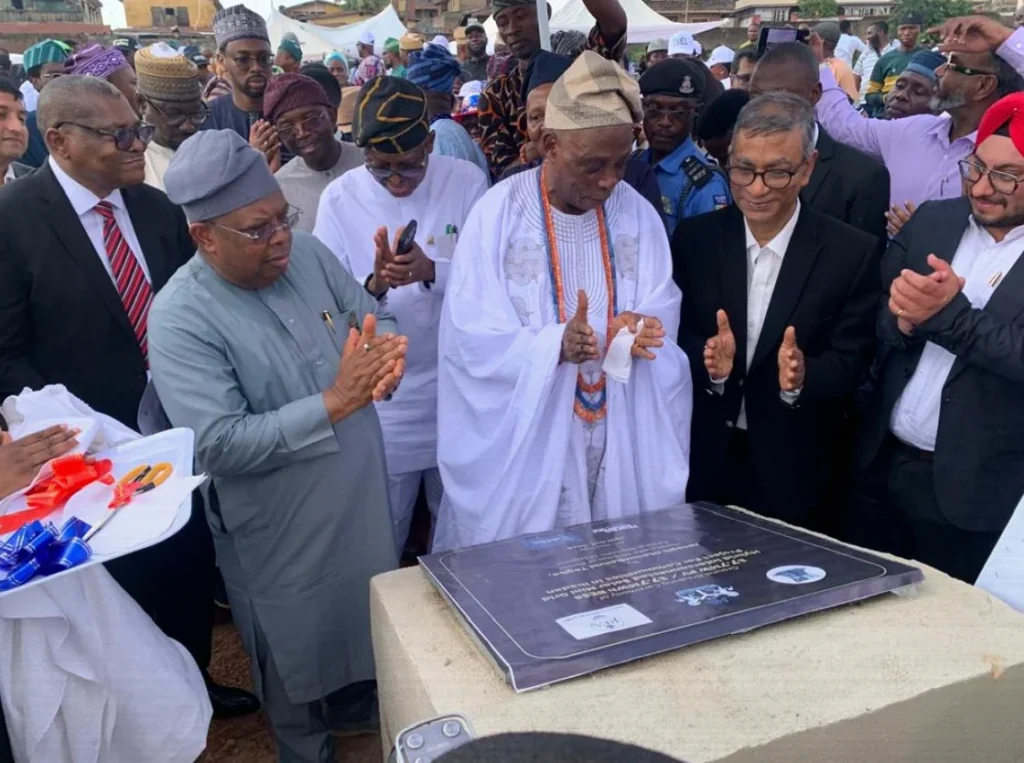
Nigeria’s Federal Ministry of Power and the Rural Electrification Agency have launched construction of a 17.7MW interconnected mini-grid in Ibadan, Oyo State, aiming to deliver at least 20 hours of daily electricity to five communities along the city’s Iwo Road corridor.
Developed by Paras Energy & Natural Resources Development Limited, the scheme is intended to add generation capacity, improve supply dependability and support commercial activity in the Bola, Jiboye, Ogo-Oluwa, Molade-Adelubi and Sooko Elega communities.
Quick facts
- Capacity: 17.7MW interconnected mini-grid.
- Location: Iwo Road axis of Ibadan, Oyo State.
- Target service: a minimum of 20 hours of power each day.
- Distribution upgrade: 18 transformers are planned for the beneficiary areas.
- Developer: Paras Energy & Natural Resources Development Limited.
- Further pipeline: another 17.7MW of Ibadan projects for major institutions and economic hubs.
The initiative is part of a wider federal strategy to pair national-grid upgrades with decentralised generation located nearer to electricity users. The government expects the facility to extend both the duration and consistency of supply for the communities served.
Power Minister Joseph Tegbe said the project underlines the administration’s effort to expand electricity availability, make supply more dependable and convert power-sector investment into tangible economic opportunities.
He said the policy focus was not limited to building more infrastructure. New capacity must also serve enterprises, manufacturers, households and other productive users, he said.
“The goal is straightforward: raise the volume of power available to Nigerians, improve the dependability of service, and make electricity a driver of productivity, investment and growth,” Tegbe said. He added that projects of this kind turn that commitment into infrastructure for communities and productive business clusters.
The Ibadan development adds to the REA’s expanding programme of both interconnected and standalone mini-grids nationwide. The agency has held groundbreakings and moved interconnected projects forward in Pankshin, Plateau State, as well as Kofare, Mbamba and Saminaka in Adamawa State, alongside other locations.
The investments signal a shift in Nigeria’s distributed-energy market from smaller systems centred primarily on basic access toward larger decentralised assets. Such projects are designed to support communities, commercial centres and productive consumers while working alongside existing distribution networks.
Tegbe said this strategy is being implemented in parallel with federal work on generation, transmission and distribution assets. Planned and continuing upgrades across major electricity corridors are expected to gradually improve the durability and reliability of the country’s power system.
REA Managing Director and Chief Executive Abba Aliyu said the 17.7MW scheme reflects the scale of a new class of distributed renewable-energy projects being developed under President Bola Ahmed Tinubu’s Renewed Hope Agenda.
The agency is increasingly directing generation investment to locations where it can create the strongest economic benefits, while drawing on private capital and commercially sustainable operating structures, Aliyu said.
“This ceremony concerns more than adding 17.7 megawatts,” he said. “It concerns what the electricity can make possible: longer business hours, less reliance on costly self-generation, stronger productivity, fresh investment, and ultimately jobs and wider economic opportunity.”
Aliyu said the Ibadan facility is one component of a substantially larger investment pipeline being facilitated by the agency.
Distributed power, he said, can advance beyond an electricity-access tool to become a major contributor to supply stability and economic development. The objective remains dependable electricity for productive economies, from earlier mini-grid projects elsewhere in Nigeria to the capacity now being introduced in Ibadan.
When completed, the project will install 18 transformers to reinforce local electricity distribution in the five communities.
The REA is separately progressing an additional 17.7MW of projects in Ibadan for strategic institutions and economic centres, including University College Hospital, the University of Ibadan and The Polytechnic, Ibadan. Taken together, the projects are intended to create clusters of dependable generation around communities, public facilities and centres of commerce.
The Olubadan of Ibadan, Oba Rashidi Adewolu Ladoja, welcomed the intervention, saying better electricity would benefit businesses, households and livelihoods in the affected communities.
He thanked President Tinubu for infrastructure work under way across Oyo State and urged that the projects be completed promptly.
Paras Energy & Natural Resources Development Limited Managing Director Yashwant Kumar said the company would deliver the project efficiently and in line with required standards. He said reliable electricity could substantially change conditions for residents and businesses in the project zone.
The groundbreaking highlights a federal and REA power-sector approach combining new generation, stronger networks, decentralised infrastructure and private investment to improve supply quality.
For the REA, success will be judged not only by installed megawatts, but by the economic output they enable: enterprises supplied with power, longer productive hours, supported employment, attracted investment and communities reshaped by dependable electricity.