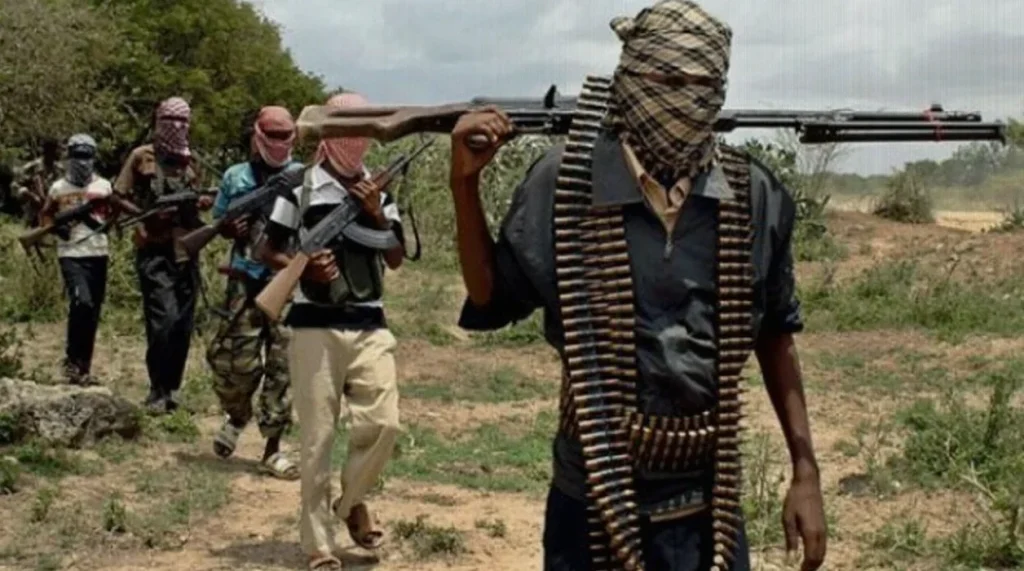
Nigeria’s long-running security emergency has entered a more alarming phase after police in Sokoto State recovered rocket launchers from armed groups, underscoring the expanding firepower available to bandits operating across the country’s north.
Key takeaways
- Police recovered at least two rocket launchers after an assault on Tsabre Village in Sokoto’s Isa Local Government Area on October 2.
- Security concerns are rising over arms-smuggling routes, alleged supply networks and the possible diversion of weapons by personnel.
- Kidnappers received an estimated N7.78 billion in ransom payments nationwide from July 2025 through June 2026.
- At least 36 serving or prospective National Youth Service Corps members were abducted in separate incidents between August and October 2026.
- A retired police superintendent says the campaign against banditry must target powerful financiers and beneficiaries beyond forest hideouts.
More powerful weapons and suspected supply routes
The Sokoto State Police Command said it seized the launchers and other dangerous equipment from bandits who attacked Tsabre Village in Isa Local Government Area. The discovery has intensified nationwide anxiety as armed groups continue to kill residents and carry out ransom kidnappings, especially across the North-West and North-Central.
For many years, these groups mainly used assault rifles and other small arms in raids on communities and worship centres, attacks on security forces, and abductions. Their apparent access to heavier weaponry, including rocket launchers, has prompted renewed scrutiny of where the arms originate, how they are moved and what this could mean for military efforts to contain the violence.
Claims have circulated that helicopters deliver weapons into forest areas, particularly in the North-West, where bandit groups have maintained a campaign of terror against local populations. In 2021, former President Muhammadu Buhari imposed a no-fly zone over Zamfara State to restrict the movement of weapons and supplies to gangs active there and in nearby states.
That restriction did not end the concerns. Videos later surfaced appearing to show helicopters touching down in isolated forest sites where non-state actors were reportedly present, fueling suspicions that arms and logistical supplies could still be reaching armed groups.
Security specialists also point to extensive, weakly protected frontiers as a central problem, notably Nigeria’s border with the Republic of Niger. Separately, influential figures connected to illegal gold extraction have for years faced accusations of financing instability in northern areas to enable access to valuable mineral deposits.
In March 2021, a former bandit who said he had renounced criminal activity alleged in an interview that government officials knew how the groups obtained their weapons. Other allegations have suggested that military officers and commanders have sold arms and ammunition intended for Nigeria’s anti-terrorism and anti-banditry operations to the same armed networks.
In October 2025, suspected arms trafficker Shehu Ali Kachalla, a 30-year-old citizen of Niger, said military personnel had provided armed escorts and protection for illegal arms shipments to bandit groups in northern Nigeria. Zamfara State Police Command arrested Kachalla in a joint operation involving the Federal Intelligence Bureau and the Special Tactical Squad.
During his public presentation and questioning, Kachalla admitted smuggling more than 450 rifles and 8,000 rounds of ammunition from the Republic of Niger and selling them to groups in Zamfara, Kaduna and Niger states. He said the consignments moved in convoys through porous border corridors and claimed that military personnel normally escorted and shielded the deliveries.
He alleged that armed soldiers travelled with the convoys, protecting them from rival criminal groups, customs officers and anti-smuggling patrols.
Ransom proceeds, youth targets and calls to pursue financiers
Ransom income has given criminal groups the financial resources to purchase increasingly advanced and lethal weapons. An SBM intelligence report estimated that kidnappers collected at least N7.78 billion across Nigeria between July 2025 and June 2026, a period in which 7,825 people were abducted.
The report put total ransom demands during those 12 months at roughly N22.856 billion, with N7.78 billion believed to have been paid to secure victims’ release.
Parents of 20 prospective National Youth Service Corps, or NYSC, members abducted in Imo State recently said they paid N6 million for each victim. Security agencies maintained that the prospective corps members were rescued in an operation. However, Alirat Wahab, the parent of one abductee, said her family borrowed funds and received contributions from relatives and others to raise the N6 million allegedly demanded for her son.
Wahab said the kidnappers originally requested N50 million for every prospective corps member before lowering their demand after parents appealed to them. Security analysts say payments of this kind materially increase the capacity of criminal groups to buy better weapons and sustain attacks.
Young Nigerians completing the mandatory one-year NYSC programme have increasingly become kidnapping targets. Between August and October 2026, at least 36 serving and prospective corps members were seized in separate attacks.
On August 26, bandits attacked and abducted at least 16 corps members in Kogi State as they travelled home from an orientation camp in Bayelsa State. Their captors sought a substantial payment, but intelligence-led security operations later secured the victims’ rescue.
In another incident, around 20 prospective corps members travelling from the South-West to orientation camps in Abia and Akwa Ibom states were kidnapped on the Owerri-Onitsha Road in Imo State on October 1. Accounts differ over whether a ransom was paid before they were freed, but they regained their liberty on October 7.
A serving corps member in Abuja, who gave her name only as Mary, said NYSC participants no longer feel safe wearing the programme’s distinctive khaki uniform because it can make them identifiable targets.
“In the past, corps members often travelled in khaki, particularly with the headgear on, because they wanted people to know they were serving,” she said. “That is no longer the reality.”
She said even movement within Abuja now feels risky for people in uniform because they cannot know what may happen. Mary added that she does not wear khaki while travelling to Community Development Service activities, instead carrying it in her bag and changing only once she reaches the venue, then changing again before leaving.
“I have wanted to travel home, but given the current situation, I will remain in the city until my service is over,” she said.
Retired Superintendent of Police Desmond Omale said the fight against terrorism and banditry is unlikely to produce meaningful results if it remains focused only on forest camps.
“The principal bandits and terrorists are not in the bush; they are elsewhere, travelling in private jets and enjoying the proceeds,” Omale said.
He argued that communities near gold deposits and other valuable mineral resources are frequently controlled by bandits. “Go to a mining location and ask a miner who they are working for,” he said. “There is always somebody behind the operation.”
Omale questioned whether authorities were unaware of those beneficiaries and whether, in some instances, state governors could also be gaining from mining activities. He also linked the security crisis to the arming of political thugs during election cycles.
“If you provide people with weapons, you should expect them to use them,” he said. “Politicians arm many thugs ahead of elections. Once elections are over and the payments stop, those people must find other ways to survive with the weapons they still possess.”
Nigeria’s leaders remain central to the problem, he said, arguing that the security challenge cannot be solved from the grassroots alone. “It must be addressed from the top, unless we intend to keep deceiving ourselves,” Omale said, adding that military personnel, police officers and other security operatives are dying daily because of the greed of a few people.