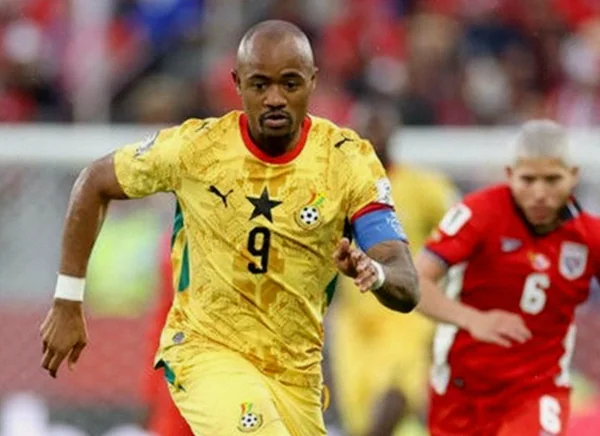
Ghana’s qualification campaign reached a dramatic high in October 2025 when the Black Stars edged Comoros 1-0 at Accra Sports Stadium, triggering scenes of relief as supporters flooded the pitch and chanted “U-S-A! U-S-A!”. The final whistle confirmed Ghana’s place at the 2026 FIFA World Cup, marking a renewed moment of national pride.
While the celebrations surged around him, Jordan Ayew remained notably calm, smiling quietly. The captain—an influential figure across the qualifying process with seven goals and seven assists—appeared removed from the loudest parts of the noise, as if he was already thinking about what came next.
In an interview, Ayew described his mindset after that match: “I’m a very humble person. It doesn’t change much for me. I’ve always been the same person, and I’ll always be the same person.” His response captured a theme that has followed him throughout a long spell in the spotlight—success without losing perspective.
That steadiness has helped define Ayew, a player who has spent more than a decade under the public eye yet has managed to stay grounded in the middle of intense pressure.
Inside the dressing room, the mood was emotional but controlled, as the team balanced release with restraint.
“Everyone was happy, of course,” Ayew said. “But we were measured as well. Qualification is one thing; going there and performing is another.”
For Ayew, that blend of celebration and preparation reflects the maturity of someone who has lived through both sides of elite sport: early promise, painful setbacks, waves of criticism, and eventual comebacks.
Now aged 34, he has taken on the role of emotional backbone for a Ghana side in transition—helping steer a young Black Stars group through a period where experience and leadership matter as much as talent.
He understands the weight that comes with representing a nation that expects more than participation. “It’s important that everyone wakes up in the morning and feels that happiness. It’s been lacking for some years now, and to bring that back is a good feeling,” Ayew said.
Ghana’s failure to earn a place at the 2026 Africa Cup of Nations had stirred concerns in a country known for football passion and frequent success. Ayew, however, insisted that the disappointment became motivation rather than a stumbling block.
“Everyone knew the disappointment when we didn’t qualify for the AFCON,” he explained. “We wanted to make sure we didn’t miss out on the World Cup. We wanted to make people proud again. Mistakes happen in life, but you do one mistake, you don’t do a second one.”
He framed the turnaround as something rooted in collective character. “This qualification was more about team unity and resilience. Everyone fought for one another. That’s why we got rewarded,” Ayew said.
Despite his status, Ayew admitted that captaining Ghana was never a goal he chased.
“To be honest, being a captain is not really my thing,” he said with a smile. “I never dreamed of being one. But when the time is right, you can’t run away from it. You need to take it and embrace it.”
His leadership is described as quiet and thoughtful, built on respect rather than constant instruction. “I don’t speak much. I just give one or two pieces of advice here and there. But I’m not the type who’s always on them. Some of the boys have kids, they have families; I just let them know I’m there for them,” Ayew said.
It is a style that stands out in an era where some captains are defined by volume and frequent commands. “You just need to be yourself,” Ayew added. “That’s what I’ve been doing.”
A football family and a captain’s track record
In Ghanaian football culture, the Ayew name carries deep significance. Jordan’s father, Abedi Ayew—often known as “Pele”—is widely regarded as an icon, while his uncle, Kwame Ayew, won Olympic football bronze at Barcelona in 1992.
Jordan’s brother André previously captained the Black Stars at the prior World Cup, with Rahim Ayew— the oldest of the brothers—also appearing at the 2010 FIFA World Cup for Ghana.
Now, Jordan has added himself to a select list of Ghana captains who have led the team to the World Cup, a group that includes Stephen Appiah and Asamoah Gyan.
“It’s a very special group,” Ayew said. “But for me, I don’t take it to a different level. The most important thing is to stay focused on my job, to perform for my club and country. I don’t dwell on statistics or things like that. I just want to make people smile.”
Even so, the milestones behind that mindset are remarkable. With 123 international appearances, Ayew holds Ghana’s all-time appearance record. He is also among only four Ghanaian players—alongside Gyan, Sulley Muntari and his brother André—to feature at three World Cup tournaments for the country.
Asked about how long this journey has lasted, Ayew shrugged off the scale of it. “I’ve never thought this would be possible,” he said.
“The way my national team journey started, I didn’t think I would last. But in life, things change. You have plans, but God has other plans.”
For him, the purpose has remained consistent. “I just want to make people happy. That’s all I’ve ever wanted,” Ayew added.
World Cup form: pressure, preparation, and a calmer approach
Ghana have reached the knockout stage of the World Cup for the first time since their historic quarter-final run in 2010. Ayew started all three group matches, reinforcing that he remains a key part of this Ghana setup.
In the Black Stars’ opening two fixtures—against Panama and England—Ayew recorded more defensive pressure than any other player in the tournament, with 204 such actions. The statistic underlined his relentless approach, even at 34.
“I work very hard. It doesn’t come by chance. I put work into my recovery, my individual sessions. Football is my life,” Ayew said.
He suggested that playing time remains tied to impact. “As long as I feel effective and important in the squad, I’ll keep playing. Once you stop, you can’t turn back,” he reflected.
One of the clearest changes, he believes, is the sense of peace that now comes with experience.
“I’m more relaxed on the pitch. I just go there to enjoy myself. Maybe this might be my last game, maybe not. So I just go in and put on a show,” Ayew said.
When asked about how long modern elite players can stay at the top, he pointed to the longevity of current superstars. “If Ronaldo and Messi are playing until 40, and we haven’t even reached a quarter of that level, who are we to say we can’t?” he asked.
As for how he wants to be remembered, Ayew offered a simple answer. “Just being a respectful person, a good person, a good professional,” he said without hesitation.
It is a modest description, but one that reflects the shape of his career: steady, unassuming, and reflective. For Ayew, football has always been tied to enjoyment as much as effort—joy, hard work, and gratitude.
“You have to enjoy what’s in front of you,” he said.