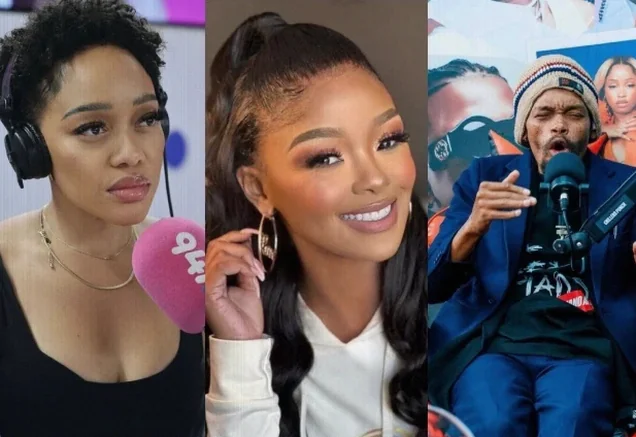
South African music executive and outspoken media commentator Nota Baloyi has thrown fuel on a growing controversy after his criticism of Thando Thabethe’s interviewing approach during a recent sit-down with veteran entertainer Nonhle Thema. Baloyi accused the radio host of inadvertently (or perhaps deliberately) diminishing Thema through her on-air reactions while the pair discussed Nonhle’s career and influence.
The disagreement traces back to Nonhle’s appearance on Your Story with Thando Thabethe on 947, where she looked back on her work in entertainment and made several remarks that quickly became talking points online.
As the interview circulated, viewers took a close look at Thabethe’s facial expressions and delivery, with some social media users arguing that her reactions suggested scepticism or disbelief as Nonhle spoke.
Among the most discussed moments was Nonhle’s assertion that she played a role in helping popularise Twitter—now branded as X—in South Africa.
“I was the first South African celebrity on Twitter. I found X (formerly known as Twitter) in America, and I came back, and everybody joined because of me,” Nonhle said during the conversation.
The clip spread fast, and audiences split into two camps: some felt Thabethe’s questions and expressions read as normal, inquisitive interviewing, while others believed her body language came across as subtly dismissive.
The matter resurfaced again on the latest instalment of Music Pulse, where Nota returned to the topic and criticised Thabethe’s style. He also leaned into his frustration with an emphatic assessment of the moment.
“You’re with Nonhle f****** Thema, dog. That’s generational talent, dog,” Nota said.
From Nota’s perspective, Nonhle is part of a foundational wave of talent that opened doors for a newer generation of South African presenters and entertainers.
“I feel like the seat that you have right now as Thando Thabethe was made by the Nonhle Themas of this world,” he added.
He then drew comparisons between Nonhle’s international achievements and the paths of other well-known media figures, arguing that her accomplishments predate similar milestones credited to others.
“Before Anele Mdoda was going out there to the Grammys, Nonhle Thema was doing that. You saw Nonhle Thema do that. She was your icon at some point in time. You even said that in the interview. For you to treat her like that… Don’t do that, Thando,” Nota continued.
Baloyi went further by suggesting that Thabethe—given her experience and seniority in broadcasting—should have handled the conversation with greater care.
“She’s a very intelligent girl… She hosts drive time on 947. They don’t put her in that seat for nonsense. She’s prime talent. She should know better. You don’t make our legends look bad,” he said.
Not everyone agreed with Nota’s reading of the exchange. His co-host, Thakgi Ledwaba, offered a different interpretation, saying viewers may have misinterpreted Thabethe’s reactions.
“I feel like Nonhle Thema is a person who calls things out. Had she seen those things? Because they’re just projecting stuff that didn’t really exist. It’s just shock that, ‘Oh, I actually forgot about that,’ and she’s just realising in the moment as she was interviewing Nonhle Thema,” Ledwaba said.
Ledwaba also argued that if Thabethe had truly been disrespectful, Nonhle would likely have addressed the issue herself rather than allowing it to become a viral talking point.
Nota, however, dismissed that explanation, maintaining that Thabethe understood how her expressions could be interpreted by audiences.
Since then, the dispute has continued to play out online, with social media users still split over what the interview actually showed—both in terms of Thabethe’s intentions and the significance of Nonhle’s claims.
Some viewers insist Thabethe was simply doing her job, asking follow-up questions to clarify points and reacting naturally in real time. Others agree with Nota, arguing that Thabethe’s facial expressions cast doubt on Nonhle’s recollections and the legacy she presented during the interview.
For many fans, the conversation has also reignited wider debate about Nonhle Thema’s role in South African entertainment—prompting renewed attention to her television impact and her appearances on international red carpets—while critics continue to challenge specific statements she made during the now-viral segment.