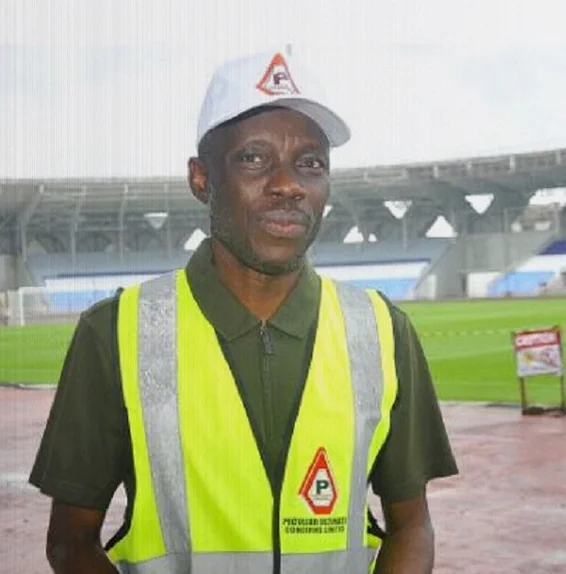
Lanre Adeleke, the managing director of Peculiar Ultimate Concerns Limited, believes Nigeria’s return to football’s grandest stage will depend heavily on improving its pitches, and he is putting his company’s reputation behind that conviction.
He expects Peculiar to have delivered between six and eight playing surfaces around Nigeria within two years. With reforms under way in the system, Adeleke is convinced the Super Eagles can reach the following World Cup. Nigeria’s 2026 campaign is already over, so his confidence is focused on 2030, when he expects the team to benefit from substantially improved home grounds in Warri and Lagos before qualifying begins.
His campaign for better stadium infrastructure has found support from Segun Odegbami, the celebrated former Nigeria international and Green Eagles captain. During a recent media visit to the ongoing Warri City Stadium renovation in Delta State, Odegbami called poor pitches the foremost barrier to the advancement of Nigerian football.
“I have always believed that the pitch is Nigerian football’s biggest problem,” Odegbami said. “If you want to build the football industry, you must have quality grounds for football.”
He added that, over the last three decades or more, nobody had tackled the condition of Nigeria’s football grounds — which he described as central to development — in the manner Adeleke is now doing.
The backing comes while Adeleke’s company advances two prominent projects: the redevelopment of Warri City Stadium and eight mini-stadiums spread across Lagos State. The firm is also continuing its work at Teslim Balogun Stadium. It has created an unusual meeting of minds between a former national-team star and a contractor, with both identifying the same weakness in Nigeria’s football infrastructure and looking ahead to 2030.
From faith-inspired name to stadium engineering
Adeleke said the company’s name has roots in the Bible. He referred to a passage in Second Peter describing “a holy nation” and “a peculiar people” as the inspiration. His time at the Federal University of Technology, Akure, also influenced the eventual identity of the business, after FUTA Consult made an impression on him as a student.
That led to the creation of Peculiar Consult for consultancy services and Peculiar Ultimate Concerns for construction work. Adeleke describes it as a covenant name, saying the business represents an expression of faith as much as a commercial enterprise.
With 30 years’ experience as a civil engineer, Adeleke holds a Bachelor of Engineering degree in Civil Engineering and is a Fellow of both the Nigerian Society of Engineers and the Nigerian Association of Civil Engineers. He rejects the idea that stadium projects should be seen as separate from mainstream civil engineering.
In his view, engineering can broadly be divided into civil work and what he calls military branches, including mechanical, electrical, chemical and metallurgical fields. Those other fields, he said, do not deal directly with people in the same way. Civil engineering, meanwhile, is a wide discipline that covers hydraulics, structural work, bridges and stadium construction. Because it has not been broken into sub-specialisms in the way those other branches have, he believes people too easily overlook its role in delivering sporting venues.
Adeleke’s principal case, and apparently the one that persuaded Odegbami, is that Nigeria has historically assessed stadiums in the wrong order. He said earlier evaluations gave each department roughly equal importance, including the pitch, despite CAF and FIFA being able to reject an entire venue solely because its playing surface is unsuitable, no matter how impressive the stands, exterior finishes or other features may be.
“All the departments were given equal marks, which means the pitch received a very low weighting,” he said. “That order has to change. The pitch should receive 70 per cent, with lower scores assigned to the other areas.”
He compared the existing approach to an examination in which six questions are given identical marks even though one should carry far more value than the rest. Nigeria, he argued, has placed too much emphasis on secondary matters. His preferred model would make turf quality worth between 50 and 70 per cent of any stadium assessment, leaving floodlights, scoreboards and dressing rooms to be considered after the playing area has met the required standard. Everything beyond the grass, he said, is simply the finishing touch.
That approach has been tested at Warri, where his team faced criticism online after people claimed newly installed grass was being dug up. Adeleke said the operation was actually surface trenching, the last stage of a drainage process carried out below the field at intervals of 1.5 metres. He estimated that it would take around a month before the surface was ready for football again.
He explained that there are four drainage layers underneath the turf, all connected to a main discharge channel, while the trenching adds a fifth layer closer to the surface. Adeleke said the pitch had not flooded and, with God’s help, would not do so.
Maintenance, Lagos projects and a 2030 target
Adeleke’s personality is perhaps most evident in the way he describes grass maintenance. Asked why playing surfaces repeatedly fail in Nigeria, he used an extended comparison involving women, computers and the continuous care required to maintain a healthy lawn.
He began by suggesting that a computer, if it were assigned a gender, would be male: someone can purchase a new model only to find that an updated version has arrived almost immediately. He contrasted that with his portrayal of a woman waiting for a husband for years, only for several more prospective partners to emerge as soon as she accepts one. He then applied the analogy to turf.
“If this grass had to be given a gender, it would be a woman,” he said. He argued that women require continual attention and products such as creams and powder, even in the sun. Adeleke said his wife had disputed his comparison and argued that the grass was male. He remained unconvinced, saying a surface that requires constant fertiliser behaves like a woman needing regular care to remain in good shape.
Behind the colourful analogy is a serious message about insufficient spending on maintenance. Adeleke recalled an argument over manure during a project in Ibadan, when a supplier quoted four million naira for cow dung.
He said he asked why they could not simply buy a cow, but was told that waste from one animal would be nowhere near enough for the size of the project. The monthly cost of maintaining such a surface, he said, would alarm many people. He added that comparable budgets at facilities in nearby states, including the Godswill Akpabio International Stadium in Uyo, Akwa Ibom State, would likely produce the same reaction. The failure to meet those ongoing costs, he said, is a major reason Nigerian grass pitches die.
He cited another example from his own work. After completing and handing over a natural-grass field to an unnamed state government, Adeleke warned officials that it would fail if regular maintenance was not funded. The warning was dismissed, but the grass died within three months, he said, and the state then contacted him. He has since been paying for the upkeep himself.
Adeleke said the pitch is associated with his company’s name, making its condition a matter of professional standing rather than merely a contractual responsibility. He praised Delta State for understanding the need for long-term planning, saying its government had already budgeted for maintenance over a period of two to five years. He described the state’s work as excellent and said the governor is deeply committed to the project.
On the conditions surrounding the Warri development, Adeleke pointed to a close supervisory framework involving the Ministry of Housing, a specific project-monitoring office and the governor, whom he described as the project’s “Chief Monitor.”
He stressed that the judgment on the quality of Peculiar’s work should come from those responsible for supervision and monitoring, rather than from his own company. Still, he said he was confident the venue would become one of the finest in Nigeria.
Adeleke also proposed a broader policy measure: a public ranking of states based on their sporting facilities, published at least twice every year. He suggested naming a top 10 in much the same way WAEC results can place pressure on state education systems. Proper ratings, he said, would compel states with inadequate facilities to improve, comparing the concept to aviation-style regulation. In his view, rules are rarely followed when no one is checking compliance.
In Lagos, Peculiar is working on eight mini-stadiums. Adeleke said three are at or close to full completion, including Ketu. Work remains ongoing at Epe and Shomolu, while the company has moved into Badagry but has not yet begun at Orile.
He identified Agege Stadium separately as a fully completed venue with an entirely artificial playing field, rather than part of the mini-stadium group. Other sites include Ikorodu and Ifako. Adeleke said Lagos already has its practice pitches in place, meeting FIFA’s current requirement for four training grounds per venue, an increase from the previous requirement of two. Delta is still completing that part of its work.
Interest from outside Lagos and Delta, he said, shows that the model is beginning to gain wider acceptance. Adeleke recalled receiving a call from the Bayelsa governor after reports circulated that the grass in Warri was performing well.
“Everyone is concerned because you can plant this grass and it may still fail to grow in Nigeria,” he said, noting that soil conditions vary. With about four states already involved, he said government officials would become increasingly encouraged by the results.
Beyond construction, Adeleke is a committed golfer, and colleagues associate the sport with the restrained and polite approach he brings to meetings and project sites. He also runs the Lanreleke Sports Academy in Ile-Ogbo, Osun State, a free, fully residential school which he said currently serves 350 students from disadvantaged backgrounds.
He linked the academy to a wider philosophy of giving. At Peculiar, he said, part of the company’s monthly earnings is set aside for people he has never met. Adeleke believes everyone should be able to close a gap in some way and that people should be less selfish, less driven by greed and more prepared to share.
His Nigerian club loyalties are Shooting Stars and Warri Wolves, the latter sponsored by Peculiar, even though Adeleke is from Osun State rather than Ibadan. His favourite pitches are those in Warri and Ile-Ogbo because of their turf. Overseas, he singled out Real Madrid’s stadium, although he said his real loyalty is to José Mourinho rather than any particular team: wherever Mourinho manages, Adeleke supports him.
When pressed once more about Nigeria’s prospects, Adeleke returned to the argument that underpins his work. Better pitches at home, he believes, will give the Super Eagles stronger preparation for 2030, the World Cup cycle he is aiming to support through stadium development.
He said he was certain Nigeria would qualify for the next World Cup, repeating the belief with his familiar youthful smile.