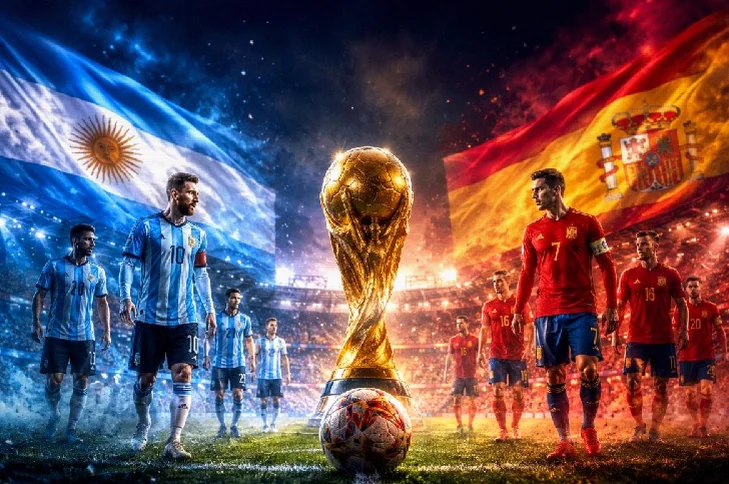
UEFA president Aleksander Ceferin stayed away from the World Cup final between Argentina and Spain as a protest against FIFA, despite traveling earlier for the tournament’s opening match in Mexico City.
Ceferin’s World Cup snub and UEFA’s protest
Ceferin, a Slovenian official, did attend the opening game between the co-hosts in Mexico City and South Africa. However, he chose not to make the trip to New Jersey for the final on Sunday, citing a chain of decisions taken by football’s governing body, FIFA.
Balogun suspension dispute and UEFA’s stance
One of the most significant triggers for Ceferin’s decision was UEFA’s reaction to the way Folarin Balogun escaped a suspension. UEFA said the outcome followed intervention from US President Donald Trump, a move UEFA viewed as undermining the disciplinary process.
UEFA had already criticised FIFA’s approach at the time, describing the decision as “unprecedented, incomprehensible and unjustifiable”.
In a statement, UEFA added: “When the certainty of rules is no longer guaranteed by its guardians, the integrity of the game is at stake and the credibility of a competition is undermined.”
Other FIFA-driven changes UEFA opposes
Ceferin is also strongly against a wider set of proposals associated with FIFA president Gianni Infantino, including alterations to match break formats. UEFA has made clear that these changes will not be introduced to either the Champions League or the European Championship.
- UEFA opposes Infantino-linked changes such as half-time entertainment, stating they will not be used in the Champions League or the European Championship.
- At the World Cup, the standard half-time interval of 15 minutes was stretched to 27 minutes and 22 seconds, with pop stars including Madonna, BTS, Shakira and Justin Bieber among the featured artists.
- UEFA is also against a proposed 64-team World Cup format, which Infantino appeared to leave open during the tournament.
Refereeing, ticket pricing and VAR identity rules
Beyond competition format and entertainment, UEFA’s concerns extend into officiating procedures and commercial decisions.
- After referee Omar Artan was denied entry to the United States before the tournament began, UEFA brought the Somali official in to referee the Super Cup between Paris St-Germain and Aston Villa on 12 August.
- High ticket prices have drawn criticism inside UEFA.
- UEFA plans to broadly freeze ticket prices for Euro 2028, meaning fans could be able to buy five tickets for what is described as the cost of a single parking space at a World Cup stadium in the United States this summer.
UEFA’s stance on enforcement and disciplinary standards has also carried into video assistant referee (VAR) guidance. BBC Sport reported on Friday that UEFA has instructed its VAR officials not to take account of diving under a new “mistaken identity” protocol, which FIFA used during the World Cup.
The impact of that approach was visible at the World Cup, where Switzerland striker Breel Embolo was sent off in the quarter-final defeat to Argentina.
- UEFA has told its VAR officials not to factor in diving under FIFA’s mistaken identity protocol.
- UEFA will not show red cards in its competitions for players who cover their mouths during confrontations with opponents.
“Covering mouths” controversy and red-card law changes
The topic of players covering their mouths became widely discussed in February, when Benfica winger Gianluca Prestianni raised his shirt while speaking to Real Madrid’s Vinicius Jr during a Champions League match.
The Argentina international was accused of racist abuse and was provisionally banned for one game. After a UEFA investigation, Prestianni was found guilty of homophobic conduct and given a six-match ban, with three of those matches suspended.
UEFA noted that the red-card law change underlying the broader debate was introduced at the initiative of FIFA president Infantino, who wanted an approach that would have “a deterrent effect” at the World Cup.
World Cup sending-offs: Almiron and Hincapie
There was also notable precedent at the World Cup for red cards in different stages of play. Paraguay’s Miguel Almiron was the first player dismissed in his team’s group match against Turkey. Arsenal defender Piero Hincapie followed with a red card in Ecuador’s last-16 elimination to co-hosts Mexico.