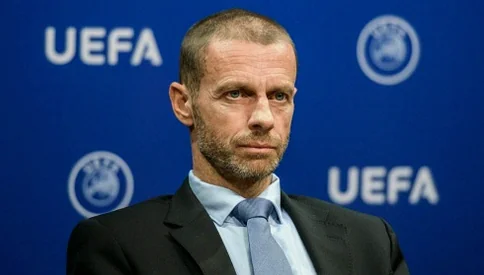
UEFA president Aleksander Ceferin stayed away from the World Cup final between Argentina and Spain as a form of protest against FIFA, a decision he linked to a chain of rulings he felt undermined the sport’s rulebook.
The Slovenian did make the trip to Mexico City for the opening match between tournament co-hosts Mexico and South Africa. However, he declined to travel to New Jersey for the final on Sunday after what UEFA described as a series of choices made by world football’s governing body.
Quick facts
- Ceferin attended the World Cup opener in Mexico City but did not go to the final in New Jersey.
- UEFA cited FIFA decisions as the reason, including a suspension escape involving Folarin Balogun.
- UEFA called FIFA’s approach “unprecedented, incomprehensible and unjustifiable.”
- UEFA opposes several FIFA-led proposals, including longer half-time entertainment and a 64-team World Cup.
- UEFA plans a broad freeze on Euro 2028 ticket prices.
- UEFA instructed VAR officials not to apply a “mistaken identity” diving protocol, tied to an Argentina quarter-final sending-off.
One of the decisive issues in Ceferin’s thinking was the case of United States forward Folarin Balogun, who avoided a suspension after an intervention involving US President Donald Trump. UEFA viewed that outcome as further evidence that the consistency of enforcement was being compromised.
UEFA had already reacted sharply at the time, denouncing FIFA’s call as “unprecedented, incomprehensible and unjustifiable.” In a statement, the federation warned that when the assurance of rules is no longer upheld by those tasked with guarding them, the integrity of competition is put at risk and credibility is weakened.
UEFA’s stance on FIFA changes
Ceferin is also opposed to multiple other adjustments that FIFA president Gianni Infantino has pushed, including expanded half-time entertainment. UEFA said those changes will not be introduced in either the Champions League or the European Championship.
At the World Cup, the pre-planned show featured major pop names including Madonna, BTS, Shakira and Justin Bieber. It also extended the traditional break from 15 minutes to 27 minutes and 22 seconds, a format UEFA is resisting elsewhere.
UEFA is similarly against Infantino’s apparent opening for a 64-team World Cup, which he floated during the tournament. The federation’s position underscores its broader reluctance to expand the calendar and dilute competitive structure.
Officials, tickets and VAR enforcement
Beyond event formats, UEFA cited match-administration disputes as well. After referee Omar Artan was turned away from the United States before the tournament began, UEFA arranged for the Somali official to referee the Super Cup between Paris St-Germain and Aston Villa on 12 August.
Ticket costs have also drawn internal criticism within UEFA. The federation plans to broadly freeze ticket prices for Euro 2028, a move described as allowing fans to purchase five tickets for the same price as a single parking space at a World Cup venue in the United States this summer.
On Friday, BBC Sport reported that UEFA has instructed its VAR officials not to consider diving under a mistaken identity protocol, which FIFA had applied during the World Cup. That approach was linked to Switzerland striker Breel Embolo being shown a red card during the quarter-final loss to Argentina.
UEFA also said players who cover their mouths during confrontations with opponents will not be flashed red cards in UEFA competitions.
The gesture drew major attention in February when Benfica winger Gianluca Prestianni lifted his shirt while speaking to Real Madrid’s Vinicius Jr in a Champions League match. Prestianni, an Argentina international, was accused of racist misconduct and initially received a provisional one-match ban.
After a UEFA review, he was found guilty of homophobic behavior and handed a six-match ban, with three of those fixtures suspended.
How the red-card law was shaped
UEFA’s concerns over enforcement tie back to a rule change FIFA president Infantino helped shape. He wanted a mechanism at the World Cup that would have “a deterrent effect,” framing the adjustment as a way to discourage misconduct.
Infantino’s reform has already influenced high-profile dismissals. Paraguay’s Miguel Almiron was the first player sent off in his group-stage match against Turkey. Arsenal defender Piero Hincapie followed with a red card in Ecuador’s last-16 defeat to co-hosts Mexico.