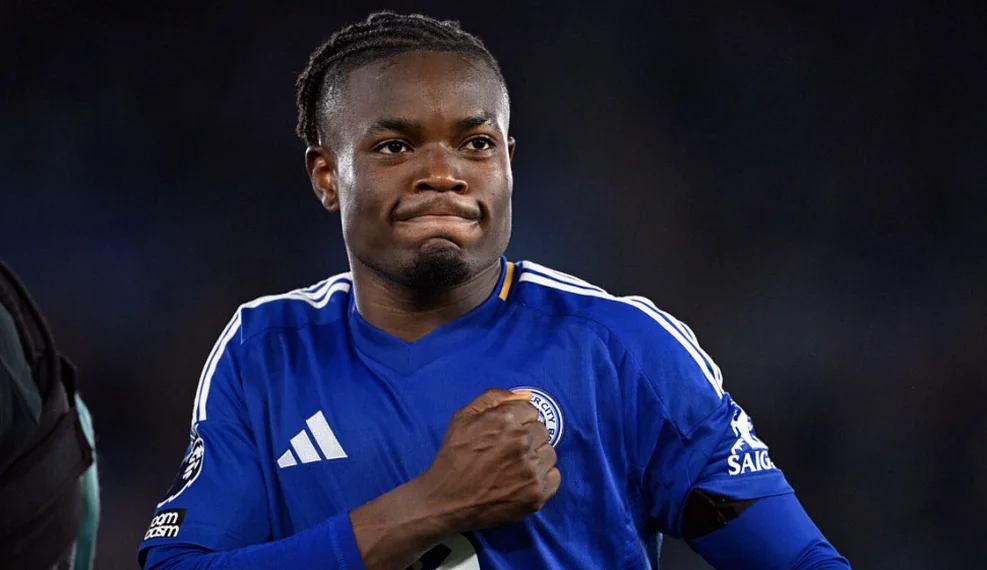
Ipswich Town have completed the signing of Ghana winger Abdul Fatawu from Leicester City on a deal running for five years, with the transfer fee kept undisclosed. The move marks a significant recruitment push for the newly promoted Premier League side as they prepare for life back in England’s top flight.
Fatawu arrived on the international stage during Ghana’s campaign at the 2022 World Cup in Qatar, where he was named in the squad and took part in all four of the team’s matches at the tournament in North America this past summer. The 22-year-old has earned 32 caps for Ghana and has scored three goals for his country.
His club journey has included a breakthrough period at Leicester. Fatawu joined the Foxes on loan from Sporting for the 2023-24 season, and he played an influential part in their Championship title-winning campaign. His performances earned him the club’s Young Player of the Year award.
After returning to league action, his time in the top tier was interrupted by injuries during the 2024-25 season, limiting him to 11 Premier League appearances. Despite that setback, he still produced a strong output in the Championship, finding the net nine times in 44 league matches as Leicester were relegated to the third tier.
Ipswich will begin their Premier League campaign with a trip to Sunderland on August 22, returning to the top flight after spending the previous season in the second tier.
Meanwhile, the debate over football’s global calendar and governance has intensified in Spain, where La Liga president Javier Tebas has called on FIFA president Gianni Infantino to resign. Tebas accused FIFA of “destroying the football industry” by pushing to grow international competitions while domestic leagues and clubs lose out.
Tebas has previously taken aim at FIFA’s approach to scheduling, including concerns about fixture congestion and plans to expand the World Cup further. In an interview with Italian newspaper La Gazzetta dello Sport, he was asked whether Infantino should step down and replied, “In my opinion, yes, I think his time is up.”
Infantino, for his part, said in April that he intends to seek re-election for a fourth term as FIFA president. The election for the 2027-2031 cycle is set for March 18 next year in Morocco. When Tebas was asked about the mounting criticism of Infantino’s leadership, he suggested the FIFA president still enjoys solid backing among national federations, even though there are worries within the sport.
“He shouldn’t stay, but the current state of affairs means he won’t leave,” Tebas said. He added: “There’s no opposition candidate; no one wants to run to lose. This is the system, and it’s a system that’s flawed from the ground up. I’ve heard a lot of people against Infantino, who don’t agree with what he’s doing. They say it, but then they don’t do anything.”
Tebas also questioned FIFA’s handling of discipline, specifically the decision to postpone a one-match ban imposed on United States striker Folarin Balogun after he received a red card during the World Cup. The ruling followed intervention involving U.S. President Donald Trump. Belgium defeated the United States 4-1 in the last 16.
Describing the suspension as a major issue, Tebas said: “The suspension of the American player’s ban is an extremely serious matter. They were lucky that Belgium eliminated the U.S., because otherwise a case could have arisen that might have cost Infantino his job. Since Belgium won, they managed to bury the matter. But these things are just the tip of the iceberg.”
His remarks come as tensions continue to simmer within soccer’s governing structures. UEFA president Aleksander Ceferin was reported to have missed Sunday’s World Cup final after a series of disagreements between European football’s governing body and FIFA over disciplinary processes, refereeing arrangements and match logistics.
Tebas’s criticism also extended to proposals to expand the men’s World Cup to 64 teams. He responded after CONMEBOL president Alejandro Dominguez renewed calls for FIFA to enlarge the centenary edition of the tournament in 2030. Infantino has previously acknowledged that a 64-team format could be considered in the future, but Tebas argued that any further increase in nations would be paid for by domestic competitions and the broader football industry.
“Increasing the number of national teams makes no sense,” Tebas said. He continued: “The football industry isn’t just the World Cup, which is the most important event. But not everything can revolve around the World Cup. It’s the national competitions that sustain this sport. They’re destroying the football industry, the one that generates tens of thousands of jobs for an event that lasts 40 days and only a minority of players attends.”