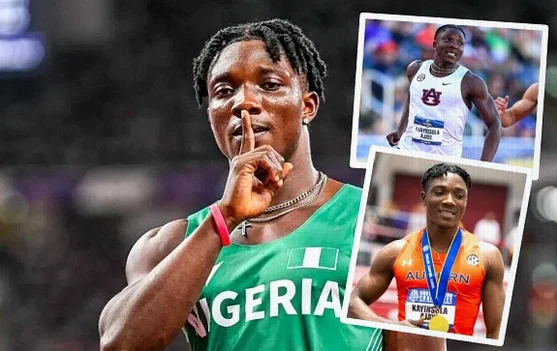
Nigeria’s Kanyinsola Ajayi has established himself as one of the most exciting young sprinters in world athletics after a breakthrough season that includes a Nigerian record, major victories and a Commonwealth Games bronze medal in Glasgow.
Key takeaways
- Ajayi ran 9.84 seconds to defeat world champion Oblique Seville at the Prefontaine Classic.
- The result gave the Nigerian a 3-1 head-to-head record against Seville during the season.
- He rose to 83rd in the overall World Athletics rankings and fifth among 100m runners.
- His Glasgow bronze made him the first Nigerian man in 20 years to win a Commonwealth Games medal in the blue-riband event.
- Ajayi says disciplined preparation, recovery and consistency have driven his rapid progress.
Ajayi emerges as a global sprint contender
Ajayi arrived at the Commonwealth Games in Glasgow carrying significant expectations after a highly consistent campaign. The Auburn University product had broken into the elite 100m scene and had already earned recognition at home as Nigeria’s fastest man, a distinction that is difficult to claim in a country with a proud sprinting tradition.
The Nigerian record-holder later produced a wind-assisted but legal 9.84 seconds, with a following wind of -0.7m/s, to finish ahead of Jamaica’s reigning world champion Oblique Seville, who crossed the line in 9.87 seconds at the Prefontaine Classic.
That performance was Ajayi’s third run below 9.85 seconds in the season and matched both his personal best and Nigeria’s national record. It also extended his advantage over Seville to three wins from four meetings in 2026, following earlier victories at the NCAA East Regional and the Prefontaine Classic.
His repeated high-level performances underline a progression from outstanding collegiate athlete to credible contender on the global stage. After the race, Ajayi kept his attention on the present, saying that he wanted to enjoy the process, remain focused and continue pursuing larger objectives as the season developed.
The result further strengthened his position as Nigeria’s leading sprint prospect and one of the most promising young athletes in world track and field. With the 2026 campaign still in progress, his ability to perform against elite Diamond League opposition has marked him out as a serious future medal candidate at major championships.
His rise has also added to the increasing depth of Nigerian sprinting, extending the country’s long association with world-class speed.
Earlier, on July 4, Ajayi had won the men’s 100m at the 2026 Prefontaine Classic in 9.84 seconds, with a legal tailwind of +0.1m/s, at Hayward Field in Eugene, Oregon.
Seville took second in 9.89, while United States Olympian Christian Coleman ran 9.95 to finish third. Coleman narrowly beat compatriot Kenneth Bednarek, who recorded 9.96, in the non-Diamond League meeting.
The victory was a major statement from the rising African star. He separated himself from a powerful field and followed up his recent triumph in the men’s 100m at the 2026 NCAA Outdoor Track and Field Championships in emphatic fashion.
Although Seville made a strong start, Ajayi gained ground during the acceleration phase, moved clear by the 30-metre point and maintained his advantage through the finish. His 9.84 was the second-fastest time in the world that season behind Seville’s 9.82.
Ajayi said his main satisfaction came from maintaining the standards he had set for himself. “I feel good because I have been consistent,” he said. “That was one of my aims: stay on top of things, come out here, execute my race and do what I needed to do.”
Seville was disappointed not to win but found encouragement in remaining fit. “It was not that bad,” the Jamaican said. “I know it was not my best race and I could have executed better, but I am happy that I am healthy.”
Bednarek, who had recently won the 100m at the 2026 LA Grand Prix, was less satisfied after being passed by Coleman for third place. He described his performance as “terrible” and said he was in much better condition than his race had shown.
The American said he lacked his usual acceleration and had made an error at the start. In a field of that quality, he added, athletes cannot afford such mistakes.
Ajayi’s results also produced a dramatic rise in the World Athletics standings. For the first time, he entered the top 100 of the men’s overall rankings, collecting 1,340 points during an impressive 2026 season to move to 83rd across all track and field events.
He climbed to fifth in the men’s 100m rankings, reinforcing his credentials as one of the fastest sprinters in the world ahead of the major international championships later in the year.
The Eugene victory played a major role in that progress. By matching the Nigerian 100m record with his 9.84, Ajayi earned the maximum performance score of 1,400 points under the World Athletics system, which considers both the quality of a performance and an athlete’s placing at recognised competitions.
His rapid ascent has not been based on one race alone. Ajayi won the NCAA indoor 60m title and the outdoor 100m championship before carrying that form onto the Diamond League circuit. Those achievements have enhanced Nigeria’s profile in international athletics and underlined the country’s sprinting strength ahead of future competitions.
“Consistency is the biggest thing for me,” Ajayi said. “If I keep running under 10 seconds, it shows that I am doing the right things and moving in the right direction.”
He also stressed that his progress has come from detailed preparation rather than speed alone. In his view, top-level sprinting is built away from the track as much as it is during competition, with recovery essential to maintaining performance across a long season.
“Recovery matters a lot,” he said. “Eating properly, resting well and following the right routines have made a big difference. I stay focused and trust the process.”
Glasgow medal inspires Ikorodu’s next generation
After securing bronze for Nigeria in the men’s 100m at the ongoing Commonwealth Games, Ajayi described the achievement as significant, particularly because it came in his first Commonwealth Games final. He expressed gratitude for how much he had accomplished in a relatively short period.
He also spoke warmly about his modest beginnings and the responsibility he feels as a possible source of hope for young people from small communities. Ajayi believes those early experiences helped shape both his career and his outlook.
The 21-year-old became the first Nigerian man in two decades to win a Commonwealth Games medal in the blue-riband event. He said he hoped his progress would encourage young athletes in Ikorodu and elsewhere in Nigeria to set ambitious goals.
“Your starting point does not decide what you can achieve,” Ajayi said after collecting his bronze medal in Glasgow on Wednesday. “You can do it.”
His message comes as Lagos increases its focus on developing sport at grassroots level. Under Director General Lekan Fatodu, the Lagos State Sports Commission has launched a broad reform programme centred on identifying talent, improving athlete welfare, developing local sport and building clearer routes from schools and communities to elite competition.
Lagos is also preparing to stage the inaugural National Intermediate Games. At the same time, the Commission is expanding access to facilities, creating talent hubs across the state’s five IBILE divisions and deepening cooperation with schools, parents and community clubs so that promising athletes can be found early and supported properly.
Ajayi’s development began before some of those initiatives were introduced, but his career illustrates the talent available in communities such as Ikorodu when young athletes receive the chance to train and compete.
The sprinter, whose achievements have regularly attracted public attention, said he takes great pride in representing the neighbourhood where he grew up.
“People often say, ‘Ikorodu to the world,’ and I am proud to be part of that,” he said. “It feels good to know that you are helping put Ikorodu on the map.”
Ajayi rejects the idea that an athlete’s birthplace should limit their ambitions. He said the belief that someone from Ikorodu cannot succeed is completely false.
In his view, discipline, self-belief, faith and a clear understanding of one’s goals can overcome those assumptions. “If you are disciplined, know what you are doing and trust yourself and God, things will work out,” he said. “It does not matter where you come from. You can do it.”
The bronze ended Nigeria’s lengthy wait for a men’s 100m medal at the Commonwealth Games and confirmed Ajayi’s standing among Africa’s fastest sprinters after a remarkable season.
Even so, he admitted that he had entered the Glasgow final with a loftier target: becoming the first Nigerian man to win Commonwealth Games gold in the 100m.
“I went into the race believing I could be the first Nigerian man to win gold,” Ajayi said. “I wanted it badly, but I am grateful that I came away with a medal.”
The achievement completed a memorable year in which he set the Nigerian record, equalled it twice and recorded consecutive Diamond League victories.
“I am on the right track and doing the right things,” he said. “I have been consistent, and consistency is part of being a good athlete.”
Despite his growing profile, Ajayi believes humility is essential. He said he returns to his ordinary routine after every race and does not consider himself superior to anyone.
“You have to remain humble,” he said. “You cannot allow success to get into your head.”
At 21, Ajayi insists that his career is still in its early stages. He plans to continue working, trusting his ability and maintaining his faith as he pursues the next stage of his development.