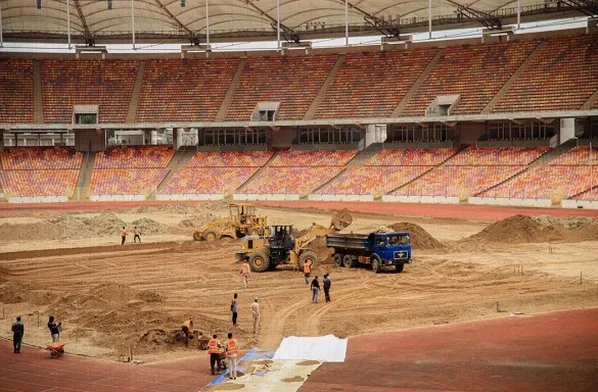
Nigeria’s Federal Government is moving to modernise the Moshood Abiola National Stadium in Abuja, with plans aimed at making the venue better equipped for major sports fixtures, entertainment programmes and commercial activity.
Key takeaways
- National Sports Commission chairman Shehu Dikko outlined the upgrade plans during a meeting with four federally owned media bodies on Tuesday.
- Work under consideration includes improvements to the pitch, floodlighting and other core stadium facilities.
- Authorities are assessing the possibility of adding a roof to strengthen the venue’s usability and visual appeal.
- The long-term objective is to turn the stadium into a revenue-generating sports and entertainment destination.
- The NSC wants private investors to play a greater role in developing and operating sporting infrastructure.
Stadium redevelopment plans
Dikko discussed the project while welcoming representatives of the News Agency of Nigeria, Nigeria Television Authority, Voice of Nigeria and the Federal Radio Corporation of Nigeria at the commission’s Abuja offices.
He said current and future projects form part of a wider drive to restore the Moshood Abiola National Stadium’s standing as a top-level venue capable of staging major sporting tournaments as well as non-sporting occasions.
The commission is seeking to improve several parts of the complex, including the natural turf, lighting system and other vital infrastructure. Dikko said officials were also looking at whether the stadium could be roofed, a move intended to improve both its presentation and its capacity to accommodate a wider range of events.
He said the proposed work would increase the facility’s appeal for athletes, sporting officials, event organisers and private-sector backers.
The NSC is examining options for converting the stadium into a multi-use sports and entertainment hub able to earn income on days when no matches are taking place.
“We want the stadium to be active, not only when football matches are being played but also for other events and commercial activities,” Dikko said.
“The plan is to develop the stadium into a vibrant sports complex with complementary facilities, including hospitality, commercial and conference services.”
He added that the commission was pursuing an approach that would bring private investment into both the construction and management of sports facilities.
Dikko said such a framework would lessen reliance on public funding for maintenance while opening up jobs and business opportunities. He stressed that sporting venues must be regarded as national assets that can produce economic returns when maintained properly and operated on commercial lines.
Media partnership and sports economy
The NSC chairman also underlined the media’s role in advancing sport, drawing investors and promoting Nigeria’s achievements across different disciplines.
He called for closer cooperation between the commission and the government-owned media organisations, saying stronger partnerships would improve reporting of sport and raise public awareness of the reforms now being pursued.
“The commission is committed to developing grassroots sports, expanding opportunities for young athletes and strengthening Nigeria’s capacity to compete internationally,” he said.
“A stronger sports economy would create direct and indirect employment opportunities across several sectors, including broadcasting, tourism, hospitality and commerce.
“We will continue to engage relevant stakeholders to ensure that sports facilities across the country were properly developed, maintained and utilised.
“I urge the media organisations to work closely with the commission in communicating its programmes and projects to Nigerians.”
The meeting gave the NSC and the four media organisations an opportunity to discuss joint media work and measures that could support sports development and investment across Nigeria.