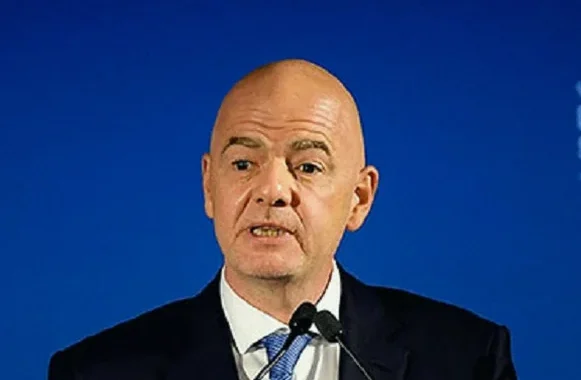
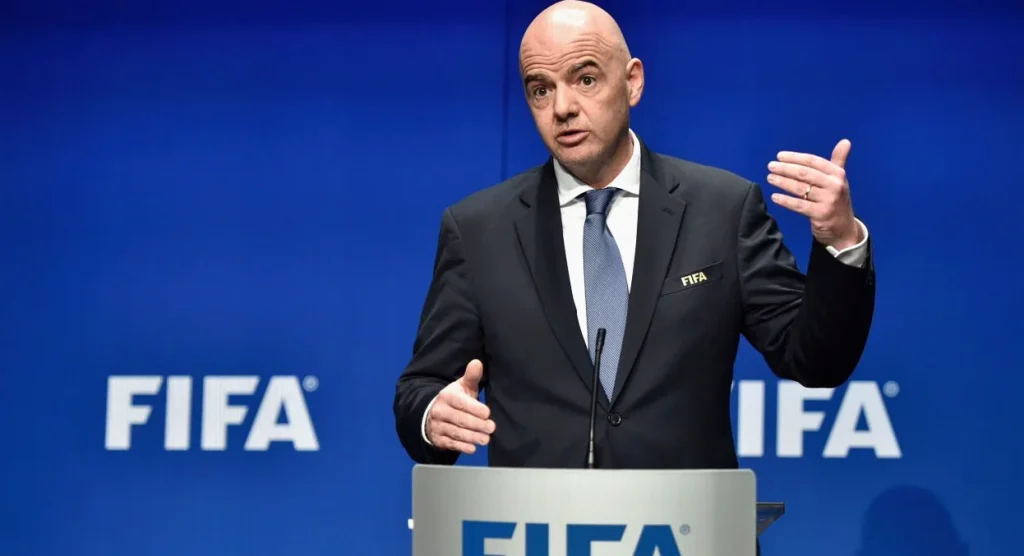
FIFA president Gianni Infantino faced fresh criticism on Monday after UEFA, CONCACAF and the AFC issued a joint statement insisting that football is not owned by any one person.
Infantino has been subjected to sharp attacks since he unveiled a proposal to attract private funding for FIFA competitions, including the World Cup, before abandoning the idea just days later.
On Saturday, FIFA responded by condemning what it called a coordinated, continuing attempt by certain parties to weaken both the organisation and its president.
Monday’s message from the authorities representing European football, North and Central America, and Asia demonstrated that the opposition to Infantino’s approach remains firm.
“Authority in football is not something anyone can own,” the confederations said. “It is not defined by acquiring power or insisting that power must remain in one’s hands.”
They continued: “If trust is destroyed by misleading conduct, and a person puts himself ahead of the collective that gave him responsibility, he has deserted that responsibility.”
The three bodies had already spoken out forcefully against Infantino’s investment proposal and continued their criticism even after the plan was withdrawn.
CONCACAF president Victor Montagliani is regarded as a possible rival to Infantino, who intends to pursue a fourth and final term in the FIFA presidential election in Rabat next March.
The deadline for candidates to formally enter the race is November 18.
UEFA’s warning that it could stay away from future World Cups if the investment scheme proceeded was decisive in Infantino’s decision to drop it. Such a boycott could theoretically have kept teams including reigning men’s champions Spain, as well as 2026 semi-finalists France and England, out of the tournament.
Before the controversy erupted, Infantino had appeared set to face no opposition after presiding over a successful World Cup staged in the United States, Mexico and Canada.
The 56-year-old Swiss has held office for 10 years. He has CAF’s support, while CONMEBOL in South America is generally on his side.
However, the confederations do not vote as unified blocs. Infantino has also received backing from figures within CONCACAF and Mexico, along with two AFC members: Kuwait and Qatar, hosts of the 2022 World Cup, where the FIFA president owns a house.
More than a week after the proposal was effectively abandoned — and despite UEFA describing it as an underhanded and non-transparent arrangement — the confederations accused Infantino of poor judgment. “FIFA’s latest message to its vice-presidents and 211 member associations admits that errors occurred during the process,” they wrote. “It presents the episode as a communications problem, whereas football saw a failure of judgment.”
Infantino convened an emergency gathering in Morocco last week and obtained the “full support” of FIFA’s senior directors, but the confederations dismissed the significance of that endorsement.
“The latest gathering involved only a chosen group from the FIFA Management Committee, rather than the entire committee, and they were called overseas,” the confederations said. “Instead of travelling to Zurich to engage with FIFA’s staff, the organisation’s core, the leadership took another course. That only deepens our concerns and repeats the behaviour that led to the present situation.”
“This is not how a guardian of the sport acts; it is how someone acts when he believes the sport must answer to him.”
Infantino had been enjoying the praise that followed an exceptionally successful World Cup, the biggest edition in history with 48 participating teams.
Yet the confederations stressed that the tournament’s success could not be credited to Infantino alone.
“The game has genuinely expanded during the last 10 years,” they said. “But that development was not created by one person.”
“It came through the combined efforts of FIFA, the confederations, the member associations and the thousands of people who devote their working lives to football.”
“Larger competitions, the decisions to award the 2030 and 2034 World Cups, and the allocation of funding to associations were collective successes. They were approved jointly and carried out jointly.”
The statement concluded with the claim that Infantino’s tenure had produced “silence where accountability is required, and separation where transparency should exist”.
“That is the reason for our position,” they added. “We have taken it deliberately, together rather than individually, and because we have a responsibility to the sport we represent. Football has always drawn its power from unity.”