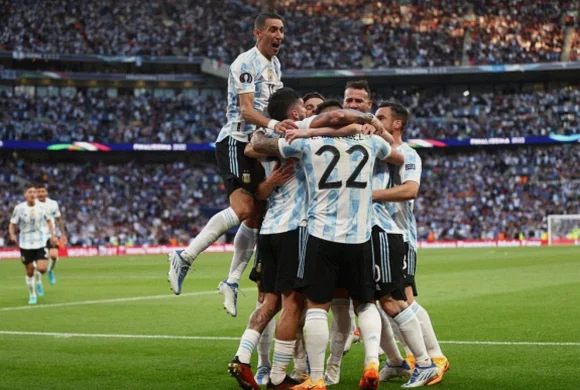
The FIFA World Cup has never been just a tournament on the calendar. It is the sport’s biggest shared celebration, uniting countries, cultures and generations through one common love of football. Since the competition first began in Uruguay in 1930, it has crowned unforgettable champions, launched iconic careers and delivered moments that have helped define the modern game.
Key takeaways
- The 2026 World Cup is being staged jointly by the United States, Canada and Mexico.
- The finals will include 48 teams, marking the first time the tournament has expanded beyond the traditional 32.
- Argentina will play Spain in the final on Sunday, 19 July, at MetLife Stadium in New Jersey.
- Argentina reached the showpiece with a late 2-1 comeback against England, while Spain earned their place via a 2-0 victory over France.
- England and France will contest the third-place play-off in Miami Gardens on Saturday.
- Morocco advanced to the quarter-finals after beating Canada 3-0, though their run ended against France.
Final line-up after a dramatic run
With the semi-finals completed, the World Cup final is now set. Defending champions Argentina will face Spain on Sunday, 19 July, at MetLife Stadium in New Jersey.
Argentina secured their place in the final through a tense 2-1 turnaround against England. The decisive theme was timing: the team scored twice late on to overturn the match and book a spot in the final.
Spain, meanwhile, reached their first World Cup final since lifting the trophy in 2010. They did it in emphatic fashion, beating France 2-0 in a match described as comprehensive.
Elsewhere, the third-place match is also confirmed. England and France will meet in Saturday’s play-off in Miami Gardens.
Format expansion, Morocco’s rise and the VAR debate
Beyond the headline results, the knockout phase lived up to the World Cup’s reputation for high-stakes football. Each match carried major consequences, with contrasting tactical plans, late surges and standout individual moments all playing their part in deciding which nations moved forward.
One of the standout storylines has been Morocco. The Atlas Lions again underlined the upward trajectory of African football by defeating Canada 3-0 before reaching the quarter-finals. Their campaign ultimately ended against France, but Morocco’s performance reinforced the idea that teams from the continent can consistently challenge the established powers at the highest level.
Yet, for all the quality on the pitch, the tournament has also been shaped by intense discussion around officiating and the Video Assistant Referee (VAR) system.
The most contentious game came in the Round of 16 clash between Argentina and Egypt. Egypt looked set to pull off one of the biggest shocks in World Cup history after taking control early and building a lead, only for Argentina to respond with a dramatic late comeback to win 3-2.
The controversy escalated after Egypt had a goal overturned following a VAR review. There were also rejected calls for a late penalty linked to Mohamed Salah. In response to the officiating, the Egyptian Football Association filed an official complaint with FIFA, arguing that several key refereeing decisions had a meaningful impact on the result.
FIFA, however, defended the decision-making process and the independence of the match officials, stating that the VAR interventions were in line with the Laws of the Game.
That match has since become one of the tournament’s defining talking points, bringing renewed focus to a long-running global argument: whether technology improves football or simply shifts the source of controversy from the referee’s whistle to the VAR screen. While some analysts believe VAR corrected clear errors during the competition, critics maintain that uneven interpretations continue to frustrate players, coaches and supporters.
Africa’s bigger stage and the continent’s World Cup progress
Even amid the officiating debate, the standard of football across the expanded tournament has remained exceptionally high.
The enlarged format has been especially significant for Africa. In earlier decades, the continent had just one representative at the finals, but it now benefits from nine automatic qualification places. There is also the possibility of an extra slot through inter-confederation play-offs—an increase that reflects the growth of African football and its expanding influence on the global stage.
Africa’s World Cup story has been one of resilience and steady progress. Egypt became the first African nation to take part in the tournament in 1934. Cameroon captured worldwide attention by reaching the quarter-finals in Italy in 1990, and Senegal later repeated that achievement in 2002. Ghana came close to making history by being only a penalty kick away from becoming Africa’s first semi-finalist at the World Cup in South Africa in 2010.