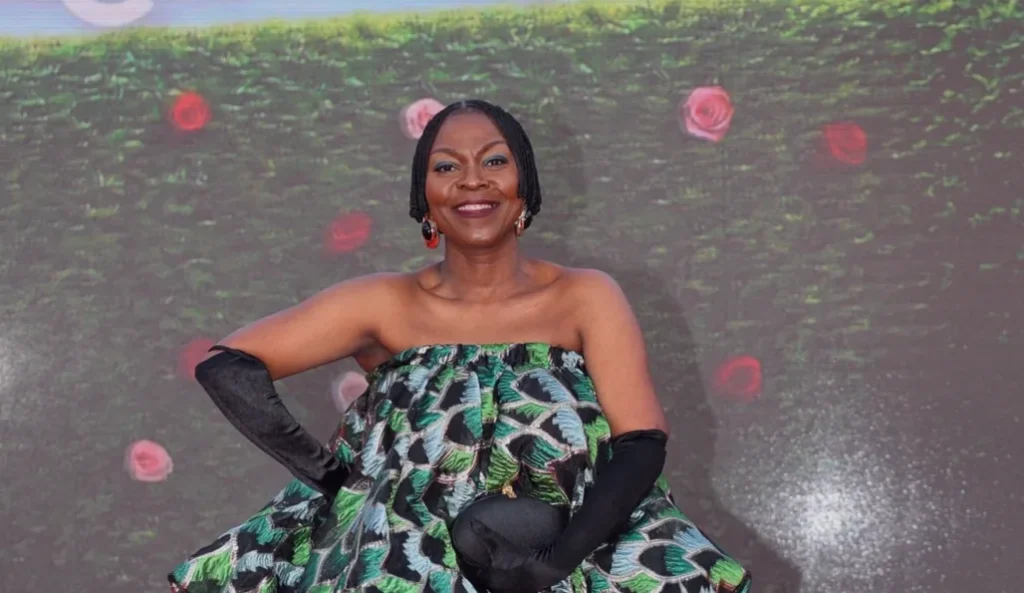
There was a time when 8 p.m. really meant 8 p.m. in South Africa, and families across the country gathered around the television for Generations. Viewers held on to two shared convictions: that one day they might build Moroka-level wealth, and that Sthandiwe Kgoroge had a real-life twin.
Between 1999 and 2005, Kgoroge portrayed both Zinzi and Zoleka Mudau on the SABC1 soap opera. Her performances were so persuasive that much of the country was convinced it was watching two different women.
She laughs when asked, partly in jest, where her “twin” might be now. We meet at Olives & Plates in Hyde Park, where she has arrived ahead of time and is greeted by a waiter who instantly recognises her.
Also read: From engineering ambitions to Springbok success — the story of Sibusiso Kotelo.
As she puts the waiter at ease with friendliness rather than celebrity distance, one thing becomes clear: Kgoroge is an icon, but she has never lost sight of being a person before being a star.
Still Here, Still Curious
Over 20 years after Zinzi and Zoleka turned her into a household name, Kgoroge says she is enjoying a particularly busy period. In 2026 alone, she is balancing the arrival of Dear Sis’ Dolly with a range of other projects.
That sort of staying power is something many performers pursue but relatively few maintain. Kgoroge has spent time considering the qualities that have helped her career endure.
“What you put into the world is what you draw back,” she says. “I remain curious, and I still want to grow. The more curious and thankful I am, the more opportunities continue to arrive.” She consciously guards that outlook, determined not to allow an accomplished career to become an excuse for complacency.
“I don’t believe I’ve reached the end, because once you do, your life starts telling you that everything is finished and there is nowhere more to go.”
For Kgoroge, that drive is closely tied to appreciation. Even after decades in the business, she approaches each new opportunity as something valuable rather than guaranteed.
“I never assumed I would get this interview,” she says. “I thought, wow, somebody wants to hear from me. Somebody values my thoughts.”
When asked to define herself, Kgoroge says being an actor is only one part of her identity. Away from the screen, she has directed, curated exhibitions, shaped editorial ideas — including the award-winning Black is Love feature for Media24 — and collaborated directly with South African artisans on beadwork and textiles.
“As a creative person or artist, I think you carry many different sides of yourself,” she says. She applies that belief to the wider country, too. “South Africans are incredibly gifted. Our creativity does not come in just one form. If someone cannot sing, perhaps they can draw; if drawing is not their strength, they may paint.”
In her view, the problem is not a shortage of ability but a lack of systems to support it. “If our industry worked like America’s, we would be doing exceptionally well, because the talent is already here, even when it is still unpolished.”
The same desire for movement and progress informs her views on representation, especially the way Black women are depicted on screen. She speaks openly about the shortage of influence behind the camera.
“We need more Black women directing,” she says. She also wants more of them working as producers with meaningful control of budgets and casting, helping to ensure Black female characters are not reduced to a single trait.
“Rather than showing us as these angry, one-dimensional Black women,” she begins, her thought fading briefly with the frustration of someone who has made the argument before and plans to continue making it.
She is just as adamant that South Africa does not require Hollywood’s approval before it can have worldwide significance.
“We have already entered the global arena. We have been there for some time,” she says, referring to the international attention attracted by South African productions. Her message to an industry still focused on looking overseas is straightforward: it should stop waiting for outsiders to validate it.
“The rest of the world will find its way to us.”
That desire to defend local work and present it with honesty also helped draw her to Dear Sis’ Dolly. Playing MM, the editor of Drum, Kgoroge approached the character not as a stereotypical boss, but as someone responsible for protecting an important inheritance.
“My first sense of her was that she protects a legacy. She keeps the records,” Kgoroge says. “She is deeply devoted to what Drum represents.”
Traits that might easily have been interpreted as harshness were instead grounded in care: MM is safeguarding a standard created over many years, rather than using authority simply to exclude others.
“She isn’t using her influence to play games just because she has it.”
Ultimately, the part suits a performer who has spent her own career communicating a similar idea: Black stories, when treated thoughtfully, have always possessed the power to connect with audiences.
Twenty-six years after Zinzi and Zoleka first entered South African homes, Kgoroge continues to find fresh ways to demonstrate that truth. Whether she is inhabiting a character or expressing herself through another creative discipline, she remains captivating to watch.
Also read: “Don’t let the world harden you” — Didintle Khonou discusses mental health, Sis Dolly’s legacy and the emotional price of caring.