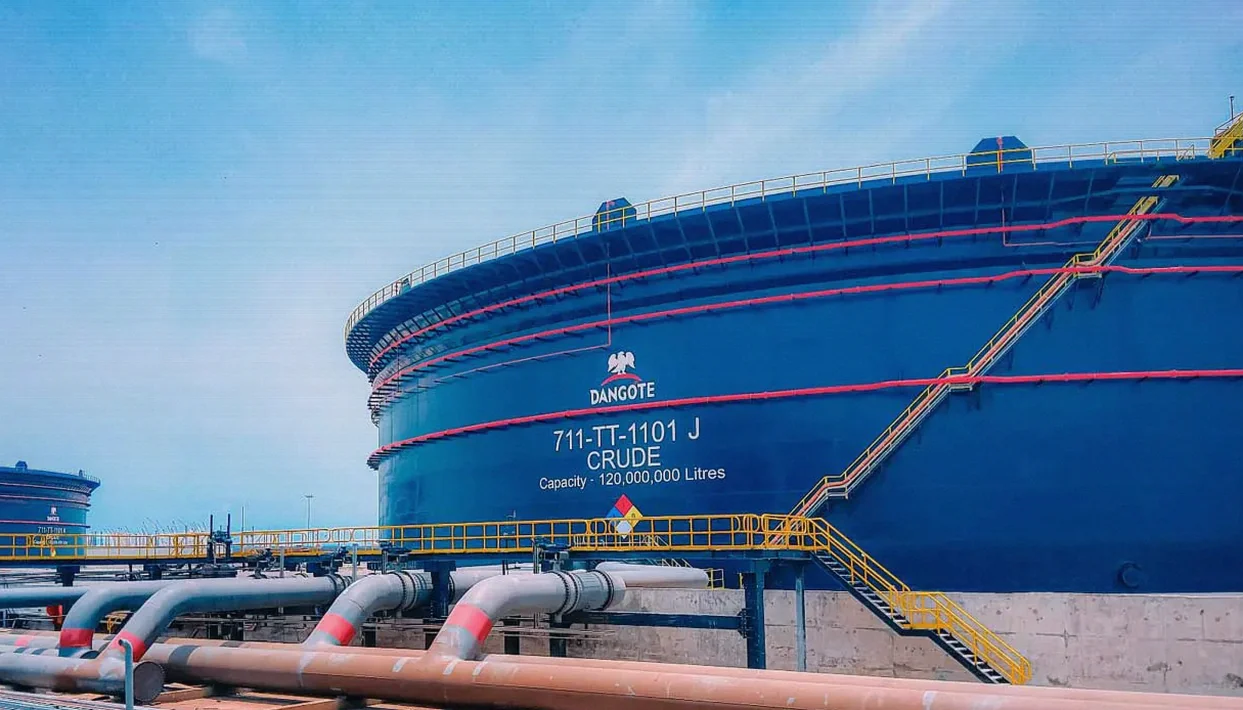
Dangote Petroleum Refinery & Petrochemicals is helping insulate Nigeria’s fuel market from swings in global gasoline prices, keeping domestic prices within a commercially workable band even as international costs climb. The pressure on importers across West Africa is rising alongside higher freight expenses and tighter worldwide product availability—factors that are generally pushing up the landed cost of fuel into the region.
Traders servicing Nigeria have grown more uneasy as spot international gasoline prices have surged. They point to a combination of stronger global product valuations and increases in shipping charges, both of which raise the price importers must pay to replace cargoes. With logistics costs moving higher and supply conditions tightening, the margin for selling fuel into Nigeria has narrowed.
A key point raised by market participants is that gasoline pricing in Nigeria is effectively constrained by Dangote’s own pricing. In practice, this limits how much importers can pass through higher international costs to domestic buyers, despite the upward move in global benchmarks.
One trader said that while gasoline meeting Ghana’s specifications is currently priced with larger premiums, cargoes for Nigeria’s specifications remain harder to clear. The reason, the trader suggested, is that Dangote’s coastal sales pricing has not been adjusted upward despite mounting external price pressure.
“Lomé values have risen above Dangote sales prices, which has shut the arbitrage,” the trader said, describing how the gap between regional replacement costs and Dangote’s posted prices has made importing into Nigeria increasingly unattractive under current market conditions.
The development is unfolding as global freight rates jump. Transporting clean petroleum products from Northwest Europe to West Africa has become more expensive: costs have climbed from US$29.70 per metric tonne at the end of June to US$37.12 per metric tonne, market data shows, as vessels shift to serve alternative routes and demand patterns.
At the same time, diesel markets have tightened after reduced availability of Russian Black Sea cargoes. That has pushed up prices for high-sulphur gasoil across West Africa, adding further to the all-in cost facing fuel importers.
Against these external headwinds, Dangote Petroleum Refinery has continued a strategy of gradual domestic price moderation. Since the end of May, the refinery has lowered the ex-depot price of Premium Motor Spirit (PMS) by more than N200 per litre, reduced Automotive Gas Oil (AGO) by N300 per litre, and cut Jet A1 aviation fuel by N520 per litre.
These reductions have taken place even as the refinery processed crude purchased when international crude prices were substantially higher than today’s levels. The company has repeatedly said that domestic petroleum product pricing is linked to the real costs of crude procurement rather than day-to-day moves in the Brent benchmark.
Its explanation is that crude supplies are typically bought weeks or months before refining, under commercial arrangements tied to monthly average pricing mechanisms—meaning the pricing impact of global oil moves does not necessarily show up immediately at the pump.
Industry analysts say the most recent market picture reinforces the strategic value of Nigeria’s domestic refining capacity. With international product prices rising and freight costs increasing—and with regional hubs such as Lomé reflecting gasoline prices above Dangote’s offerings—Nigeria’s reliance on imports would likely have resulted in materially higher pump prices if the refinery were not operating at scale.
The latest assessment also points to Dangote Refinery’s expanding influence over petroleum pricing across West Africa. Market participants increasingly treat its pricing as the regional reference point, and importers often struggle to compete when the price to replace cargoes internationally exceeds what Dangote sells at domestically.
Analysts say the situation illustrates a central rationale behind the refinery’s 700,000-barrel-per-day capacity: to reduce Nigeria’s exposure to global disruptions, lower dependence on imported fuel, preserve foreign exchange, and deliver steadier prices for consumers and businesses.
As geopolitical tensions, tighter product supply and higher shipping costs continue to reshape global fuel markets, Dangote Petroleum Refinery is increasingly positioned not just as Nigeria’s main outlet for refined products, but also as a stabilising force for energy pricing dynamics across West Africa.