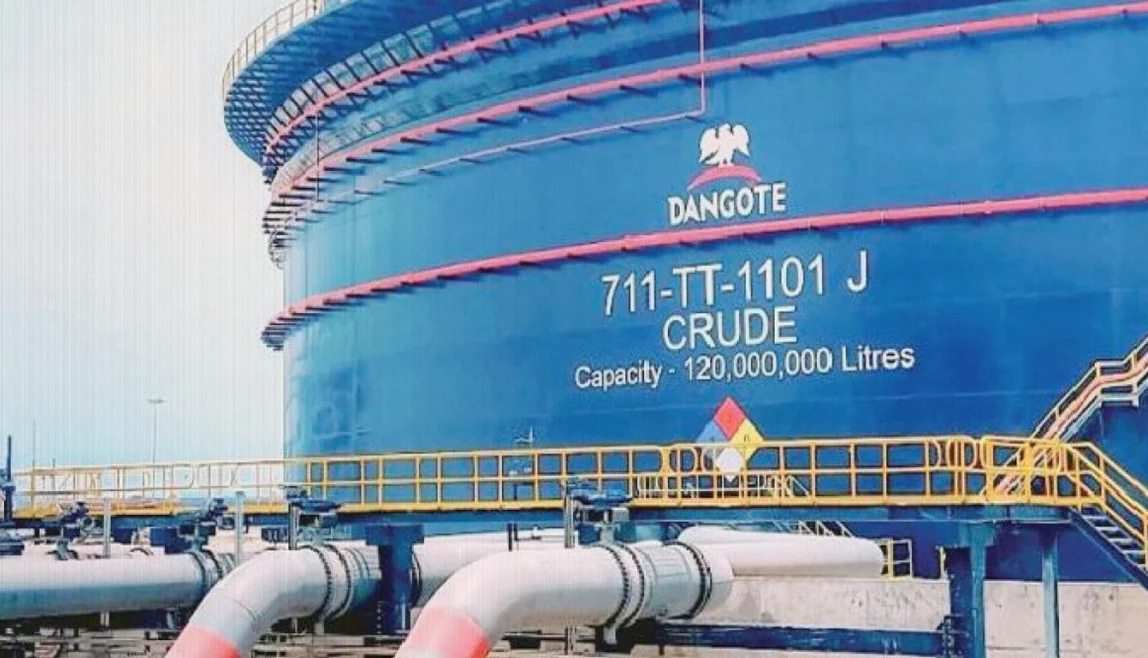
Nigeria’s 650,000-barrel-per-day Dangote Petroleum Refinery & Petrochemicals is starting to change the economics of the country’s downstream oil business, cutting reliance on imported refined products while improving the trade balance and bolstering foreign-exchange prospects, an assessment of the fuel market and regulatory landscape says. As the refinery moves toward full output, it is also colliding with vested interests tied to the older import-led model—setting up a policy and legal standoff that could shape Nigeria’s energy security and industrial strategy for years.
Key takeaways
- The Dangote refinery’s ramp-up is already meeting close to four-fifths of Nigeria’s domestic petrol needs, with April output reported as covering about 80% of demand.
- Before the refinery’s rise, Nigeria relied heavily on imported fuel despite producing roughly 1.5 million barrels of crude oil per day.
- Lower import requirements and higher refined-product exports are expected to strengthen Nigeria’s balance of payments.
- Legal and regulatory friction has surfaced as authorities eased petrol import constraints while the refinery’s capacity continues to expand.
- Analysts say wider domestic refining capacity is improving energy security and reducing exposure to external supply shocks and foreign-exchange volatility.
How Dangote’s operations are reshaping Nigeria’s fuel market
The report describes the refinery’s performance as a structural shift for Nigeria’s downstream sector, which it characterises as having been “long dysfunctional.” The country has been an important crude producer, but its refining base has struggled to operate effectively for years, leaving consumers and businesses dependent on imported petroleum products that tend to be costly and expose the economy to external price swings.
In its latest view of Nigeria’s fuel market and the rules governing it, the assessment says the refinery has already altered supply conditions. It notes that in April the plant met nearly 80% of domestic petrol demand, and that production was sufficient to cover local consumption as the business moved toward full operating capacity.
More broadly, the report argues that the refinery is reducing import dependence, improving the availability of refined fuels inside Nigeria, and supporting foreign-exchange performance. It links these gains to both reduced purchases of imported products and an increase in exports of refined petroleum, which together can lower pressure on external accounts.
The research notes that the refinery’s gradual scale-up—starting from May 2023—has been central to the change. It says Nigeria’s main refineries, which are state-owned, had been offline for years, making import dependence the default route for refined supply. Against that backdrop, the arrival of Dangote’s throughput has shifted the downstream system toward domestic production.
Capacity expansion, export outlook and the policy fight over imports
The assessment further points to the medium-term upside from reaching full capacity and expanding output. It says the completion of full operating levels at the Dangote refinery, along with plans to increase scale, is expected to support economic growth and foreign-exchange earnings over the coming years.
It adds that full-capacity operations and higher export volumes should help underpin real gross domestic product growth and foreign-exchange generation in 2026 and 2027 and beyond. This expectation is tied to a planned doubling of the plant’s output, with the report indicating that the additional capacity is scheduled to come online around the end of the decade.
Industry analysts view the refinery not just as a domestic supply project but as an emerging refining and export hub for Africa. They argue that this role can change energy trade patterns across the continent and reduce the risk that countries face when they must buy refined fuels from abroad—especially during periods of disruption or currency stress.
The refinery’s expansion is also occurring alongside major downstream reforms in Nigeria, including the removal of fuel subsidies and the move toward market-based pricing. However, the transition has triggered pushback from groups linked to the previous import-heavy arrangement, the report says.
One of the latest flashpoints followed a decision by the Nigerian Midstream and Downstream Petroleum Regulatory Authority to loosen restrictions on petrol imports, even as the refinery’s capacity was rising to cover domestic requirements. Dangote Industries then moved to court, arguing that continued import approvals erode the rationale for domestic refining investment and run counter to goals set out in the Petroleum Industry Act—specifically the encouragement of local refining capacity and the reduction of import dependence.
Analysts say the growing presence of large-scale domestic refining capacity is strengthening Nigeria’s energy security. They argue it also reduces vulnerability to external supply disruptions and moderates exposure to foreign-exchange fluctuations.
At the same time, the Centre for the Promotion of Private Enterprise warned against letting petrol imports expand without firm constraints. It cautioned that unrestrained importation could weaken Nigeria’s push toward industrialisation and discourage investment in domestic refining. In remarks attributed to the organisation’s chief executive officer, Muda Yusuf, the centre said historical reliance on imported fuel has contributed to pressure on foreign reserves, exchange-rate instability and fiscal leakages.
Credit implications and Africa-wide demand pressures
The refinery’s influence is also showing up in Nigeria’s wider macroeconomic narrative. Earlier this month, S&P Global Ratings cited increased domestic refining capacity and rising hydrocarbon exports among the factors supporting an upgrade to Nigeria’s sovereign credit rating—its first improvement in 14 years.
Looking beyond Nigeria, analysts say the Dangote facility is increasingly treated as a strategic industrial asset for Africa. They point to a regional challenge: many countries still depend heavily on imported fuel even as demand rises for transportation, manufacturing and power generation.