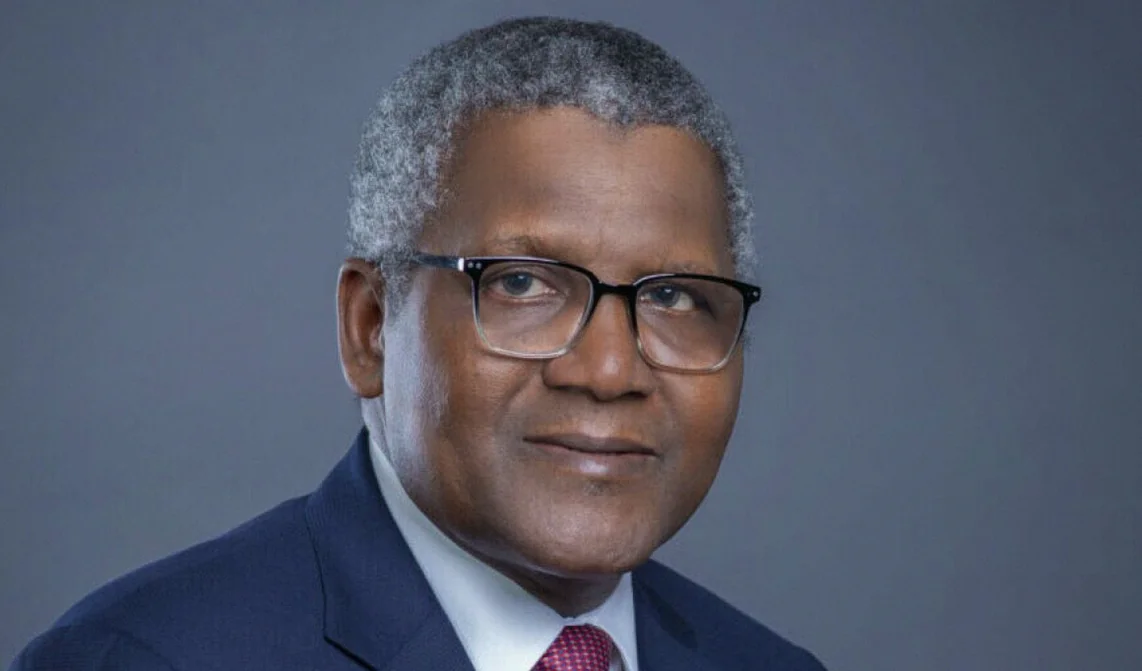
Aliko Dangote, the president of Dangote Group and Africa’s wealthiest person, has been named the African Energy Person of 2026, a recognition announced by the African Energy Chamber in a statement on Monday. The award highlights individuals who have helped move the continent’s energy agenda forward by enabling projects that improve energy security, support African development and energy capacity growth, advance freer markets with limited government involvement, and build economic resilience—benefiting households through local content and better energy infrastructure. The chamber pointed to a history of recipients that includes Frank Fannon, a former U.S. Assistant Secretary of State for Energy Resources; Mohammad Sanusi Barkindo, a former OPEC Secretary General; Hage Geingob, the former President of Namibia; Meg O’Neill, CEO of Woodside Energy; Benedict Oramah of the African Export-Import Bank; and João Lourenço, President of Angola.
In Monday’s announcement, the African Energy Chamber said it presented the 2026 prize to Dangote for his investments across the continent. The chamber described the Nigerian industrialist as a fitting choice, citing billions put into efforts meant to reinforce energy security, build infrastructure, create jobs, reduce reliance on imported fuels, and support regional development while championing African-led approaches to energy poverty. The award also frames Dangote’s work within a broader push for energy systems that can withstand shocks and translate industrial growth into wider economic gains.
A career built around expanding Africa’s economic base
Before entering heavy industry, Dangote studied business at Al-Azhar University in Cairo and later moved into multiple sectors, including cement, sugar, salt, flour, and fertilizer. Starting from a trading business, he has expanded into one of Africa’s largest conglomerates, Dangote Group, which the chamber describes as a multinational industrial platform developing local technical expertise, strengthening domestic supply chains, and expanding industrial capacity. The strategy, the statement argues, has helped open new pathways for economic diversification.
The chamber also emphasized Dangote’s long-standing focus on one of Africa’s structural economic challenges: the continent’s tendency to export raw materials while importing finished goods. Dangote’s stated mission has been to address that imbalance by building manufacturing scale, logistics capabilities, energy infrastructure, systems for processing raw inputs, and transport networks designed to keep more production and value creation within Africa.
Under Dangote’s leadership, the group is portrayed as among the most ambitious industrial conglomerates built on the continent, with its distinguishing feature being less about trading or extraction and more about investing directly in physical infrastructure that supports industrialization across Africa. The narrative turns to hydrocarbons as the key chapter in that shift, particularly through the company’s push into refining.
A refinery that reshapes fuel security and regional supply
In recent years, Dangote’s profile has risen globally with the Dangote Refinery in Lekki, near Lagos, Nigeria. The project is described as one of the world’s biggest refineries and the largest single-train facility, with planned refining capacity of roughly 650,000 barrels per day. The complex also includes petrochemical operations and fertilizer facilities, producing gasoline, diesel, aviation fuel, and other refined products at a scale intended to alter both regional and international fuel markets.
Supporters of the refinery argue it is not merely an industrial asset but a broader macroeconomic shift for Nigeria and a step-change in African energy security. For years, Nigeria’s dependence on imported refined products contributed to recurring fuel shortages, increased pressure from fuel subsidies, foreign exchange strain, and incentives for corruption linked to import channels and arbitrage networks. The refinery, the chamber suggests, has redirected that trajectory by enabling domestic refining at an unprecedented scale while supporting Nigeria’s energy sovereignty.
In a period marked by global energy volatility, the refinery is cited as a reason African economies have been able to remain resilient against outside fuel shocks. Beyond Nigeria, the project is framed as evidence that Africa can build and operate infrastructure at world scale—an important message as geopolitical risks continue to affect shipping and supply chains. With tensions involving Iran and uncertainty around the Strait of Hormuz continuing to pose threats to global transport routes, the refinery is described as a stabilizing force for Nigerian and international energy markets, helping cover gaps as disruptions intensify.
The statement says refined products from the Dangote facility are already reaching multiple markets across Africa, including Ghana, Cameroon, and Côte d’Ivoire. It adds that the refinery has begun supplying fuel products to the United Kingdom, Europe, and the United States, and that a first major gasoline shipment to Asia is expected in June 2026.
The chamber noted that many observers previously doubted the project would be completed, pointing to skepticism from international quarters alongside issues such as financing constraints, infrastructure bottlenecks, technical complexity, political uncertainty, and currency fluctuations. Despite those challenges, it said the project was carried through to completion, and today stands as a symbol of African industrial ambition and confidence.
The economic impact is also highlighted with reference to S&P Global Ratings, which the statement says points to a significant rise in Nigeria’s refining capacity driven by the Dangote Refinery. By lowering the country’s need to import refined fuel, the refinery is credited with contributing to an increase in Nigeria’s gross foreign exchange reserves from $33 billion in 2023 to $50 billion by early March 2026.
But the account stresses that expansion plans are ongoing. Feasibility work in early 2026 is said to have indicated interest in raising capacity to 1.4 million barrels per day. If realized, the chamber suggests the move could place Nigeria among the world’s largest refining hubs by the end of the decade, potentially putting it in a position to rival major refining centers in India and parts of Asia by 2027 or 2028.
At the same time, Dangote Group is expanding fuel storage and logistics infrastructure beyond Nigeria’s borders, with planned new storage tank projects in Namibia and the potential for a second refinery in East Africa. The statement argues that these efforts are expected to strengthen regional industrialization, improve supply reliability, and deepen energy integration across the continent.
Philanthropy and development alongside industrial expansion
The chamber adds that Dangote’s influence extends beyond business outcomes. It describes him as committed to supporting Nigeria and improving the lives of Nigerians through philanthropic work, including leadership of the Aliko Dangote Foundation (ADF). The foundation supports health initiatives, education, disaster relief, poverty reduction, and nutrition programs across Africa, and is described as one of the largest private charitable foundations on the continent.
Established to reduce poverty and improve quality of life through strategic philanthropy and sustainable development initiatives, the ADF is also said to have been shaped by Dangote’s public commitment of a large share of his wealth to charitable giving. The statement notes that he signed the Giving Pledge, an initiative encouraging billionaires to donate most of their fortunes.
The ADF is described as gaining international recognition for support of Nigeria’s campaign to eliminate polio. The foundation is said to have partnered with the Bill & Melinda Gates Foundation, UNICEF, the World Health Organization, and multiple Nigerian government agencies. The statement links the effort to Nigeria being declared free of wild polio in 2020, following years of vaccination campaigns.
It says the foundation also backs nutrition programs aimed at children, pregnant women, and other vulnerable groups. On poverty reduction and employment, agricultural work is cited, including support for farmers, improved access to fertilizer, training for agricultural practice, and rural development initiatives.
During emergencies, the ADF is said to regularly provide significant funding and relief materials across Nigeria, responding to events such as flooding, food shortages, displacement, and outbreaks of disease. The statement highlights that during COVID-19, the foundation helped coordinate private-sector responses through the Coalition Against COVID-19 (CACOVID), contributing emergency resources for medical supplies, isolation centers, and food assistance.
Under Dangote’s leadership, the foundation also promotes programs aimed at creating sustainable livelihoods. These include support for small businesses, agricultural initiatives, women’s empowerment projects, and entrepreneurship development designed to move communities away from aid dependence toward long-term participation in economic activity. The ADF is also described as working with universities and educational institutions to strengthen research and learning capacity, improving education access and workforce readiness for young Nigerians through scholarships, school facilities, university programs, and vocational training.
Finally, the statement says the foundation frequently collaborates with African governments, international non-governmental organizations, UN agencies, community organizations, and global philanthropic institutions. It argues that this partnership model matters because many of the challenges facing African development require coordinated action between public institutions and private funding.
In closing, the African Energy Chamber portrays Aliko Dangote as a leading figure investing time and resources in the belief that Africa can build industries, improve energy security, and create enduring opportunities for economic growth across the continent. The chamber said it looks forward to seeing the results of those efforts continue to unfold in the years ahead.