We have mourned, we have paused our tears, and now we are ready to celebrate the life and football legacy of Nigeria’s celebrated soccer promoter and patriot, Henry Nwosu (MON).
I first got to know Henry Nwosu during his secondary school years at St. Finbarr’s College in Akoka, Yaba, under the direction of the well-known Irish-born missionary, Rev. Father Joseph Dennis Slattery.
Father Slattery, who had previously worked at St. Gregory’s College, Obalende, in the early 1950s, oversaw a group of committed teenage footballers, with Henry Nwosu among the standout members.
As a schoolboy football talent, Henry Nwosu drew attention from fans both inside and beyond the school gates. He began his journey with a strong local side, Johnson White, where he played alongside childhood friends including the late Stephen Keshi, Franklin Howard, Sunday Edema Benson, Obe Adedeji and goalkeeper Brown Okegbe.
As a respected football admirer and sports writer, I encouraged my colleague Joe Audu of the Evening Times to take a close look at the speedy young star. It turned out that Joe Audu was also a friend of Mr. Kpotie, one of the lecturers at St. Finbarr’s during that period.
The year 1980 is remembered as a bright chapter in Nigerian football. The country was preparing to host the Africa Cup of Nations for the first time, while Nigerian juniors were also set to compete in the Gothia Cup in Gothenburg, Sweden, backed by the Youth Sports Federation of Nigeria (YSFON) and led by Mr. Spencer Tony Eke.
Henry Nwosu’s name was raised as a potential addition for the Gothia Cup squad, but events took an unexpected direction. As YSFON officials—Tony Eke, Kayode Abiade and Dokun Abidoye—were weighing when to approach Henry, the NFA delivered a surprise: an invitation for the youthful Nwosu to join the Green Eagles. In doing so, he became the second-youngest player to turn out for Nigeria at senior level, trailing only Richard Wilson of King’s College, Lagos, who had appeared against Gold Coast (now Ghana) in 1938 during a ceremonial fixture marking the opening of Nigeria’s first football stadium at Onikan, Lagos.
Although Henry Nwosu did not take part with the YSFON group, the delegation still left with a strong set of young players, including Taju Disu, Alphonse Akhahon, Tarila Okorowanta, Christopher Anigala, Muyiwa Oshuntolu, Femi Olukanni, Paul Okoku, Patrick Udoh, Monday Onyekachi, Dipreye Tebowie, Aliu and Felix Egogo. Coached by Nigeria’s 1949 UK tour player Peter “Diamond-toed” Anieke, the team produced attractive football, won the tournament, and saw Felix Egogo finish as the leading scorer.
Henry Nwosu’s international career timeline
-
Henry Nwosu played 56 Grade A matches for Nigeria over a decade, spanning 1980 to 1990.
-
He made his debut on 26 January 1980 in a friendly versus Liberia’s Lone Star at the National Stadium, Surulere, Lagos. Segun Odegbami scored the only goal as Nigeria won 1-0. As the youngest in the squad, Henry was lifted on fans’ shoulders at full time.
-
On 2 February 1980, a week later, Nwosu earned another start in a friendly—this time against Cameroon’s Indomitable Lions at Liberty Stadium, Ibadan. The game finished 0-0.
-
His baptism of fire arrived at the 1980 Africa Cup of Nations finals, when coach Father Tiko named him for Nigeria’s opening match against Tanzania. Henry performed with credit, and Nigeria opened their campaign with a 3-1 win, with goals from Muda Lawal, Ifeanyi Onyedika and Segun Odegbami.
-
He went on to be part of the Green Eagles team that captured Nigeria’s first Africa Cup of Nations title, and he also became the proud beneficiary of a duplex provided through the federal government under President Shehu Shagari.
Described as a player of refined quality, Henry Nwosu featured across different eras of Nigerian football and lined up with famous sibling pairings at various stages. Those combinations included Emmanuel and Patrick Okala, Segun and Wole Odegbami, Alloy and Andrew Atuegbu, and Monday Enyinnaya alongside Augustine Eguavoen.
A cherished memory shared by those who watched him closely came on 11 July 1987 at the National Stadium in Lagos, when Henry Nwosu turned into a dribbling virtuoso. He delivered passes with apparent ease and left the Liberians looking badly outmatched, as they suffered a humiliating 4-1 defeat. The rout featured a hat-trick from Samson Siasia and Henry’s own scissor-kick that made it 4-1. The match was an Olympic Games qualifier, and with 1987 proving an exceptional season for Nigerian football, Henry Nwosu appeared to deserve much of the praise. He captained the Green Eagles and produced consistently in ten consecutive matches across the continent.
Those close to the game also recalled the understanding Henry Nwosu built with different partners—his link-up play with Wole Odegbami, the chemistry with Chibuzor Ehilegbu, the almost instinctive connection with Fatai Amoo, and the sharp one-two exchanges involving Friday Ekpo. The common thread, as many observed, was free-flowing attacking football.
As a reliable passer, Henry could even create scoring chances from difficult positions, including in a tense Lagos State Challenge Cup final for ACB in 1985.
Beyond Nigeria, Henry was associated with Stade Abidjan in Côte d’Ivoire and was also a familiar face at Racing Bafoussam in Cameroon. He also led Benin City’s NNB to defeat Ghana’s Sekondi Hasaacas in Accra, securing the WAFU Cup. Across a playing span running from 1980 to 1991, Henry Nwosu recorded appearances in 24 Africa Cup of Nations matches, ten Olympic Games qualifiers, five World Cup fixtures and 15 friendlies, finishing with six international goals before retiring in 1991.
Even toward the end of his career, Henry Nwosu continued to earn admiration from football followers. He sponsored and played for “South Africa” in the 20th edition of the Ajegunle Mock Nations Cup final in 1994, where his team beat “Botswana” to lift the trophy. He also appeared for the beloved Lagos club Stationery Stores in an Oba Cup encounter.
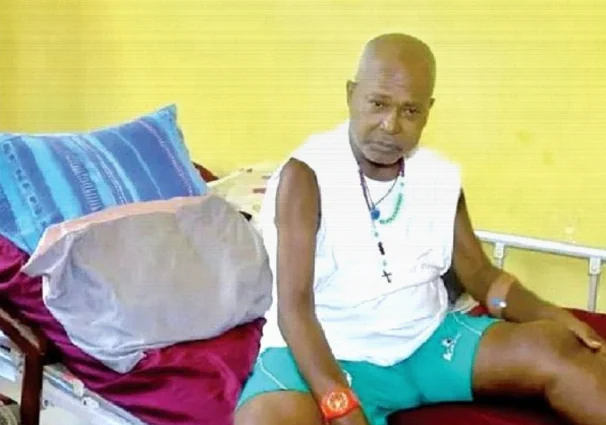
A special acknowledgement was also made to Governor Babajide Sanwo-Olu of Lagos State, who stepped in to support Henry Nwosu during a time of need. The family’s gratitude was passed directly by Henry himself, who asked that thanks be conveyed to the Governor while he was still alive.
Henry Nwosu’s remains will be laid to rest at his home in Imo State on 6 June 2026.
Henry the Great—sleep peacefully in the care of the Lord, until we meet again.