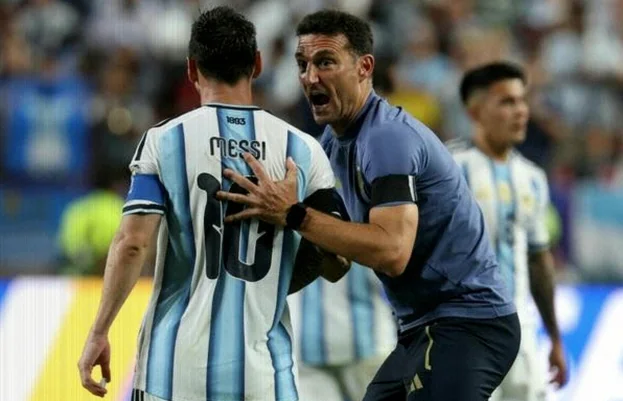
Argentina coach Lionel Scaloni has sought to strip away the political and historical backdrop around Wednesday’s World Cup semi-final with England in Atlanta, insisting the last-four clash is “just a football game.”
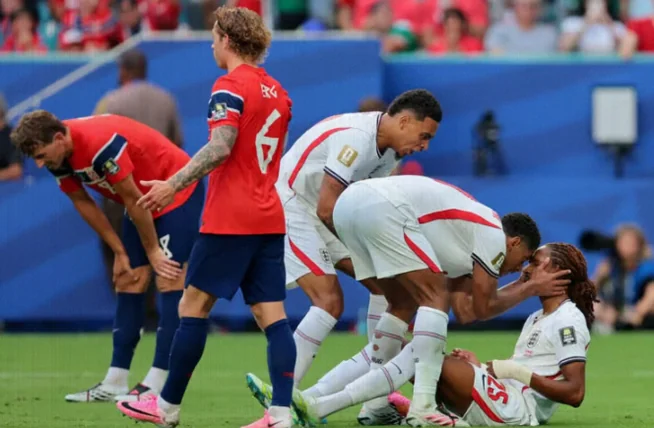
The reigning champions earned their place with a 3-1 triumph after extra time against Switzerland in Kansas City, while England booked their own semi-final spot by beating Norway 2-1 in added time in Miami. The winners of Wednesday’s meeting will advance to the final on 19 July, where they will face either France or Spain, who square off in Texas on Tuesday.
Argentina’s route to the semi-finals began brightly as Alexis Mac Allister gave them an early lead. Switzerland responded through Dan Ndoye, who levelled during the middle phase of the second half. Switzerland’s challenge became tougher when Breel Embolo was shown a red card for simulation, and Argentina used their numerical advantage to go ahead again as Julian Alvarez found the net in the 112th minute. Lautaro Martinez then wrapped up the scoring late, adding a third goal after coming on as a substitute.
After the win, Scaloni said he wanted to underline that the tie against England should be viewed purely as a football fixture, even if it comes with heavy emotion and expectation. He also pointed to the mindset of his team in overcoming Switzerland, noting that their hunger to succeed was tied to an intention to avoid penalties. In Scaloni’s view, it was a victory driven by will rather than the quality of football alone. He added that reaching the semi-finals is a privileged position that cannot be treated as guaranteed, and that Argentina would give everything they have until the end, regardless of the final outcome.
If Argentina defeat England, they would move a step closer to an historic milestone—becoming the first team to defend the World Cup since Brazil achieved the feat in 1962. England, meanwhile, are built around the combination of Jude Bellingham and Harry Kane and are seeking their first major trophy in 60 years.
The semi-final is steeped in history. It comes 40 years after Argentina’s 2-1 win over England in the 1986 World Cup quarter-final in Mexico, a match in which Diego Maradona scored twice, including the famous “Hand of God” strike, as well as a solo effort that is widely remembered as one of the tournament’s finest moments.
These teams have met twice more at World Cups since then, with Argentina winning on penalties in 1998 and England taking the return encounter four years later.
For Lionel Messi—often viewed as Maradona’s successor—Wednesday’s match will be his 206th appearance for Argentina, but his first against England.
There is also an international political backdrop to the fixture, tied to the long-standing sovereignty dispute between Britain and Argentina over the Falkland Islands, which Argentina calls the Malvinas, in the South Atlantic. Britain sent a military task force to regain the islands in 1982 after Argentine forces had invaded them.
England coach Thomas Tuchel adopted a harsher tone than Scaloni after the win over Norway, acknowledging that his side made the match more complicated than it needed to be. England still progressed despite a contest that remained tight for long stretches, with extra time required to settle it. Andreas Schjelderup had put Norway ahead, before Bellingham restored parity in first-half stoppage time. Bellingham then scored the deciding goal in extra time to send England through.
Tuchel said England had unnecessarily put themselves under pressure, even as he was pleased to reach the last four. He stressed that while the result went their way, they will have to be significantly better against Argentina.
Norway’s departure brought an end to a surge at the tournament led by Erling Haaland, who finished with seven goals but failed to find the net for the first time in 15 competitive international matches. Haaland said the moment that moved him most was seeing Norway make an impact on the World Cup stage, and he expressed hope that the achievement will inspire a new generation of young players at home to believe they can compete at major events.