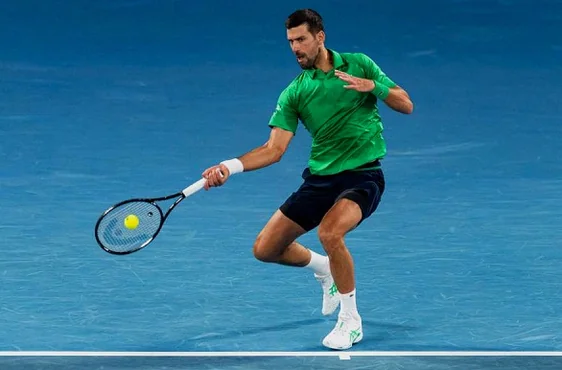
Novak Djokovic admitted he was unhappy with an “ugly” version of his game at Wimbledon, even as he made more Centre Court history by reaching the last eight with a hard-fought win over Roman Safiullin.
The 39-year-old overcame the Russian qualifier 7-6 (8/6), 6-3, 3-6, 6-3, grinding through an uneven spell of tennis as several frustrated outbursts punctuated the contest.
Despite the win, Djokovic’s mood did not improve. He had also moved past Roger Federer to take sole possession of the record for the most men’s singles match victories at Wimbledon, reaching 106.
That landmark, however, failed to lift him after a performance that came with inconsistency throughout. It marked the third time in four matches at this year’s Championships that Djokovic had dropped a set.
Djokovic now turns his attention to the quarter-finals, where he will face Canadian third seed Felix Auger-Aliassime. The seven-time Wimbledon champion knows he will need a noticeable step up if he is to end his long wait to claim a record 25th Grand Slam singles title.
Speaking after the match, Djokovic said: “To be honest, haven’t felt really great on the court, so I was just relieved to get out of it and get a win.”
He added that the victory lacked the satisfaction he usually associates with his best tennis: “Satisfaction and enjoyment was not part of today’s win, to be honest. Of course, I’m relieved and happy to win, but I haven’t enjoyed it.”
Djokovic said he struggled to reach the level he expects from himself, stating: “I struggled to find the desired level in the game that I’m looking for. But a win is a win, even if you win ugly. Hopefully I can build from this.”
Djokovic is no stranger to the demands of a Grand Slam, where managing energy and staying sharp through a long schedule can be decisive. He also acknowledged that, as a perfectionist, it is difficult for him to accept performances that fall short of his standards.
“There’s been definitely more than few where you go through a difficult match or two at least on your path to win a championship,” he said. “Of course, I’m a perfectionist at core. I always want the best game, the best performance for myself and for the crowd. It’s not always possible, and sometimes it’s hard for me to accept that and deal with it.”
When asked whether his frustration during matches helps him reset and refocus, Djokovic responded that it can sometimes serve as a kind of mental filter, even though he is not proud of the behavior.
“Sometimes it helps to kind of just filter things that are building inside. Not something I’m proud of when I get warning or something like that, I have a meltdown. Not something I’m looking for, for sure. But when it happens, it happens. Just try to eliminate it, not think about it too long, move on to the next point and the next task at hand.”
Djokovic also has further Wimbledon milestones within reach. Only Martina Navratilova, with 120 singles wins at the All England Club, has more victories in the men’s singles era, but Djokovic framed that achievement as secondary to the bigger goal of adding to his Grand Slam tally.
For Djokovic, the pressing objective is to move clear in the race for the most major titles won by a man or woman, breaking his tie with Margaret Court. He is also in position to equal Federer’s Wimbledon record of eight men’s singles championships if he can win the tournament this year.
Djokovic brushed off those milestones when asked about them, saying: “Not on my priority list, to be honest. I haven’t thought about it.”
He added: “Didn’t even know about it until after the last match win, so that’s really quite insignificant to me at the moment.”