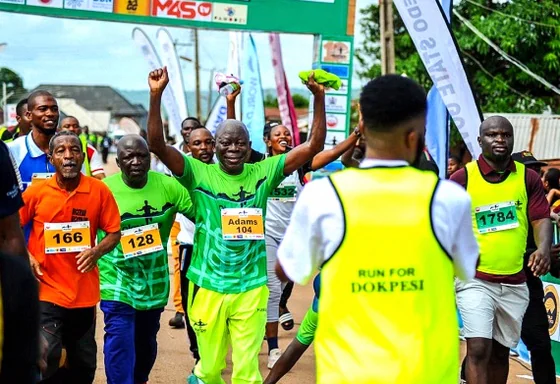
Just before 10:05 a.m. on May 30, the VIP contingent of the World Athletics Gold Label Okpekpe International 10km Road Race set off, kicking in a little over an hour after the elite athletes launched their run across the undulating hills and valleys of Etsako East in Edo State.
Among those starting in the VIP group were a senator and a federal government director-general—two of Nigeria’s most busy political figures. Their presence wasn’t a matter of necessity, but of deliberate choice, a decision they have repeated year after year and which has slowly grown into one of the event’s most distinctive storylines.
Comrade Adams Oshiomhole, now 74 and the senator for Edo North, finished in 1 hour, 17 minutes and 57 seconds. Comrade Philip Shaibu, the Director-General and Chief Executive Officer of the National Institute for Sports (NIS), crossed shortly after at 1:18:00, holding onto his personal best at the competition. The reaction from locals near the finish was loud and immediate. For many in the crowd, seeing these two men complete the course every year has become a kind of tradition—anticipated with the same excitement as the elite action itself.
“Each year, the news that Oshiomhole will be there sparks a frenzy,” said Callistus Omonfoma Ebare, a veteran broadcaster who has been a regular at Okpekpe and whose involvement has been as steady as the people who cheer. “He’s a natural performer, and he always insists on taking part from start to finish.”
There was no change this time. In the build-up to race day, when he was asked—via Chief Mike Itemuagbor’s aide—how long he expected to take, Oshiomhole admitted he couldn’t say. Still, he promised he would finish, and he delivered. Even with next year’s milestone in view, when he will celebrate his 75th birthday, Oshiomhole’s message has remained blunt and consistent: if his legs allow it, he will return.
For both Oshiomhole and Shaibu, the Okpekpe story begins less like a typical race narrative and more like a personal philosophy.
Long before he became governor of Edo State, Oshiomhole cut his teeth as a trade union leader. In that role, he spent years observing how Nigeria’s rural poor moved to cities in search of opportunities the countryside struggled to provide—something that troubled him deeply. Once he reached power, he set out to challenge that pattern.
“For me, Okpekpe is more than a race,” he said. “It’s also a statement reflecting the ideas I developed about poverty and rural-to-urban migration during my time in the trade union movement.” He added that elites in government should not lecture rural communities against migration when the rural areas offer little of what people need.
“People are rational,” he continued. “If you bring real development to the rural areas, people will choose to stay. But when rural communities are cut off, they can’t even access an ambulance. That’s why many women die during childbirth. And when places aren’t easily reached, schools suffer too—teachers don’t want to go to locations that are difficult to access.”
His conclusion was equally direct: “To be rural is not to be poor. That’s why I said we would build roads to those communities that had been abandoned for years.”
One of those connections linked Okpekpe—once a remote part of Etsako East—to Auchi and Agenebode. The road’s dramatic hills and its green valleys drew the attention of Chief Mike Itemuagbor, a native of Okpekpe and one of Nigeria’s most prominent sports marketers. In the terrain, Itemuagbor saw something that could be rare in athletics: a ready-made course. He proposed an international 10km road race, and Oshiomhole’s administration backed the plan.
“At the time, my opponents were asking, ‘Why is Oshiomhole building a road that leads to nowhere?’” Oshiomhole recalled. “But once Itemuagbor started thinking about a road race, I saw it as an exceptional chance.”
The Okpekpe International 10km Road Race was launched in 2013. Twelve years later, it holds the distinction of being the first World Athletics Gold Label 10km road race in Nigeria and across West Africa, firmly placing Edo State on the global athletics calendar. What was once described by critics as a road without purpose now appears as a results date in World Athletics records, sitting alongside events from Nairobi, Valencia and Tokyo.
“That road is why we have the Okpekpe race,” Oshiomhole said. “And I have to recognise Mike Itemuagbor. If government creates the enabling environment—and in this case, if God used me to build the road—then God also used him to work out how best to turn the infrastructure into something meaningful.”
Oshiomhole’s involvement is not confined to praising the event; he prepares for it.
In a video that circulated widely ahead of the 2026 edition, he appeared in a white Okpekpe T-shirt with a phone in hand, showing the distance he covered and the calories he burned: 8.92 kilometres in 85 minutes and 492 calories. “Getting ready for the Okpekpe race in May 2026,” he said. “It’s good to start practising. Events don’t just happen overnight.”
His case for Okpekpe goes beyond emotion. With the environment in mind—no generators, no factories, and minimal vehicle emissions in the area—he spoke as an amateur health advocate. “This might be the only road race where, once you take part, your lungs will feel better,” he said. “Before you come to Okpekpe, go and see your doctor; after the race, go again. You may not be surprised if he tells you that the oxygen in your lungs has improved because you were breathing cleaner air.”
He finished with his usual candour: “So if you’re my age and you want to live long, my friend, don’t miss the Okpekpe race.”
That message is more than self-promotion. Norrie Williamson, a World Athletics-certified course measurer from South Africa and a technical delegate to the event on multiple occasions, has independently confirmed the underlying reasoning.
“The Okpekpe course has one of the most distinctive terrains anywhere,” Williamson said. “The hills and valleys create a genuine test for athletes, while the clean air and natural surroundings give conditions that are uncommon in road running. It’s not only competition; the course itself is an experience. Okpekpe combines athletic intensity with cultural authenticity in a way that few events can match.”
Endorsements like that are hard to manufacture.
At an earlier edition, Oshiomhole made a similar point about age and exercise. “The race helps me tell people of my age that age is not a barrier to physical activity,” he said. “I’m still able to run 10km. What matters isn’t only how long it takes—it’s that I’m covering the distance.”
The baton is carried with shared passion
Philip Shaibu’s relationship with Okpekpe runs along the same road—literally.
The route between Oshiomhole’s hometown of Iyamho and Shaibu’s home base of Jattu leads directly into Okpekpe, a geographic detail that Ebare highlighted as deeply symbolic: two sons of the soil moving along the same stretch of asphalt, converging at the same finishing line year after year.
When Oshiomhole’s time as governor ended, Shaibu—who had been Deputy Governor—took over the state’s sports portfolio. With Okpekpe positioned in his own sphere of familiarity, and with his long-standing interest in sport, he moved to take ownership of the race’s continuing growth. His involvement tracked the event’s rise through the World Athletics label system, progressing from bronze in 2015 to silver in 2018 and reaching gold status in 2022.
Shaibu’s appointment as NIS Director-General by President Bola Tinubu deepened the connection further. This year, NIS medical personnel, researchers, and media staff were placed throughout the event.
“The Okpekpe race is not just the pride of Edo State—now it’s the pride of Nigeria,” Shaibu said ahead of the 2026 edition. “I’m already getting myself ready for this race. It’s not my first time participating, and the 2026 edition won’t be the last.”
He meant it in a practical sense. Less than a day before race day, Shaibu completed a 5km training run at Samuel Ogbemudia Stadium in Benin City. The next morning, he lined up at the start.
At the finish, he spoke about the event’s economic reach—how the annual arrival of competitors, officials and tourists brings measurable benefits to communities across Etsako land and Edo North. He then returned to the NIS role: “Our medical team, researchers, media personnel and other staff members were fully involved and provided support throughout the race.”
Those remarks were significant, but the impact of their preparation and participation was evident on the course itself.
The importance of Oshiomhole and Shaibu showing up each year is not lost on those who follow the event.
Frank Ilaboya, a former Owan West Local Government Chairman, described it as a lesson in discipline. “With their age and political responsibilities—which can often be demanding—it’s inspiring to see them make time to join the runners at the Okpekpe Road Race,” he said. “It demonstrates personal discipline, dedication and commitment. The message to both the young and the old is clear: you can achieve anything you set your mind to, as long as you stay disciplined and dedicated.”
For sports journalist Tayo Ogunseye, watching the pair finish carried a wider message. “What stood out for me when I saw Comrade Adams Oshiomhole and Comrade Philip Shaibu run past after the finish was the symbolic push for staying fit, taking our health seriously, and showing resilience,” he said. “The loud cheers from the locals also underlined the good they bring to people’s lives—through infrastructure, and through the wider socio-cultural benefits that come via sport. In a real way, the world truly came to the community through this event.”
That final point captures something central about what Okpekpe has become. Itemuagbor’s vision—shaped by one governor and sustained by his deputy—has transformed an isolated village in Edo North into a destination for elite runners from countries including Kenya, Ethiopia, Uganda, Morocco, and beyond.
“One of the biggest effects of the race is that it brings international elite athletes into rural Nigeria, where the real Nigerians live,” Oshiomhole said. “They smile even if they haven’t eaten, and they’re happy to see people from other parts of the world, with different colours, visiting their community. You can’t imagine the joy I feel when I see those smiles.”
At this 11th edition, Oshiomhole was formally honoured as Race Ambassador—an official title that reflected what his conduct had already demonstrated. The ambassador role was fitting. As Ebare noted, Oshiomhole commissioned the road, championed the race as governor, promoted it as APC National Chairman, and now participates as a senator.
“Today, the Okpekpe race is completely linked with Oshiomhole’s name,” Ebare said.
Shaibu’s path at the event has also continued to build momentum. From Deputy Governor to NIS Director-General, his institutional influence has grown with each edition. His promise that the 2026 race will not be his last is backed by a consistent track record of turning up.
In a country where politicians often limit involvement with grassroots events to ceremonial ribbon-cuttings, these two figures who helped create Okpekpe keep returning to run the same hills they helped put in place. They aren’t chasing cameras or optics. As Ebare put it simply, the road from Iyamho and Jattu has always brought them here—and for Oshiomhole and Shaibu, it always will.