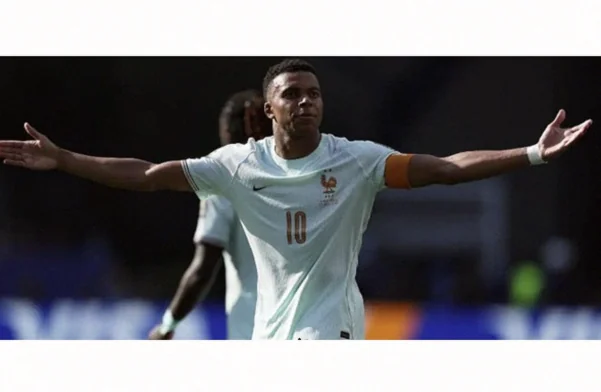
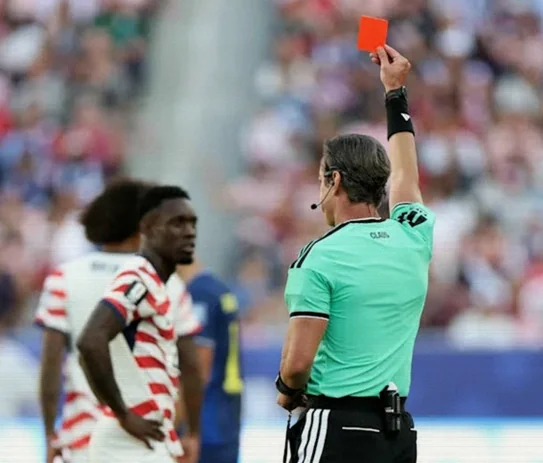
For several days during the ongoing 2026 FIFA World Cup, the biggest talking point in football had little to do with goals or tactics. Instead, it was the controversy surrounding a phone call that helped overturn a red-card ban for United States striker Folarin Balogun just before the Round of 16.
Balogun was shown a red card against Bosnia and Herzegovina in the Round of 32, an incident that should have kept him out of the United States’ next match against Belgium. However, FIFA’s disciplinary committee suspended the ban days before kick-off, a move that was reportedly linked to direct intervention at the top of the sport. The reversal was said to have followed a call from US President Donald Trump to FIFA president Gianni Infantino. Belgium then lodged an appeal to challenge the change, but FIFA rejected it.
The reaction from prominent figures was immediate. Former FIFA president Sepp Blatter posted on X on Monday, July 6, criticising FIFA’s handling of the case. “Red cards are not overturned by political phone calls,” Blatter wrote. “They are overturned by rules, evidence and independent bodies. If a US President intervenes with the FIFA President — and a player is suddenly cleared before a World Cup knockout match — the question is unavoidable: Quo Vadis, FIFA? Football must never become a playground for political power.”
While Blatter’s criticism raised an important issue, Prof. Sadiq Abdullahi argued that the headline may not be the full story. Abdullahi, a US-based adjunct professor of curriculum studies and global education who also runs Sadiq Abdullahi Sports Enterprises, suggested the Trump call was not an isolated shock but rather part of a broader, recurring pattern that has played out openly.
Abdullahi told NationSport that when governments believe their economic, political, social interests or national security are at risk, leaders around the world attempt to influence outcomes for reasons tied to pride, protection, and perceived safety. He added that sports governance and politics are inseparable in the modern era. “Sports governance and politics are intertwined and cannot be separated. We need both in today’s world,” he said. “Governance is a set of rules, systems and policies that manage sports organisations, while sports politics — which has been evolving over decades in international competitions such as the Olympics, World Championships and the World Cup — is demonstrated by athletes, officials and stakeholders, with the objective of promoting self, group, organisation and national interest.”
On Trump specifically, Abdullahi was blunt. “President Donald Trump’s call to FIFA president Infantino was not unprecedented,” he said. “Trump was doing what he does because he understands the interface of economics and politics of sport at the highest level. His initial reaction on X and his subsequent comments suggest he simply crossed the line. This is brazen interference. The lesson here is that governments will interfere or intervene in sport when they see a real or perceived threat, and when they have invested heavily in it and believe there is comparative commercial and economic advantage at stake.”
In Abdullahi’s view, the Balogun incident should not be treated as a one-off departure from precedent. Instead, it is being framed as the clearest example yet of a problem football’s own regulations were meant to prevent, but have not fully contained.
FIFA’s statutes are explicit: member associations must handle their affairs independently and without political interference, or face suspension. That rule is often tested inside individual federations. What makes Balogun’s case stand out is that the pressure, according to the claims, was directed at FIFA’s disciplinary machinery itself, producing what many describe as a genuine outlier.
The reversal is also unusual in disciplinary terms. The decision suggests it was the first time since 1962 that a World Cup red card did not lead to a suspension. However, the circumstances in 1962 were different. At that time, a panel reviewed each sending-off rather than applying an automatic ban. Brazil’s Garrincha, after being sent off in the semi-final, received a warning instead and still went on to play in the final as Brazil retained the trophy.
More recent examples have followed the opposite pattern. FIFA suspended Cristiano Ronaldo for two matches out of a three-game ban ahead of this tournament, meaning he did not miss Portugal’s opening matches. Qatar’s Assim Madibo also received a five-match ban for a tackle that seriously injured an opponent during the group stage. Balogun’s case is described as the first instance in more than sixty years where an automatic suspension was lifted entirely, rather than reduced or upheld.
Supporters of FIFA independence argue that the direction of the intervention matters. The usual worry is that a government presses its own national federation. Here, the allegation is that a government leaned on FIFA directly at the top, affecting a single player and a single disciplinary call at football’s showcase event. If the claims are accurate, it represents a more direct test of FIFA’s independence than most of the scenarios its statutes were designed to address.
Veteran broadcaster Effiong Nyong placed the blame squarely on Infantino. “President Donald Trump was unduly exuberant with his intervention, while the FIFA president showed a lack of character in his failure to protect the game — a very dangerous precedent, which FIFA must reassess and review after the World Cup,” Nyong said. “The FIFA president buckled unnecessarily under political pressure from the American president.”
Nyong then reached for a historical comparison to underline what he sees as the enduring danger of political leaders trying to shape sporting outcomes. He referenced the moment at the 1936 Berlin Olympics when Adolf Hitler, hoping for a German champion, was confronted instead with American sprinter Jesse Owens — a Black athlete — taking three gold medals in a single day. In Nyong’s telling, the comparison illustrates how political figures have repeatedly tried to steer sport toward preferred results, and what is lost when officials allow that to happen.
The controversy gained additional institutional weight through responses from Belgium and UEFA, rather than staying limited to individual critics. The Royal Belgian Football Association said it was “astonished” by FIFA’s decision and confirmed it was considering its options to protect fair play at this tournament and in future editions. Belgium coach Rudi Garcia delivered a sharp response, describing FIFA’s timing as if it were an April Fools’ joke, while insisting the federation was not only defending its own interests but safeguarding the broader integrity and ethics of the game.
UEFA went further, saying that suspending Balogun’s automatic ban for a year on a probationary basis crossed a line. UEFA added that it was left in disbelief at what it called “an unprecedented and unjustifiable ruling.”
Underneath the outrage sits a question about access: not every football administration has a head of state with a direct line to the FIFA president, or the leverage to expect a call to be acted upon quickly.
Would the same thing happen for federations in South America, Southeast Asia, or Africa? Abdullahi and others argue it is difficult to imagine a similar reversal following an intervention from those regions’ leaders. The concern is that the necessary relationship and influence would not be available in the same way, even if the circumstances were comparable.
Abdullahi also said he does not believe an equivalent call from African capitals would produce the same result. “I don’t believe the FIFA president would have entertained such interference or intervention from any African president at the scale it was done for Donald Trump,” he said. “They do not command that kind of influence that would have allowed him in, or to advise the independent disciplinary committee to suspend the red card. African governments may be emboldened, but that emboldening will not rise to the level of Trump’s antics. African leaders don’t have the clout that America has, and therefore their influence and intervention will remain theoretical rather than practical.”
He concluded by shifting the focus from football itself to the wider structure of national ambition. “Government interference in sport is real. Africa should continue to invest in sports infrastructure to create opportunities, improve the economy to raise standards of living, protect national interest, improve international sports diplomacy and promote national pride.”
Former Nigeria international Sani Kaita, who played at the 2010 World Cup, argued for a tougher stance: the incident should not encourage imitation. “Politicians shouldn’t have a say in football, as that would surely ruin the game,” Kaita said. “It was a shameful act from both men — Infantino and Trump. Football rules are very clear. We don’t want to see politicians dictating to FIFA.”
Kaita added that African leaders should not be tempted to copy what happened. “I don’t think African leaders need to do that. It’s a horrible thing to do. We need to be who we are and continue to show a good example to the world.”
Nyong, too, warned against reading the outcome as permission to interfere. “For African government officials being emboldened, there’s the need to worry, as we copy the wrong things — which is why FIFA must address the issue in strong terms,” he said.
At this point, the story moves beyond one American striker and becomes about the sport’s balance of power: who gets heard, and how rapidly decisions can change.
What happens next after the Balogun red-card reversal?
Beyond the immediate uproar, the Balogun decision leaves a difficult question hanging over the remainder of the tournament: what does it mean for trust in FIFA’s disciplinary and judicial bodies if a call to the highest level can appear to shift a ruling that would otherwise stand? From here, every red card, every appeal, and every disciplinary hearing at the World Cup may be assessed in the shadow of this incident — whether or not those concerns are fair.
Gary Neville, the former Manchester United and England defender turned widely watched pundit, summed up the mood many supporters feel. “It absolutely stinks, let’s be clear. There is no process for the red card to be overturned at a World Cup,” Neville said. “So if FIFA, somehow, decide to let a player play, I’d be absolutely raging if I was Belgium. And let’s be honest, are we surprised? No, not with this lot.”
FIFA’s statutes state that football must remain free from political interference. Yet the Balogun affair suggests that the principle may depend too heavily on which phone is ringing — and who answers.