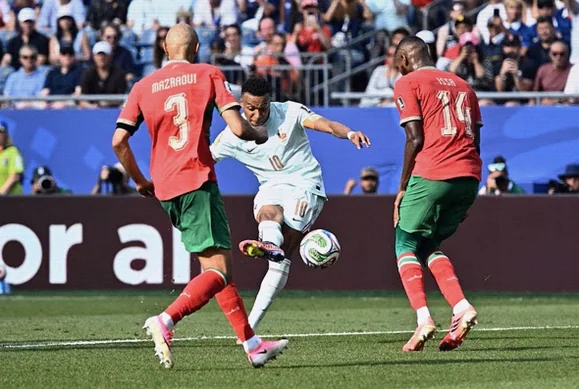
Spain believe controlling the midfield will be the deciding factor against France’s dangerous forward set in their World Cup semi-final in Dallas, with winger Alex Baena insisting the plan is to force Kylian Mbappé and Ousmane Dembélé to react rather than dictate play.
Spain’s plan: make France “watch us”
France head into the last four with an attacking combination that includes Mbappé, Michael Olise, Dembélé, and either Désiré Doué or Bradley Barcola, but Baena argued Spain’s route to victory starts with denying that group the ball.
Speaking to reporters, Baena said Spain will focus on keeping France’s attackers under pressure and limiting their time in possession. “The four up front are having a great tournament and we will have to keep an eye on them. But we will try to make them watch us more than we watch them,” he said. “Our strength is having the ball, having a lot of possession to attack and to make sure they attack us as little as possible.”
Past meetings—and why Spain are not getting carried away
Baena said the approach echoes Spain’s success against France in the Euro 2024 semi-final and their Nations League meeting from last year, when Spain came out on top. However, he warned against assuming history will automatically repeat itself.
“It is true that we come from two matches in which we beat them, and that suited us, but every match is a world of its own,” Baena added. “They are having a spectacular tournament.”
Travel fatigue in the build-up
Fatigue is also part of the backdrop to the meeting. Spain trained and stayed in Chattanooga, Tennessee during the group stage, while France remained in Boston. Spain’s itinerary has involved roughly 16,000 kilometres more travel than their opponents.
Pedro Porro, a full-back for Spain, played down the impact, saying the squad had fully recovered. Baena was slightly more direct, acknowledging the extra distance but stressing that the group still feels ready. “It is true that we are a little tired from so much travel… but I think we are all fine, with a lot of excitement and a lot of desire.”
Possession battle at the heart of the semi-final
The contest is being framed as a clash of approaches: France now have the tournament’s two leading scorers, while Spain have shown remarkable defensive solidity, conceding only once across the competition.
Mbappé tops the World Cup scoring charts with eight goals, and Dembélé has five, giving Didier Deschamps the option of a more balanced attacking threat than the one Spain faced when they beat France 2-1 in Munich two years ago.
France’s attacking danger has also been shaped by recent momentum, including moments where Lamine Yamal and Dani Olmo turned the tide after Randal Kolo Muani had put France ahead early with a header.
With the prospect that as many as seven players from France’s starting XI could be involved again, the bigger change is how Deschamps’ side operate. The team’s structure has shifted toward having more control without the ball and offering greater variety when they do have possession—something on display in their 2-0 quarter-final triumph over Morocco.
Spain’s defensive numbers, allowing just a single goal, fit the possession-first philosophy pushed by Luis de la Fuente. The underlying idea is to smother opponents by controlling the tempo and limiting attacks. Yet Spain’s quarter-final also revealed potential dangers, as Belgium managed to break their press, attack the space behind midfield, and expose a vulnerability that France could look to exploit.
With Mbappé’s acceleration and Dembélé’s ability to threaten wide areas, France appear well placed to test whether Spain can prevent the same kind of transition and direct running that Belgium used to create openings.
De la Fuente struck a respectful tone after beating Belgium, insisting the semi-final will be different. “We are the only ones to have beaten them twice in a row, but this third match will be very different. These are two very high-level teams who are going to face each other.”
If France win, they would move into their fifth World Cup final in eight editions, following appearances in 1998, 2006, 2018 and 2022. That success would also make them the first nation since Brazil (1994–2002) to reach three consecutive finals.