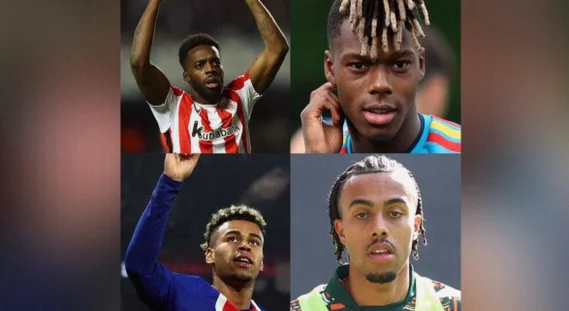
Four pairs of brothers are set to feature at the World Cup, each representing different national teams—an image of how long-standing migration patterns have woven into modern football. Their stories reflect the way players’ choices of allegiance, and family roots across borders, can shape tournament line-ups.
Quick facts: brother duos at the World Cup
- Desire Doue and Guela Doue will be in the tournament for France and Côte d’Ivoire respectively.
- Nico Williams was named player of the match when Spain beat England in the European Championship final two years ago.
- Inaki Williams switched allegiance after earlier involvement with Scotland at junior level and now represents Ghana.
- Derrick Luckassen joined the Ghana squad late as an injury replacement and will play alongside half-brother Brian Brobbey.
- Harry Souttar represents Australia, while his older brother John Souttar represents Scotland.
Desire Doue and his older sibling Guela were both born in France. Desire, currently a Paris Saint-Germain prospect, plays for France, while Guela has linked up with Côte d’Ivoire—where their father is from—and operates as a full-back.
The Williams brothers, Inaki and Nico, share Basque origins. Nico, who is 23, produced a standout showing when Spain overcame England in the European Championship final two years ago, earning player of the match recognition.
Inaki, who will turn 32 next week, has also worn Spain’s colours—though only once, and in a friendly. After a break from international football, he changed course, declared for Ghana, and claimed the nation his parents moved to from their homeland.
Ghana’s squad also includes Dutch-born defender Derrick Luckassen, aged 30. He was drafted in at the last moment as an injury substitute for the tournament and will be at the World Cup alongside his half-brother, Brian Brobbey.
Brobbey, 24, is included as a backup striker for the Netherlands. Heading into the tournament in Canada, Mexico, and the United States, he arrives on the back of a strong second half of the Premier League campaign with Sunderland, and he shares a mother with Luckassen but has a different father.
Australia and Scotland add brothers from the same birthplace
Australia have selected Scottish-born centre-back Harry Souttar, aged 27. His older brother John Souttar will be playing for Scotland, with both brothers born in Aberdeen; their mother is Australian, and Harry made his switch of international allegiance seven years ago after being capped at junior level for Scotland.
In the early phase of the tournament, there are no scheduled clashes between any of the brother combinations. However, the siblings did meet off the pitch last week: Desire attended from the stands in Nantes as Guela scored the opening goal in a warm-up match that ended with Côte d’Ivoire beating France 2-1.
After the friendly, Guela described the pre-match atmosphere with a touch of sibling mischief. “Sure, we teased each other a bit before the match,” Guela told reporters. “In the end, we’re family and we’re very happy for each other.”
Both brothers were born in Angers in north-western France and began their football education together at Stade Rennais. With Guela three years older, he initially had to operate in the shadow of Desire’s younger sibling, whose rise has been rapid—leading him to PSG and to consecutive Champions League successes.
Across recent decades, migration into Europe has broadened the talent base available to African national teams, many of which draw from diaspora communities. At the World Cup, squads such as Algeria, Cape Verde, the Democratic Republic of Congo, Morocco, Senegal, and Tunisia include more players born in Europe than in their home countries.
World Cup sibling matchups: rare, but not unheard of
Sibling duels at the World Cup have been extremely uncommon, with just one example occurring in consecutive tournaments. Jerome Boateng lined up for Germany against his older half-brother Kevin Prince, who represented Ghana, as the Germans won 1-0 in Johannesburg.
Four years later, the pair were again drawn on opposite sides, this time in Fortaleza, where their group game finished 2-2. Boateng later described the contrast between the two occasions.
“Of course, it was something special, but somehow it was also different four years later,” Jerome Boateng said. He added: “In 2010, it was truly something new, something extraordinary. I don’t want to say it’s become commonplace – because a World Cup is never commonplace. But we also played against each other quite a few times in the Bundesliga,” reflecting on how their club history shaped the context.