Manchester City will play a defining farewell fixture at the Etihad Stadium tomorrow, with Pep Guardiola set to oversee his last match in charge as the club welcomes Aston Villa.
The Catalan tactician, now 55, stunned the football scene on a May morning in 2026 when he announced that he would be leaving the club. The move closes the chapter on a landmark decade-long spell, during which Guardiola collected 20 major trophies, turned City into a true global force, and reshaped the identity of English football in ways that will be felt for years.
After his departure, Guardiola will shift into a worldwide ambassador role within the City Football Group—an official, largely ceremonial position that contrasts sharply with the intense, fast-moving character who devoted himself to the details of matchday life from the touchline for 3,570 days. In an open and heartfelt message marking his exit, Guardiola stressed that nothing lasts forever. He added that, if it were possible, he would have stayed, but he underlined that the emotions, the relationships, the recollections, and his affection for Manchester City will endure.
Guardiola arrived in Manchester in July 2016, carrying standout achievements from Barcelona and Bayern Munich. Early doubts lingered about whether his intricate, possession-oriented methods could withstand the physical demands of the Premier League. He answered those questions by building an empire. With substantial backing from the club’s Abu Dhabi ownership, City gradually dismantled the familiar domestic order, pulling themselves out of the orbit of local rivals Manchester United.
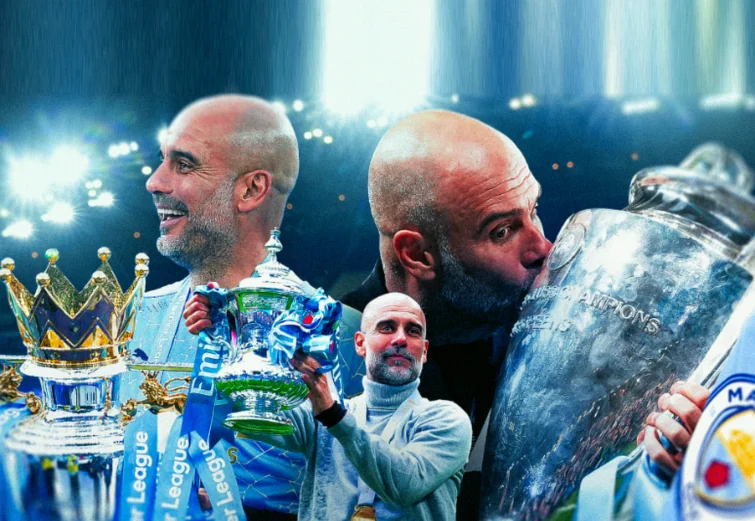
That relentless drive for excellence translated into an exceptional haul of silverware. The defining highlight came with a historic Treble in 2023, while City also produced an unmatched run of four straight Premier League titles spanning 2021 to 2024. Although Arsenal ultimately finished above Guardiola’s team this season, the standard required to overturn City during that era underlines the level of rivalry Guardiola helped manufacture. Over ten years in charge, Guardiola’s record reads as six Premier Leagues, five League Cups, three FA Cups (including a victory at Wembley this month), three Community Shields, a Champions League, a UEFA Super Cup, and a Club World Cup.
His impact on the game in England goes well beyond the trophies. Guardiola helped engineer a quieter but profound change in how football is approached at every stage, shaping the sport’s modern rhythms. His central ideas—starting attacks from the goalkeeper, applying relentless high pressing, and demanding strict positional structure—have spread beyond the Etihad and into youth setups across the United Kingdom. In 2017, he famously said he dislikes when a player prioritises personal expression over the collective, likening a group of individualists to musicians who improvise separately instead of playing as one.
That strategic influence is now visible across Europe’s busiest technical zones, with former assistants and pupils establishing their own versions of the modern game. Mikel Arteta, Guardiola’s former City colleague, has just delivered Arsenal’s first Premier League title in 22 years. Enzo Maresca, another ex-City figure, is widely expected to be formally confirmed as Guardiola’s successor at the Etihad in the coming days. Elsewhere, coaches who once played under Guardiola—Vincent Kompany and Xabi Alonso—are currently leading top-level clubs, with Kompany at Bayern Munich and Alonso at Chelsea.
Guardiola also refused to limit himself strictly to sport. He was strongly influenced by his mentor, the late Dutch visionary Johan Cruyff, and built a public identity that included a social conscience. Guardiola regularly used his high-profile media platform to speak in support of human rights and political causes, from the push for Catalan independence to the humanitarian crisis in Gaza. His firm beliefs have occasionally attracted criticism, including an FA fine in 2018 after he wore a political yellow ribbon on the touchline, but he has continued to stand by his convictions.
Even so, as Guardiola prepares his final lineup, a serious cloud hangs over the dynasty he helped create. An independent commission is still weighing more than 100 alleged breaches of Premier League financial regulations by Manchester City. After a demanding hearing that concluded in December 2024, the expected ruling is set to be delivered after Guardiola has stepped away. Guardiola has consistently defended the club throughout the three-year process, but the ultimate decision will become a challenge for the next leadership to manage.
For the moment, attention turns to the farewell itself. When the final whistle sounds against Aston Villa tomorrow, the Guardiola era will be formally written into history—leaving English football permanently altered by his methods and his mindset.