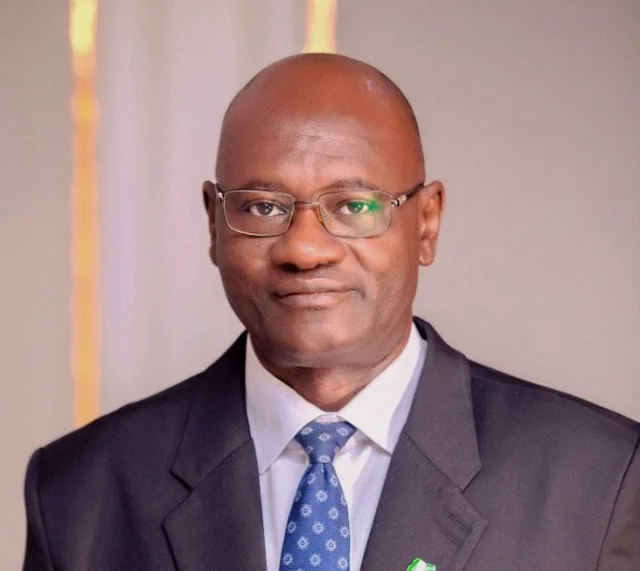
Dr. Joseph Ochogwu, Director General of the Institute of Peace and Conflict Resolution (IPCR), has urged the creation of a dedicated Religious Affairs and Interfaith Peacebuilding unit inside Nigeria’s relevant federal peace and security bodies. He wants the desk to engage religious leaders in a structured, nationwide way across all six geopolitical zones, arguing that peace efforts should not be treated as something confined to the north.
Ochogwu made the proposal during a one-day roundtable in Abuja titled “Sharing a Future of Peace: Promoting Freedom of Religion or Belief, Development and Security,” organised by the German Development Agency and the Konrad Adenauer Stiftung.
He further called for legislation through a National Peace Infrastructure Act, designed to give peace commissions and early-warning systems a lasting legal footing and dependable financing. Ochogwu also recommended tailoring violent-extremism programmes to match Nigeria’s distinct religious and identity realities in each zone.
Pointing to existing tools that have worked elsewhere, he said civil society and faith-based institutions should expand interfaith mediation approaches already proven in practice. He highlighted the Interfaith Mediation Centre’s co-mediation and early-warning methodology, urging that it be extended to areas currently receiving less support.
Ochogwu also pushed for the development of joint interfaith declarations and rapid-response procedures to curb religiously driven misinformation during periods when communal tensions rise. In addition, he called for stronger theological education across both Islamic and Christian institutions, with curricula that clearly address religious pluralism, non-violence, and conflict transformation.
He argued that external development partners should provide continued, multi-year funding commitments to indigenous interfaith peacebuilding organisations, rather than relying on short-term grants. In his view, donor dependency has contributed to fragility, and that risk must be recognised. At the same time, he said investment should continue in independent, real-time conflict-monitoring systems.
Ochogwu stressed that Nigeria’s national counter-terrorism and peacebuilding institutions still require ongoing technical and financial backing. However, he added that this assistance should reinforce local leadership and ownership, including the role of religious leaders, rather than replacing it.
He said religion in Nigeria is best understood as neither an isolated nor the main driver of conflict. Instead, he described faith as a deeply embedded identity resource that intersects with—and can be shaped by—ethnicity, political competition, insecurity around livelihoods, and scarcity of resources across the country’s six geopolitical regions.
Ochogwu pointed to the record of faith-based peace work, highlighting the Interfaith Mediation Centre in Kaduna as an example. He argued that the same religious authority capable of legitimising violence can, with the right conditions of leadership, structure, and support, be redirected toward reconciliation and long-term peace.
In his remarks, he said: “Nigeria’s route to lasting peace across its geopolitical zones will rely heavily on whether government, religious bodies, civil society, and development partners can together embed religion’s hidden potential for peace—building on, rather than discarding, the evidence-based blueprint that IPCR’s Strategic Conflict Assessment has already put forward.”
Human rights body links religious freedom to lasting peace
Tony Ojukwu, Executive Secretary of the National Human Rights Commission, said Nigeria continues to face layered security concerns, social fractures, and economic pressure. Despite these challenges, he noted the country remains united by a shared goal: building a peaceful, inclusive, and prosperous nation where people are able to profess, practise, change, or demonstrate their religion or belief without fear, intimidation, discrimination, or violence.
Ojukwu said: “Peace is not simply the absence of conflict. It is the presence of justice, respect for human dignity, equality before the law, and the safeguarding of fundamental human rights. When these principles take root, development becomes inclusive, institutions become stronger, and security becomes sustainable.”
He explained that the National Human Rights Commission has long maintained that protecting human rights is the most reliable basis for national peace, democratic governance, and sustainable development. Ojukwu added that freedom of religion or belief is not only a constitutional promise; it is a core human right and a pillar of democratic society.
Ojukwu argued that Nigeria’s religious and cultural diversity should never be viewed as a cause of division, describing it instead as one of the nation’s greatest strengths. He said diversity can enrich society and create space for mutual learning, innovation, and peaceful coexistence when guided by justice, dialogue, and respect.
He warned that Nigeria cannot ignore repeated conflicts in parts of the country, especially in states such as Kaduna, Plateau, and other regions affected by communal violence. While religion is often presented as the trigger, he said evidence shows the real underlying pressures include competition over land and resources, political interests, ethnic frictions, poverty, youth unemployment, weak governance, and longstanding grievances.
Ojukwu added that religion frequently becomes the medium through which these deeper structural problems are expressed. He said the Commission has recorded many abuses affecting freedom of religion or belief, including discrimination, attacks on places of worship, hate speech, violent extremism, arbitrary arrests, displacement of communities, and obstacles preventing victims from obtaining justice.
Responding to these issues, he said the Commission continues to use its statutory mandate through its Civic and Political Rights Department. That work, he noted, involves receiving, investigating, and resolving complaints connected to freedom of religion or belief, religious intolerance, discrimination, and other actions that can undermine peaceful coexistence.
Faith freedom framed as dignity and democracy’s foundation
Moritz Sprenker, Resident Representative of Konrad Adenauer Stiftung in Nigeria, described freedom of religion or belief as both a basic human right and the foundation of dignity. He said the right ensures that everyone can follow their conscience, practise any faith, change beliefs, or have none at all.
Sprenker said this is the ability to remain true to oneself without fear or coercion and without discrimination, adding that the topic carries particular weight in Nigeria.
He stressed that “Nigeria’s religious diversity is not just a statement of fact—it is one of our nation’s greatest strengths. Day after day, people of different faiths live, work, and plan their futures side by side. They form communities built on shared values, solidarity, and hope for a better tomorrow.”
At the same time, Sprenker said religion rarely exists in isolation, noting that it often overlaps with identity, politics, security, and economic realities. He argued that this complexity requires careful thinking: simple explanations must be avoided, but the influence religion can have on both tensions and opportunities should also not be ignored.
He added that Konrad Adenauer Stiftung believes democracy can only thrive where dignity is respected, freedoms are defended, and dialogue helps bridge differences. In his view, sustainable peace is not distant—it is created “right here, right now” through trust, respect, and the courage to truly listen to one another.
Catholic view highlights divine truth across worship styles
Professor Alexander Görlach, a German professor of political science, spoke about the Catholic Church’s understanding of religious freedom. He said the church holds that every religion contains some measure of divine truth. Görlach also referenced the global reality that people worship in many different ways, which he noted does not always align with Catholic or broader Christian practice.