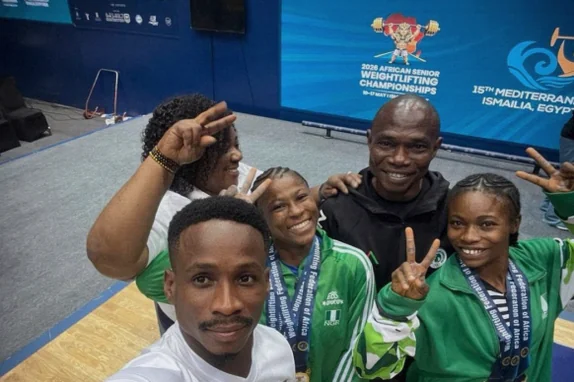
Nigeria’s weightlifting teams have carried their momentum into the 2026 African Senior Weightlifting Championships and the 16th Mediterranean Cup in Ismailia, Egypt, moving to the top of the medal table after two days. The country has amassed 10 gold medals and five silver medals so far, underscoring a dominant start in the combined event.
Quick facts
- Nigeria leads the medal standings after two days with 10 gold medals and five silver medals.
- The championships also act as qualification for the 2026 Commonwealth Games.
- The action is taking place in Ismailia, Egypt, alongside the 16th Mediterranean Cup.
- Ruth Nyong Asuquo, Onome Omolola Didih and Rafiat Afolashade Lawal each won three gold medals in their respective categories.
- Favour Omovigho Agboro won one gold and two silvers in the men’s 65kg class.
The meet, which doubles as a pathway into the 2026 Commonwealth Games, has highlighted Nigeria as one of the most formidable nations in the field. In particular, the women’s squads have delivered strong showings across several weight categories, repeatedly controlling both individual lifts and the overall totals.
Women’s highlights
Ruth Nyong Asuquo, Onome Omolola Didih and Rafiat Afolashade Lawal led the charge, with each lifter producing a three-gold haul in their divisions. Together, they accounted for nine of Nigeria’s 10 gold medals recorded to date.
In the women’s 48kg category, Asuquo set the tone immediately and never looked in danger, taking gold in the snatch, the clean and jerk, and the combined total. She registered 74kg in the snatch, finishing well clear of Tendry Tsiky Mahavy Rakotonoely of Madagascar, who earned silver with 60kg. Tunisia’s Maissa Khadhraoui completed the podium with bronze at 59kg.
Asuquo then added another decisive win in the clean and jerk, lifting 93kg to claim her second gold. Khadhraoui managed 78kg for silver, while Rakotonoely followed with 76kg. Her total of 167kg sealed a third gold, with Tunisia collecting silver on 137kg and Madagascar taking bronze on 136kg.
Nigeria’s grip on the women’s 53kg class continued through Didih, who controlled the contest from the opening lifts to sweep all three medals. She posted 87kg in the snatch, ahead of Egypt’s representative on 79kg, with South Africa earning bronze at 75kg. In the clean and jerk, Didih struck 105kg, just ahead of Egypt and South Africa, who both recorded 98kg.
Her overall total of 192kg secured her third gold, with Egypt’s 177kg and South Africa’s 173kg left them behind in the standings.
Lawal kept Nigeria’s winning momentum going in the women’s 58kg division, completing a clean sweep of three gold medals. Her output further reinforced the strength Nigeria has shown in the women’s events and added weight to the country’s Commonwealth qualification push.
Men’s medal run
In the men’s 65kg category, Favour Omovigho Agboro produced one of the tournament’s sharper performances for Nigeria, finishing with one gold and two silver medals. In the snatch, he lifted 123kg to take second place behind Egypt’s Mohamed Mahmoud Noureldin, who led with 132kg. Tunisia’s Mohamed Amine Bouhajba claimed bronze with 121kg.
Agboro responded strongly in the clean and jerk, recording 157kg to win gold and narrowly beat Noureldin, who posted 156kg. Tunisia again finished on the podium, this time with 146kg in third. The combined total of 280kg earned Agboro silver overall, with Noureldin taking the top spot on 288kg and Tunisia grabbing bronze on 267kg.
More podiums
Nigeria added additional placements through Ruth Imoleayo Ayodele in the women’s 63kg category, where she collected three silver medals. Ayodele lifted 90kg in the snatch, finishing just behind Tunisia’s Chaina Rahmouni, who managed 91kg for the win.
She produced another silver in the clean and jerk with 110kg, again one kilogram behind Rahmouni’s mark. Her combined total delivered a third silver, while Madagascar’s Soloniaina Randriamparany secured bronze in the division.
With only 10 athletes representing Nigeria in Ismailia, the climb to first in the medal standings highlights the squad’s depth, quality, and efficiency. The women’s division, in particular, continues to stand out as Nigerian lifters establish themselves among Africa’s top tier.
Beyond the medals themselves, the performances also appear to be giving Nigeria a major boost in its qualification picture for the 2026 Commonwealth Games. Several athletes have already shown the consistency and competitive standard needed to perform on a global stage.