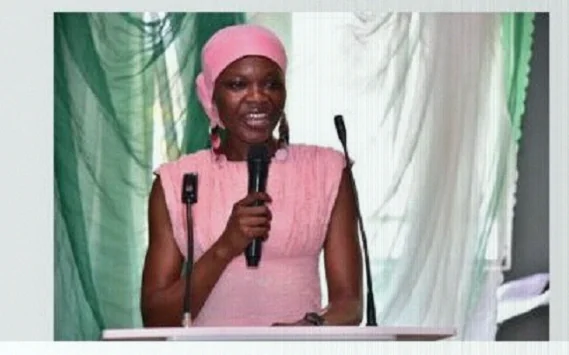
The National Institute for Sports has welcomed its first female Student Union Government president, with Alhaja Adejoke Baruwa taking the oath of office this week in a ceremony that attracted broad interest across the Lagos campus.
The swearing-in represents a landmark moment for the country’s leading sports training institution, where the role had never previously been held by a woman since the institute was established.
NIS Director-General Rt. Hon. Comrade Philip Shuaibu used the occasion to urge the newly elected leadership to fully support ongoing reforms, while also commending the process that led to their emergence.
“We are pleased that the election was free from rancour and that a lady has emerged as president,” Shuaibu said. “You are stepping into a major responsibility. If you are to move this institute ahead, you must align with the reforms we are driving. We will provide the right environment so you can achieve your academic objectives and effectively run your programmes. We are rebranding NIS, and we need everyone involved to ensure it becomes a reality.”
Baruwa, who framed her win as a shared achievement, said the moment carries significance that extends beyond individual success.
“History is not only something written in textbooks,” she said. “History is what we create when we decide the current status is no longer sufficient. This victory is not mine alone. It belongs to every student who believes leadership is rooted in vision, not gender. Today, we demonstrate that the Elite Standard has no gender — it delivers results.”
The new president presented a three-part programme under the banner of her “Elite Standard.” The plan focuses on improving classroom facilities to reflect the institute’s national standing, narrowing the divide between academic preparation and real-world industry practice by bringing experienced sports professionals to mentor students, and lifting discipline levels alongside professional output across the student community.
Baruwa described her team as the “Pioneer Set of the Renewed Hope for NIS and the Nigerian sports industry,” positioning their term as a commitment to raising professional expectations throughout Nigerian sport.
The credibility of the election and the outcome it produced send a clear message: at Nigeria’s top sports institute, inclusion and ability are no longer seen as separate priorities.