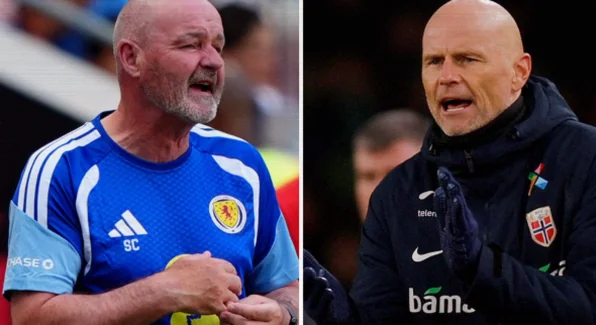
Scotland manager Steve Clarke has come under fire from Norway counterpart Stale Solbakken after the Scotland head coach cancelled a planned training-ground friendly as both teams gear up for the start of their World Cup campaigns. The dispute erupted after the match was called off last minute, with Norway claiming the decision was handled in an “unprofessional” manner.
Both squads were staying in North Carolina, and the fixture was originally set for Monday. However, the Norwegian Football Federation announced on Sunday that it had been cancelled due to injuries reported in the Scotland camp.
Clarke: “Not worth the risk”
Clarke later explained his decision to BBC Scotland. He said the plan had been a simple one-hour training game at Scotland’s facility, but that minor knocks picked up during the previous week led to the call to stand down.
He added that the aim was to avoid unnecessary risk, insisting that the issues were not severe but made the friendly feel like an unwarranted gamble at that stage of preparation.
The cancellation drew a sharper reaction after Norway’s own public warm-up match on Sunday. Norway drew 1-1 with Scotland’s Group C rivals Morocco, and Solbakken described the Scotland decision as “surprising” in comments carried by Norwegian broadcaster NRK.
Solbakken said: “It is unprofessional of Scotland.” He criticised how the news was communicated, claiming the Scotland coach did not contact him directly and that the change was instead relayed via the team manager after Norway had completed training.
He also challenged Scotland’s explanation around injuries, saying he did not believe the concerns cited had come from the most recent session. “It’s disappointing. It’s unprofessional,” Solbakken added.
Despite the criticism, Solbakken said Norway would move on, noting they adjusted their approach for the match they eventually played.
Scotland’s governing body quickly responded, stating the game was arranged “between the respective team managers – not the head coaches”. It also pointed to the fact that the same framework had been used during an earlier cancellation.
The Scottish FA added that, after injuries emerged in previous friendlies, they warned the Norway team manager as soon as it became clear that a training match would carry more danger than potential benefit. It further stressed the fixture was supposed to be held behind closed doors and not publicly advertised, leaving them surprised when details surfaced through Norwegian media.
At a glance
- Scotland coach Steve Clarke cancelled a planned Monday training-ground friendly.
- Norway manager Stale Solbakken branded the decision “unprofessional”.
- Norway said the cancellation came due to injuries in Scotland’s camp.
- Both teams were based in North Carolina.
- Norway drew 1-1 with Morocco on Sunday in a public friendly.
- Norway play Iraq next Tuesday in Group I.
- Scotland face Haiti in Group C three days before that.
On the competition timeline, Norway begin their Group I schedule against Iraq next Tuesday. Scotland’s first Group C match comes earlier, with Haiti the opposition three days before Norway’s opener.
Scotland’s last public warm-up took place on Saturday, when they beat Bolivia 4-0. Clarke used most of his available squad in that match, with the aim of sharpening preparations ahead of the tournament.
Hangeland: cancellation “embarrassing”
Norway’s team manager, former Fulham defender Brede Hangeland, said their World Cup preparations had been built around the behind-closed-doors friendly “for many months.” He explained that Norway arrived at their base in Greensboro, roughly 90 miles from Scotland’s training camp in Charlotte.
Hangeland said it was “embarrassing” that the fixture was cancelled only a couple of days beforehand, adding that there was little they could do about it. He insisted Norway would have to put the situation aside and make the best of it, while criticising what he described as a breakdown in coordination after a series of arrangements.
He said there had been extensive planning, agreements and “gentlemen’s agreements,” but that the other side then changed course. “I think that was weak, so to speak,” Hangeland concluded.